
1inch Team Suspected of Rug Pull? On-Chain Data Reveals Truth Behind Multi-Million Dollar Fund Movement


Original Title: "1inch Team Accused of Dumping, On-Chain Data Reveals Whale's Fancy Swing Trading"
Original Author: Ethan, Odaily Planet Daily
A large sell-off attributed to the "1inch Team" has once again sparked criticism.
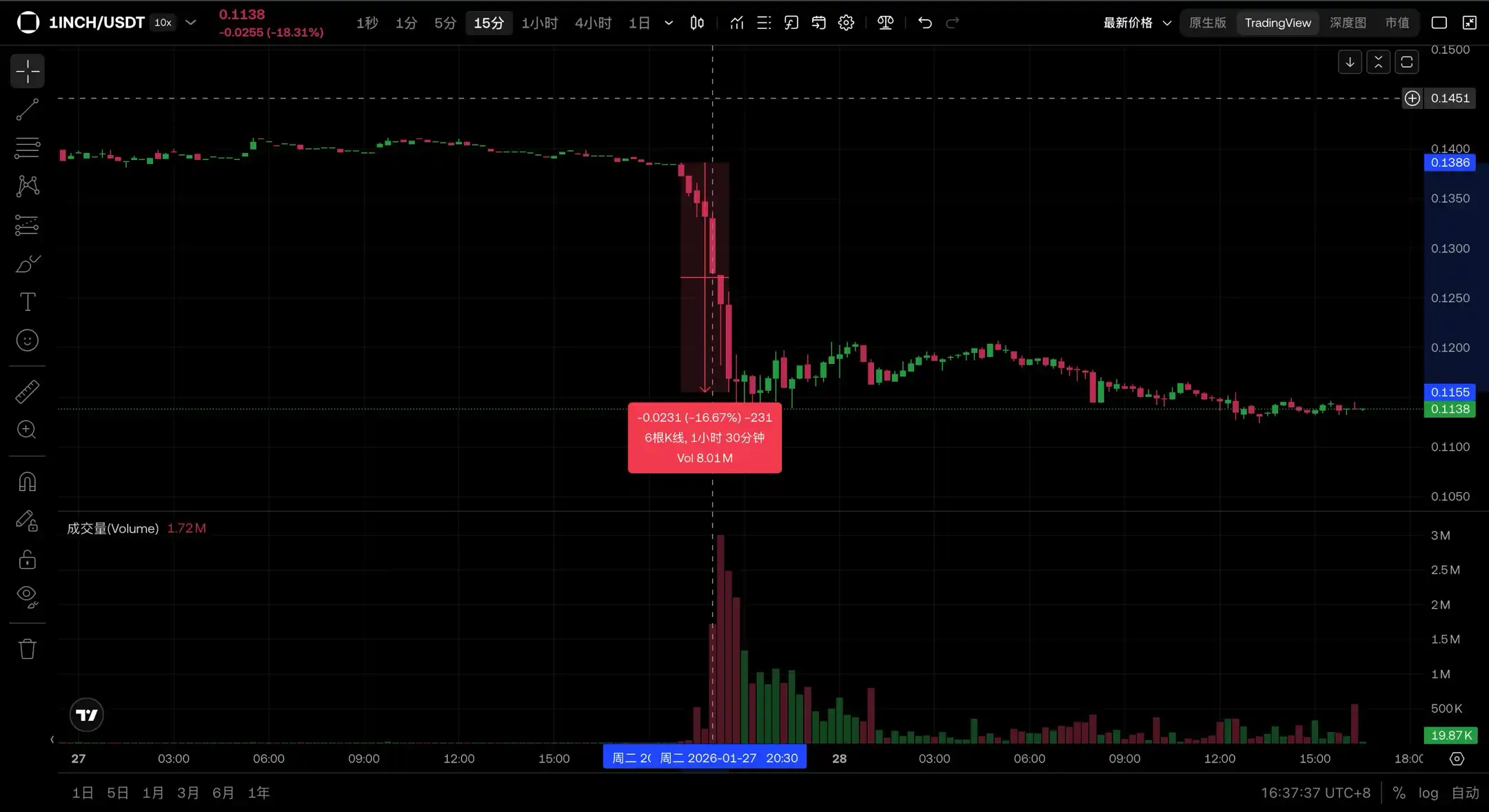
Recently, the on-chain data platform ARKHAM showed that three wallets labeled as the "1inch Team" collectively sold 36.36 million 1INCH tokens, worth $5.04 million. According to OKX market data, following this event, the price of the 1INCH token plummeted by 16.7% to $0.1155 in a short period, currently trading at $0.1164. A question quickly arose in the market regarding this sell-off: Was this really the project team dumping their tokens?
Looking solely at this sell-off, the outcome was less than ideal. On-chain data indicates that the aforementioned 1INCH tokens were primarily transferred to the relevant address in late November 2024, with a cost estimated around $0.42 per token at the time, equivalent to approximately $15.27 million. By the time of this sell-off, the price of 1INCH had dropped to around $0.14. Considering the slippage impact due to the large fund size during the sell-off, the actual loss from just this batch of tokens could exceed $10 million.
Reference Comparison: 1inch Team's Previous Trading Style
Previously, the 1inch Team's investment fund's on-chain operations during various market fluctuations were seen by the market as that of a "professional coin trading team."
As early as February to April, the 1inch Team's investment fund began consistently accumulating 1INCH at low levels. At that time, when market sentiment had not yet warmed up, 1INCH was hovering around $0.2 for a long time. During this phase, the team invested approximately $6.648 million, buying 33.19 million 1INCH tokens, with an average buy-in price of around $0.2.
However, this round of buying did not cause significant price fluctuations. What truly caught the market's attention was the concentrated accumulation in early July. From July 6th to 9th, the 1inch Team's investment fund once again made a move, injecting about $4.4 million in just a few days, purchasing 22.99 million 1INCH tokens. As buy orders continued to appear, the price of 1INCH rose from around $0.18 to $0.206, marking a phase increase of about 14%. During this period, the team transferred 3 million USDC to Binance, withdrew 1INCH to their own address in batches, did not use up the related funds at once, and continued to buy in at opportune times.
After July 10, the pace of operations noticeably accelerated. On the afternoon of July 10, the team once again bought around $880,000 worth of 4.12 million 1INCH tokens, while also adding 2 million USDT to Binance to prepare ammunition for future trades. On the evening of July 11, on-chain monitoring showed that the team allegedly bought another 11.81 million 1INCH tokens at a higher price range, with the transaction price rising to around $0.28. At this point, the address's holdings temporarily increased to 83.97 million 1INCH tokens, with a book value exceeding $23 million. On July 13, the team continued to withdraw 6.334 million 1INCH tokens from Binance.
If we rewind the timeline to early February, the 1inch team's investment fund has invested approximately $13.64 million since the beginning of the year, buying 55.85 million 1INCH tokens at a blended cost of around $0.244. With the price of 1INCH surging above $0.39 in mid-July, this portion of the position has already realized a profit of several million dollars.
It is worth noting that the team is not "buy-only." On the evening of July 13, they began to realize profits on a small scale, selling around 904,000 1INCH tokens at $0.33, exchanging them for $298,000; and at an earlier stage, they had sold some 1INCH in batches at around $0.28.
At the same time, the team is also simultaneously taking profits on another significant position: the ETH purchased in February at an average price of $2577 has begun to be sold in tranches above $4200, with the ETH position alone realizing millions of dollars in profit.
On August 11, according to on-chain analyst Yu Jin's monitoring, the 1inch team's investment fund has started to cash out some of its earlier positions on-chain. The data shows that they sold 5,000 ETH at an average price of $4215, exchanging it for $21.07 million USDC; and sold around 6.45 million 1INCH tokens at an average price of $0.28, exchanging it for approximately $1.8 million USDC.
In terms of the cost of the positions, the aforementioned ETH was bought by the 1inch team at an average price of around $2577 in February this year; the corresponding 1INCH was mainly accumulated in July, with a blended cost of around $0.253. Based solely on the ETH and 1INCH positions that have been sold this time, the 1inch team's investment fund has realized approximately $8.36 million in book profits.
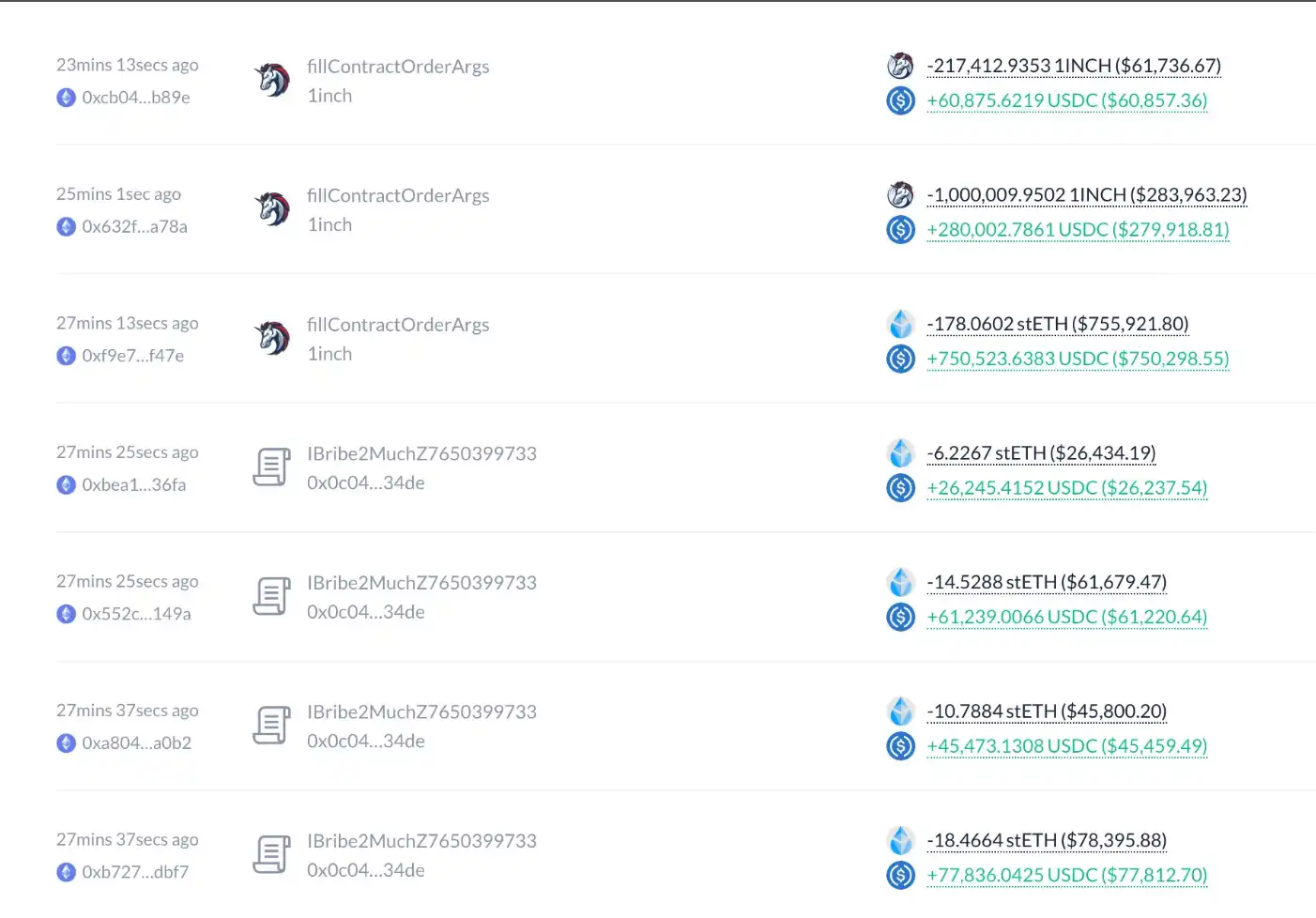
Looking back further, the 1inch team's "buy the dip, sell the rip" strategy on BTC is equally clear. Between February and March this year, they bought 160.8 WBTC at an average price of around $88,000 during a BTC pullback phase, and then completed their exit when BTC approached $100,000 again in May, achieving a total profit of nearly $1 million.
Considering the on-chain activities of BTC, ETH, and 1INCH, the 1inch team's investment fund maneuvers seem like a well-rehearsed fund strategy: accumulating positions during market corrections, consistently adding during uptrends, and gradually taking profits once the price enters a high range.
But this time, was it really them in control?
It is worth noting that the large sell-off near $0.14 this time, when compared to the 1inch team's past on-chain activities, shows a significant deviation if this sell-off was indeed led by the team directly. In their historical trades with BTC, ETH, and 1INCH, the team more commonly phased out profits after a confirmed trend, rather than concentrating sales in an obviously illiquid range.
Therefore, some market participants have started to question whether the sell-off labeled as from the "1inch team" truly originated from the team or a wallet under their direct control.
Subsequently, 1inch's official response to the related controversy was provided here. In their statement, they explicitly mentioned that this sell-off did not occur in any wallet controlled by the 1inch team, entity, or treasury multisig, and the team cannot intervene in third-party holders' asset allocations and trading decisions.
In other words, the on-chain labels indicating relationships do not equate to actual control. Based on the execution timing and price range, this sell-off most likely came from a third-party holder disconnected from the project's control, rather than a shift in the 1inch team's trading strategy.
In a phase with already limited liquidity, a single large sell-off was quickly interpreted as "team dumping," signaling an excessive compression of information. This interpretation overlooks the natural gap between address labels and actual control rights after extended token circulation.
Back to 1inch itself. The team emphasized in an official statement that the recent market turbulence did not alter its core business and long-term direction. Since 2019, 1inch has accumulated a trading volume close to $800 billion, maintaining daily trading volumes in the hundreds of millions even during market downturns. The team also mentioned plans to review the token economics this year to enhance overall resilience in low liquidity and bear markets. Against this backdrop, the discussion surrounding "Did the 1inch team dump the price?" seems more like a misinterpretation amplified by on-chain data, liquidity conditions, and sentiment analysis.
However, even if it is ultimately proven to be a misunderstanding, this sell-off has still constituted a real-world second impact on 1INCH's already weakening price. Since the last cycle's peak of $6, 1INCH has experienced a prolonged downward trend and is now hovering around $0.11.
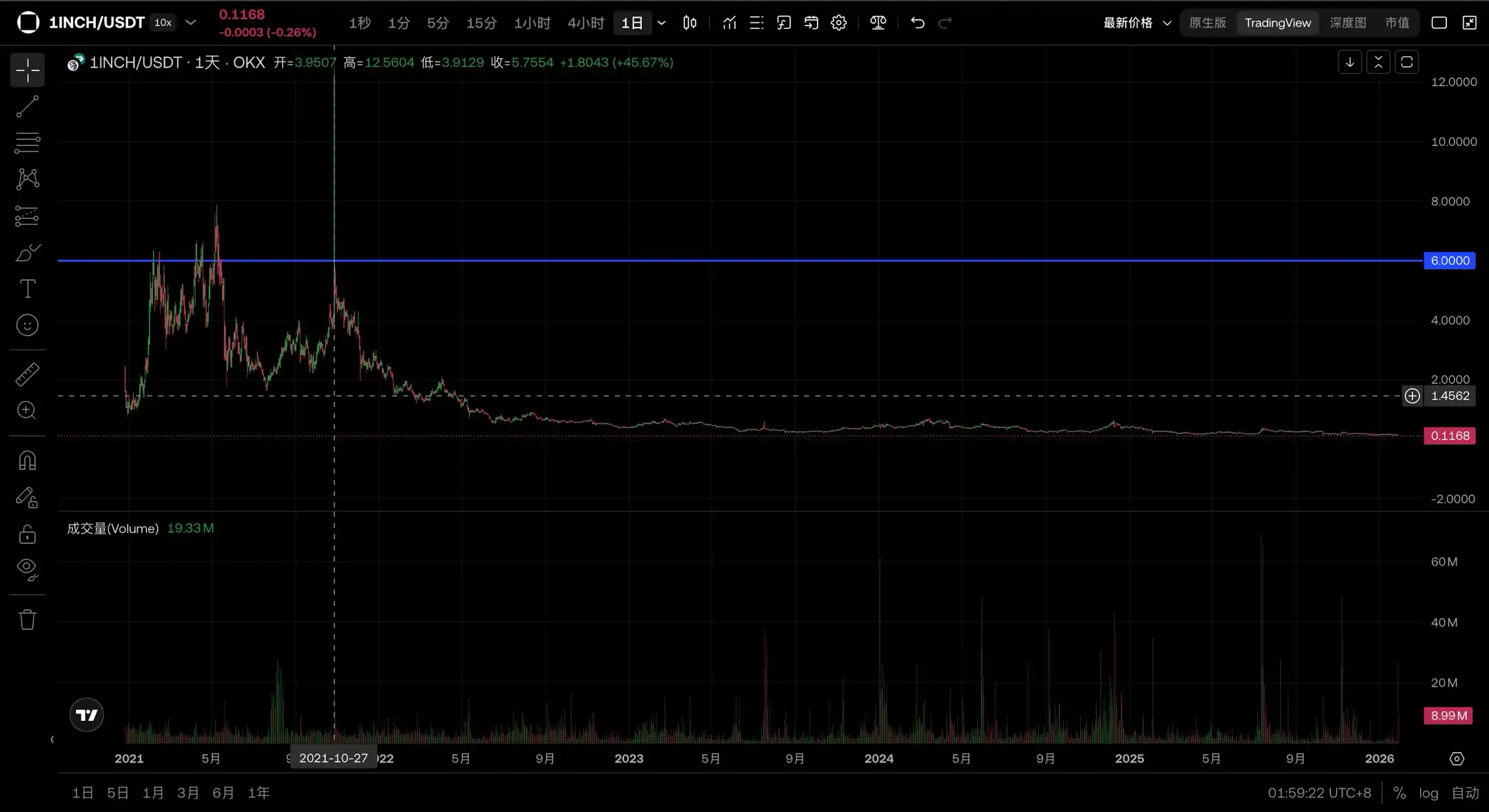
In such a trend, the market evidently had no sufficient cushion to absorb any sudden sell-off signals. In these amplified sell-off events, those who ultimately bear the brunt of emotional impact are often the weakest in terms of risk tolerance — retail investors.
You may also like

The large models in the United States are moving towards closure in the name of security

Morning Report | CoinEx becomes a key hub for Iran to evade sanctions, involving over $3.8 billion in funds; Kalshi seeks a new round of financing, with a valuation potentially rising to $40 billion

From the white-haired stock god to the billionaire fund mogul, the smart people shorting Nvidia are all getting rich using the same framework

Why do cryptocurrency projects always like to change their names?

Global Launch: As predictions become the most scarce asset in the AI era, Manadia is defining the next generation of the value internet

Who is footing the bill for the $64 billion accounting frenzy?
I never expected that the first application of AI x Crypto would be in security auditing

What is your view on Binance's competitive advantages?

ETH has entered a non-consensus phase, and the turning point is approaching!
The shift in the cloud of the air: from despising stablecoins a year ago to the high-profile entry of capital today
The survival dilemma of small and medium exchanges behind the withdrawal anomalies exposed by AscendEX
Why Is Bitcoin Falling Below $60K? 5 Key Market Drivers Explained
Bitcoin has dropped sharply amid ETF outflows, Strategy stock weakness, AI stock rallies, and changing Fed expectations. Explore the key forces driving BTC’s latest correction and what traders should watch next.

Bitcoin vs. Gold in 2026: Which Asset Performs Better in Different Markets?

Morning News | The draft amendment to the People's Bank of China Law aims to clarify the legal status of digital renminbi; South Korea will transfer about 40 unregistered virtual asset service providers to law enforcement agencies
The cryptocurrency industry has entered the "Show Me" era: merely relying on vision is no longer enough

Interpreting the Ethereum Foundation's new structure: Reaffirming self-sovereignty amid institutional trends
Former SpaceX engineer reconstructs the financial execution system using first principles
Standard Chartered Bank sings a 50x rhapsody again, aiming for AAVE to reach 3500 USD
The large models in the United States are moving towards closure in the name of security
Morning Report | CoinEx becomes a key hub for Iran to evade sanctions, involving over $3.8 billion in funds; Kalshi seeks a new round of financing, with a valuation potentially rising to $40 billion
From the white-haired stock god to the billionaire fund mogul, the smart people shorting Nvidia are all getting rich using the same framework
Why do cryptocurrency projects always like to change their names?
Global Launch: As predictions become the most scarce asset in the AI era, Manadia is defining the next generation of the value internet
Who is footing the bill for the $64 billion accounting frenzy?


