
2025 Crypto Violence Retrospective: 65 Physical Assaults, 4 Fatal Incidents


Original Article Title: In Defense of Exponentials
Original Article Author: Haseeb Qureshi, Dragonfly General Partner
Original Article Translation: Azuma, Odaily Planet Daily
Editor's Note: Do you remember the recent news about the Russian cryptocurrency billionaire Roman Novak and his wife Anna being found dismembered and buried on a beach in Dubai? In 2025, another dark side of the cryptocurrency industry is the increasing frequency of violent attacks against holders, especially the wealthy.
As a highly recognizable figure in the industry, Haseeb Qureshi, the bald-headed General Partner of Dragonfly, has today conducted a data analysis of violent incidents in the cryptocurrency field in recent years and explained that the reason for writing this article is because he is "increasingly scared." The data shows that in 2025, there were a total of 65 violent incidents in the industry, including 4 major fatal cases. Not only is the number of attack incidents rapidly increasing, but the attacks themselves are becoming more violent. Therefore, at the end of the article, Haseeb thoughtfully includes some personal safety recommendations.
Below is Haseeb's full article, translated by Odaily Planet Daily.
Are violent attacks against cryptocurrency holders on the rise?
Jameson Lopp has been quietly maintaining a database known as "wrench attacks," which are violent attacks against cryptocurrency holders aimed at coercing them to hand over their crypto assets. This is currently our closest source of "real-world benchmark data" to assess whether holding crypto assets is becoming more dangerous over time.
I have recently become increasingly afraid of such attacks, so I took Lopp's dataset and used a somewhat Vibe Coding method to visualize some of it to see what's really going on. Here are my findings.
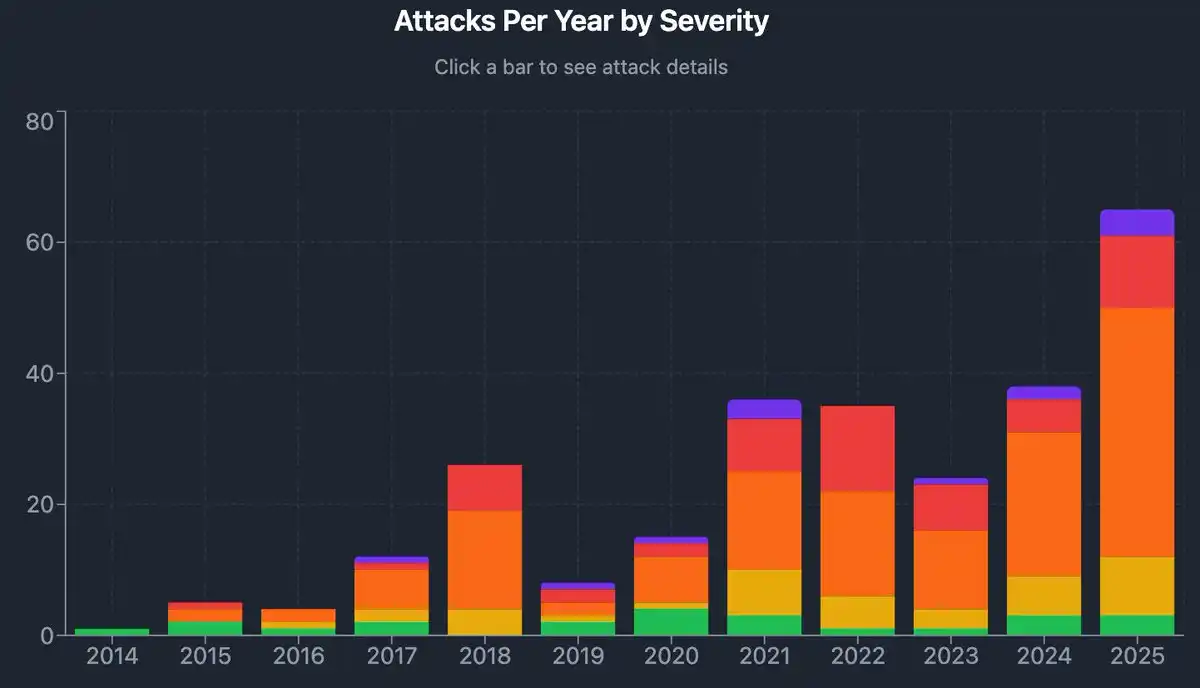
You are not mistaken—the number of attack incidents is indeed increasing over time (with 65 incidents in 2025). Furthermore, the attacks themselves are becoming more violent.
I had Claude categorize each attack into 5 levels, with the specific classification scheme as follows:
· Minor (3 incidents in 2025): Theft without physical confrontation, attempted theft, ATM/device theft.
· Moderate (9 incidents in 2025): Robbery with some level of violence or assault, drugging, extortion;
· Severe (38 incidents in 2025): Armed robbery, kidnapping, home invasion with firearms or weapons;
· Extremely Severe (11 incidents in 2025): Kidnapping involving torture, dismemberment, severe beating, gunshot wounds;
· Fatal (4 incidents in 2025): Victim fatality.
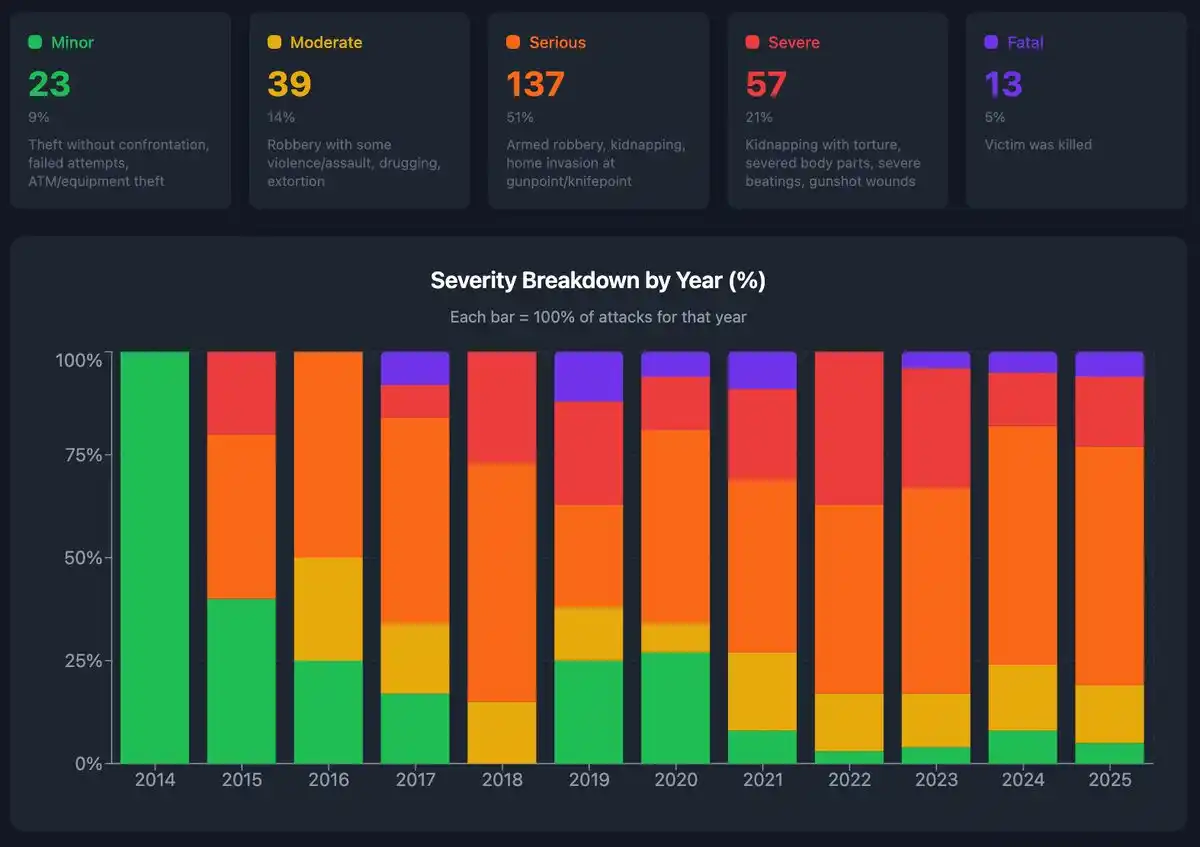
From the results, it can be seen that on average, the level of violence per single attack is continuously increasing.
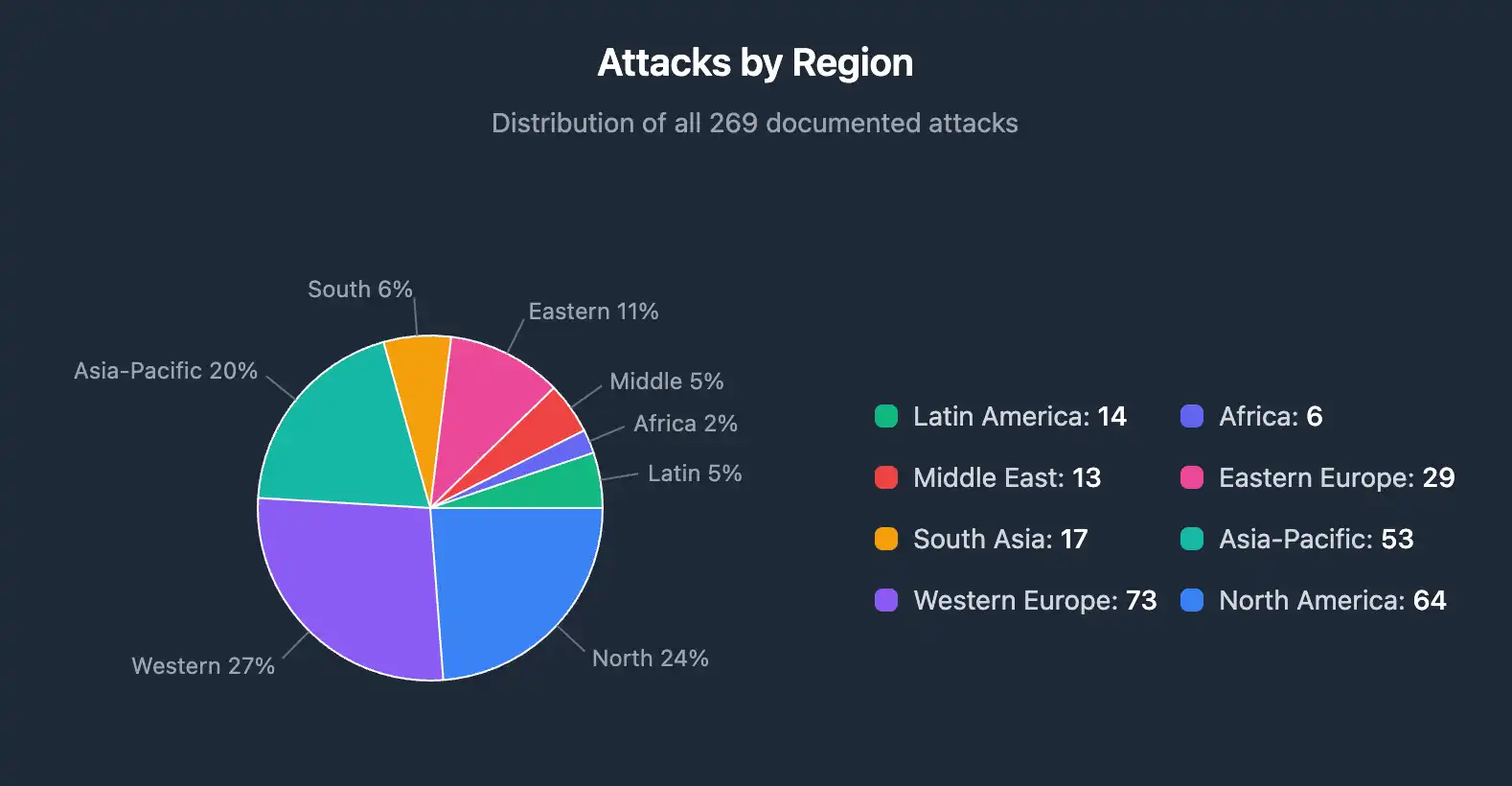
Geographically, Western Europe and the Asia-Pacific region saw the highest increase in violent incidents. North America is currently still relatively the safest region, but even in North America, there has been an upward trend in absolute numbers.
So, what is causing the rise in violent incidents?
One of the most straightforward explanations is to link the frequency of violent incidents to the total market capitalization of the cryptocurrency market. In simple terms—higher prices, more crime.
Take a look at the chart results: the white line represents the total market cap of cryptocurrency; the colored area represents the number of violent incidents.
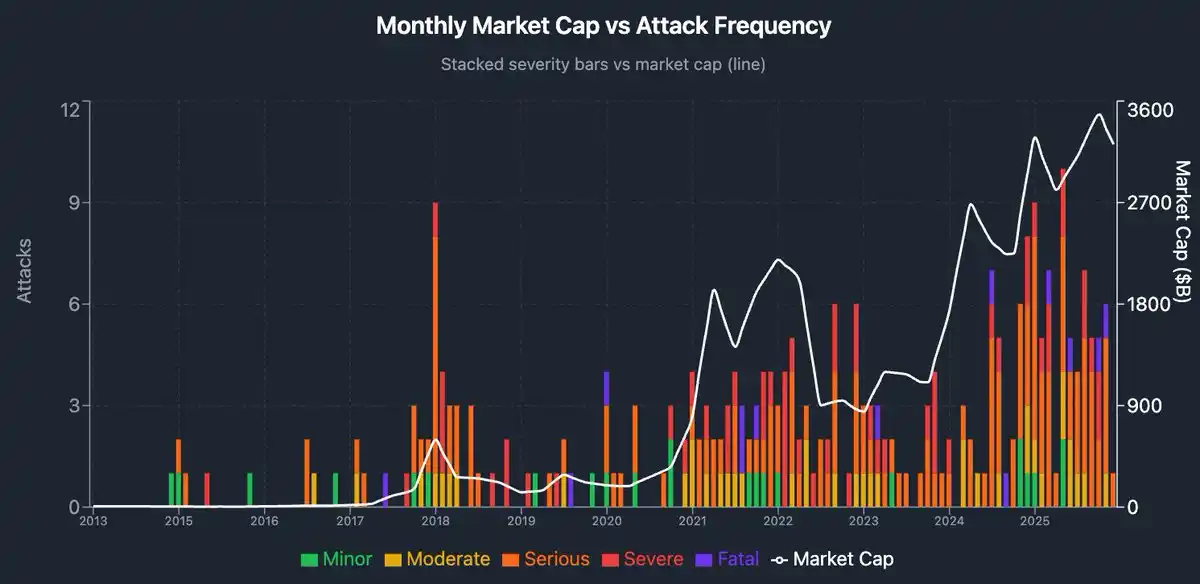
Conducting a simple regression analysis, the provided R² result is 0.45, meaning that 45% of the variation in violent incidents can be explained solely by the price itself. In other words, as we mentioned earlier, when prices rise, violent incidents increase—I have also run regression analyses on other variables, but none are as convincing as total market cap.
So, is it that simple? Does this already prove that holding cryptocurrency will pose an increasing personal danger?
We can perform another "stress test" to see if there are other hypotheses that could explain why the number of violent incidents is on the rise?
One possible explanation is that the increase in cryptocurrency prices inherently means more people hold cryptocurrency assets. In other words, the increase in criminal events may simply be because the "population base" has increased, and the actual risk of violence faced by each individual may not have truly risen.
Let's conduct a rationality check on this. Since accurately measuring the total number of cryptocurrency users is difficult, I chose two alternative indicators:
· The first is Coinbase's monthly active users, not cumulative registered users, as we want to exclude those who have already churned and no longer hold coins;
· The second method is more rudimentary, analyzing the number of violent incidents per unit market cap to derive an approximate measure of the "likelihood of theft per dollar."
Once you standardize the above data, you will see completely different conclusions: the blue line represents the number of violent incidents per Coinbase user; the green line represents the number of violent incidents per dollar of wealth
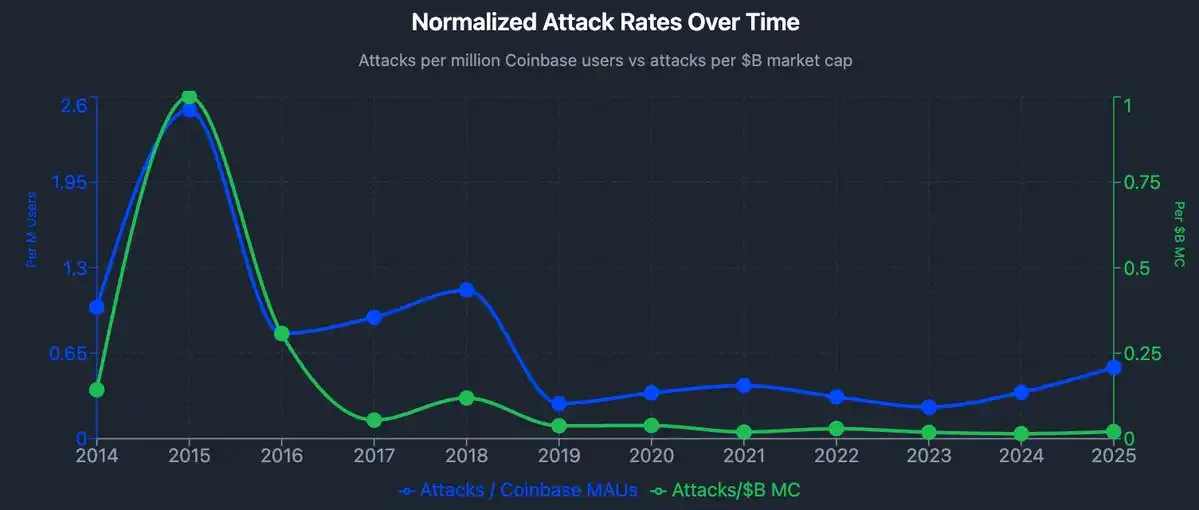
This data set suggests that 2015 and 2018 were actually the most dangerous periods to hold crypto. Yes, even though the number of attack incidents was much lower at that time, the number of cryptocurrency holders was also much, much lower.
From 2015 to 2025, Coinbase's monthly active users grew from 2 million to 120 million, a whopping 60x increase, but violent incidents did not increase proportionally.
Certainly, in recent years, the number of violent incidents per user has indeed increased, but the increase has been relatively modest, roughly equivalent to the 2021 violence levels and significantly lower than pre-2019 levels. Meanwhile, the rate of violent incidents per dollar of wealth has remained nearly unchanged.
We must also consider the alternative hypothesis of "news reporting bias"—whether incidents are just more likely to be reported—but this is beyond the scope of this analysis.
Overall, the number of violent incidents is indeed increasing, and the attack methods are becoming more violent. However, this can be partially attributed to the "population effect," meaning there are now more cryptocurrency holders, so the individual risk is not increasing as dramatically as it may seem.
But ultimately, this is not just an academic discussion. This is a truly serious, real-world issue.
If you are part of a high-risk group, there are actually many ways to improve your personal security. Here are some standard offline security suggestions:
· Try to live in a secure city, preferably in a residence with 24/7 security;
· Avoid wearing cryptocurrency-related clothing or implying that you hold cryptocurrency in public;
· Use a service like DeleteMe to remove your personal information from data brokers;
· Get a PO Box and have all commercial mail sent there to prevent your address from being widely circulated;
· Set up a hot wallet with a "giveaway" amount of money that is entirely separate from your actual cold storage assets;
· Diversify your funds: use multiple services, platforms, and devices to store your assets so that you don't lose everything at once in the worst-case scenario;
· Unless necessary, avoid publicly broadcasting your specific location in real-time, especially during cryptocurrency conferences;
· If you are truly part of a high-risk group or are about to visit a high-risk area, consider hiring private security – in some areas, this can be much more useful than you think.
2026 has arrived, and the year-end is approaching, with a long holiday ahead. Please be sure to stay safe.
You may also like

Morning Report | BitMine increased its holdings by 126,971 ETH last week; trader Eugene announced his exit from the crypto market

Wang Chuan: How can one not feel anxious after the neighbor Old Wang made thirty times profit by investing in storage stocks? (Seven) - A quarter-century cycle

Cryptocurrency CEXs are flocking to sell US stocks, and traditional brokerages are facing an "uninvited guest."

$75 billion in foreign capital has fled, and South Korean retail investors have absorbed it all using leverage

Japan’s Three Megabanks Plan Joint Stablecoin Issuance in Fiscal 2026
MUFG, SMBC, and Mizuho reportedly plan to jointly issue fiat-pegged stablecoins in fiscal 2026, signaling Japan’s growing push into bank-led digital payment infrastructure.

Humanity Discloses H Token Dual-Chain Attack Details, With Losses on Ethereum and BSC Exceeding $36 Million
Humanity said the H token attack across Ethereum and BSC caused more than $36 million in losses after leaked ProxyAdmin keys enabled malicious contract upgrades and token minting.
White House Discusses CLARITY Act With Law Enforcement Ahead of Senate Vote
The White House discussed the CLARITY Act with law enforcement ahead of a Senate vote, focusing on illicit finance risks and developer protections.

Bitcoin Trading Guide 2026: Strategies for Experienced Traders

What Is XAUT and PAXG? Why Tokenized Gold Is Booming in 2026

Will the SpaceX IPO Hurt Bitcoin? Here's What Traders Are Watching

Foreign selling in the South Korean stock market accelerates, with cumulative net sales reportedly reaching $75 billion this year
On June 9, The Kobeissi Letter, citing Goldman Sachs data, reported that global investors are selling South Korean stocks at an unusually rapid pace. In the latest trading session, foreign investors sold about $801 million worth of Kospi constituent stocks again; total foreign outflows last week reached about $10 billion, and the market has been in net foreign selling on nearly every trading day over the past month. According to the data cited in the report, foreign investors have sold about $75 billion worth of South Korean stocks so far this year. Meanwhile, South Korean retail and institutional investors together recorded roughly $69 billion in net buying over the same period, suggesting that the market’s main buying support has come from domestic capital rather than returning overseas funds. The information currently disclosed still mainly comes from The Kobeissi Letter’s retelling and Goldman Sachs data summaries, while public details on the statistical period and the specific definition of “selling” remain relatively limited.

Fortune Warns of Strategy’s Financing Structure Risks as Bitcoin Premium Narrows
Fortune warned that Strategy’s Bitcoin treasury model faces growing financing risks as MSTR’s net asset premium narrows and preferred stock dividend pressure increases.

Ferrari Challenge Le Mans: Carl Moon to Dominate in WEEX Livery

Sahara AI Responds to SAHARA’s Sharp Drop: No Contract or Product Security Issues Found, Internal Investigation Underway
Sahara AI responded to SAHARA’s 60% price drop, saying no token contract or product security issues have been found and an internal investigation is underway.

WEEX Deposit/Withdrawal Dynamic Island: Your Asset Status, Always in Sight
Scaling Crypto Derivatives: The Digital Asset Infrastructure Behind High-Volume Trading
In the fast-moving digital asset ecosystem, derivatives platforms face an extreme architectural test. High-leverage futures markets demand more than just standard security—they require absolute operational precision, zero-latency matching engines, and ironclad structural scalability, all while navigating intense market volatility.
As global platforms scale to meet these demands, the industry is shifting away from rigid, monolithic setups toward a more agile, "decoupled" infrastructure philosophy.
The Blueprint for High-Volume Copy TradingFor elite global exchanges like WEEX (founded in 2018), this architectural choice becomes critical when scaling high-volume retail features like social copy trading. When thousands of users automatically mirror the real-time strategies of elite traders simultaneously, it triggers sudden, monumental spikes in concurrent transactional volume.
To prevent execution latency or settlement bottlenecks during these peak volatility events, a platform's primary engine must remain entirely dedicated to risk management, copy-trade synchronization, and order matching.
The Architectural Rule: New-generation platforms must separate front-end user execution engines from heavy backend infrastructural overhead to eliminate operational friction.
By separating these layers, platforms can maintain complete sovereignty over their trading environments and user experiences while strategically aligning with institutional-grade infrastructure ecosystems. This strategic framework allows modern exchanges to leverage advanced Digital Asset Custody infrastructure such as Cobo’s behind the scenes, ensuring that backend wallet management scales elastically alongside trading spikes.
Capitalizing on Market Momentum and 400× LeverageIn a derivatives arena where platforms offer up to 400× leverage on perpetual contracts, capital efficiency and market agility are core business metrics. To capture market momentum, an exchange needs the ability to rapidly expand its asset offerings, supporting everything from legacy crypto assets to sudden, trending altcoins across a massive library of trading pairs.
Adopting a flexible, scalable Wallet-as-a-Service (WaaS) solution such as Cobo’s could completely rewrite the development timeline for high-growth exchanges. Instead of spending months of engineering capital building out custom backend wallet architectures for every new blockchain network, platforms can deploy localized infrastructure in days.
This agility allows platforms to instantly scale their listings to over a thousand trading pairs without compromising security or delaying time-to-market. It mirrors the exact operational advantages seen during high-velocity market events, similar to how advanced wallet infrastructure empowers platforms during sudden asset surges; allowing exchanges to pass that speed and liquidity directly to their global user base.
A Mature Foundation for GrowthThe synergy between trusted infrastructure ecosystems and global trading platforms represents the natural evolution of a maturing crypto market. As WEEX continues to scale its global spot and derivatives offerings for over 6 million users, adopting robust backend paradigms proves that platforms no longer have to compromise between cutting-edge trading velocity and uncompromised structural security.

Get Paid to Onboard? Try WEEX’s New Homepage with Rewards for Registration, Deposit & Trade
WEEX Custom Layout: Build Your Perfect Trading Workspace in Seconds
Morning Report | BitMine increased its holdings by 126,971 ETH last week; trader Eugene announced his exit from the crypto market
Wang Chuan: How can one not feel anxious after the neighbor Old Wang made thirty times profit by investing in storage stocks? (Seven) - A quarter-century cycle
Cryptocurrency CEXs are flocking to sell US stocks, and traditional brokerages are facing an "uninvited guest."
$75 billion in foreign capital has fled, and South Korean retail investors have absorbed it all using leverage
Japan’s Three Megabanks Plan Joint Stablecoin Issuance in Fiscal 2026
MUFG, SMBC, and Mizuho reportedly plan to jointly issue fiat-pegged stablecoins in fiscal 2026, signaling Japan’s growing push into bank-led digital payment infrastructure.
Humanity Discloses H Token Dual-Chain Attack Details, With Losses on Ethereum and BSC Exceeding $36 Million
Humanity said the H token attack across Ethereum and BSC caused more than $36 million in losses after leaked ProxyAdmin keys enabled malicious contract upgrades and token minting.


