
A computation bug that allowed Truebit to be hacked for 8535 ETH


Original Title: "Truebit Protocol $26.44M Hack Contract Vulnerability Analysis"
Original Source: ExVul Security
On January 8, 2026, the Truebit Protocol was hacked, resulting in a loss of 8,535.36 ETH (approximately $26.44 million). The official Truebit Protocol announcement was made early the next day. The ExVul security team conducted a detailed vulnerability analysis of this attack, with the following results:
Attack Process
Attacker's Address:
0x6c8ec8f14be7c01672d31cfa5f2cefeab2562b50
Attack Transaction Hash:
0xcd4755645595094a8ab984d0db7e3b4aabde72a5c87c4f176a030629c47fb014
The attacker completed the attack by looping 4 times through calls to getPurchasePrice→0xa0296215→0xc471b10b transactions. The analysis focuses on the first loop as an example.
1. The attacker first called the getPurchasePrice(240442509453545333947284131) function, which returned 0.

2. The attacker called the 0xa0296215(c6e3ae8e2cbab1298abaa3) function with a msg.value of 0 and successfully minted 240442509453545333947284131 TRU tokens.

3. The attacker called the 0xc471b10b(c6e3ae8e2cbab1298abaa3) function. They then burned 240442509453545333947284131 TRU tokens and received 5105.06 ETH.
Attack Logic Analysis
By understanding the above attack process, it is evident that there are issues in the logic of the getPurchasePrice function and the 0xa0296215 function. The following is an in-depth analysis (as the contract is not open-source, the following code is decompiled code).
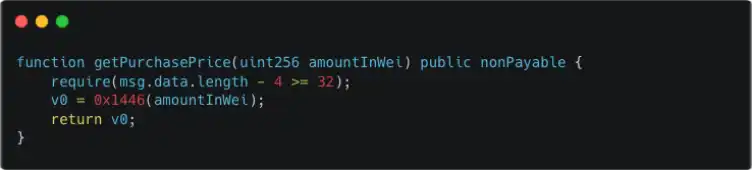
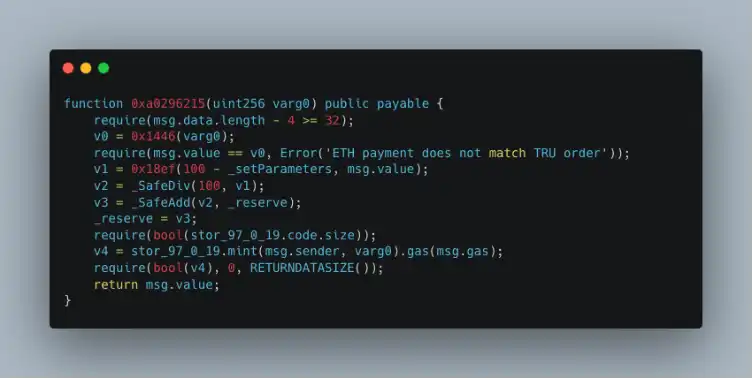
By comparing the similarities of two functions, we can discover that the 0x1446 function is used to determine how much ETH is needed to purchase a specific amount of TRU. Clearly, there is a flaw in the logic of the 0x1446 function, leading to an incorrect ETH calculation. The following is a detailed analysis of the logic in the 0x1446 function.
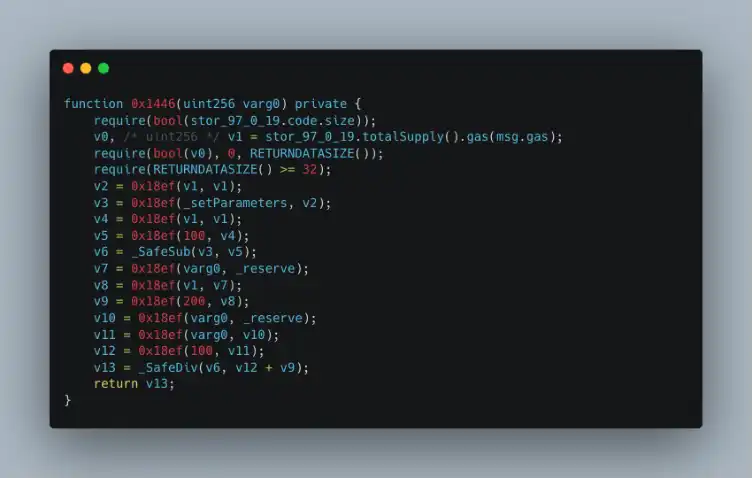
Observing the logic in the 0x1446 function, because the final calculation result v13 == 0, it is certain that the calculation logic mentioned earlier is flawed. It is important to note that the function 0x18ef is equivalent to _SafeMul, so the issue lies in using native addition v12 + v9 (the contract version is ^0.6.10, hence no overflow check).
v12 and v9 represent:
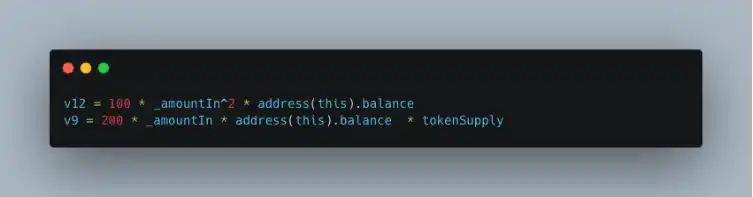
Through the above analysis, the attacker's approach is to input a huge _amountIn to overflow v12 + v9 into a very small value, ultimately resulting in (v12 + v9) / v6 == 0.
Summary
The fundamental reason for the attack on the Truebit Protocol this time is the presence of a severe integer overflow bug in its token purchase price calculation logic. Since the contract uses Solidity version ^0.6.10 and does not perform safety checks on crucial arithmetic operations, it ultimately led to a significant loss of 8,535.36 ETH. The new version of Solidity itself has already alleviated overflow vulnerabilities. This attack should be seen as a hacker leveraging AI to automatically scan some live but older DeFi protocols to discover vulnerabilities (including the recent Balancer and yETH attacks). We believe that such AI-driven attacks on older DeFi protocols will become more common in the near future. Therefore, we recommend that projects conduct new security audits on their contract code. If vulnerabilities are found, they should promptly upgrade the contract or transfer assets, maintain on-chain monitoring, promptly detect anomalies, and minimize losses.
This article is contributed content and does not represent the views of BlockBeats.
You may also like

Morning Report | Samsung announces a 265.5 trillion won investment plan, focusing on semiconductor and AI computing power data centers; Vitalik publishes an article detailing the entire technology tree behind the confusion protocol (iO) mainline
What you bought on CEX is really not US stocks: Analyzing the 94% liquidation monopoly and the evaporation of equity under a five-layer pipeline
In such a crowded cross-border payment arena, where is the next stop for the future?
Why Is Bitcoin Down in 2026? What We Can Learn From 2022
The large models in the United States are moving towards closure in the name of security
From the white-haired stock god to the billionaire fund mogul, the smart people shorting Nvidia are all getting rich using the same framework
Morning Report | CoinEx becomes a key hub for Iran to evade sanctions, involving over $3.8 billion in funds; Kalshi seeks a new round of financing, with a valuation potentially rising to $40 billion
Global Launch: As predictions become the most scarce asset in the AI era, Manadia is defining the next generation of the value internet
Why do cryptocurrency projects always like to change their names?
Who is footing the bill for the $64 billion accounting frenzy?
I never expected that the first application of AI x Crypto would be in security auditing
What is your view on Binance's competitive advantages?
ETH has entered a non-consensus phase, and the turning point is approaching!
The shift in the cloud of the air: from despising stablecoins a year ago to the high-profile entry of capital today
The survival dilemma of small and medium exchanges behind the withdrawal anomalies exposed by AscendEX
Why Is Bitcoin Falling Below $60K? 5 Key Market Drivers Explained
Bitcoin has dropped sharply amid ETF outflows, Strategy stock weakness, AI stock rallies, and changing Fed expectations. Explore the key forces driving BTC’s latest correction and what traders should watch next.
Bitcoin vs. Gold in 2026: Which Asset Performs Better in Different Markets?
The cryptocurrency industry has entered the "Show Me" era: merely relying on vision is no longer enough
Morning Report | Samsung announces a 265.5 trillion won investment plan, focusing on semiconductor and AI computing power data centers; Vitalik publishes an article detailing the entire technology tree behind the confusion protocol (iO) mainline
What you bought on CEX is really not US stocks: Analyzing the 94% liquidation monopoly and the evaporation of equity under a five-layer pipeline
In such a crowded cross-border payment arena, where is the next stop for the future?
Why Is Bitcoin Down in 2026? What We Can Learn From 2022
The large models in the United States are moving towards closure in the name of security
From the white-haired stock god to the billionaire fund mogul, the smart people shorting Nvidia are all getting rich using the same framework