
Arbitrage Era Ends as Wall Street Exits Bitcoin Basis Trading


Original Article Title: Wall Street Pulls Back From Bitcoin's Money-Spinning Basis Trade
Original Article Author: Sidhartha Shukla, Bloomberg
Translation: Peggy, BlockBeats
Editor's Note: The once-considered "risk-free" Bitcoin basis arbitrage is quietly losing its appeal: the open interest of CME and Binance's futures contracts is fluctuating, with the spread narrowing to the point where it barely covers the funding and execution costs.
Superficially, this indicates a squeezed arbitrage space; more profoundly, the crypto derivatives market is maturing. Institutions no longer need to rely on "brick-and-mortar" to generate returns, and traders are shifting from leverage to options and hedging. The era of easy high returns is exiting, and new competition will arise in more complex and sophisticated strategies.
Below is the original article:
A quiet yet significant change is taking place in the crypto derivatives market: one of the once most stable and profitable trading strategies is now showing signs of malfunction.
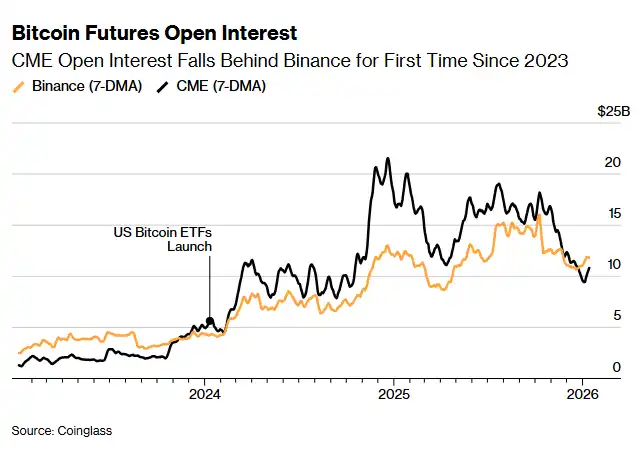
The institutional favorite "cash and carry" trading strategy, which involves buying Bitcoin spot and simultaneously selling futures to earn the spread, is on the verge of collapse. This not only foreshadows a rapid compression of the arbitrage space but also signals a deeper message: the structure of the crypto market is undergoing a transformation. The open interest of Bitcoin futures on the Chicago Mercantile Exchange (CME) has dropped below Binance for the first time since 2023, further indicating that with the narrowing spread and more efficient market access, the once lucrative arbitrage opportunities are rapidly eroding.
Following the launch of a Bitcoin spot ETF in early 2024, CME briefly became the go-to platform on Wall Street to execute such strategies. This operational logic is highly similar to the traditional market's "basis trade": buying Bitcoin spot through an ETF and simultaneously selling futures contracts to earn the spread between the two.
During the months following the ETF approval, this so-called "Delta Neutral Strategy" often saw an annualized return rate in the double digits, attracting billions of dollars in funds—these funds were indifferent to the direction of the Bitcoin price, only concerned about earning returns. However, it was precisely the ETF that catalyzed the rapid expansion of this trade that sowed the seeds of its demise: as more and more exchanges flocked to the scene, the arbitrage spread was swiftly flattened. Today, the returns from this trade can barely cover the funding costs.
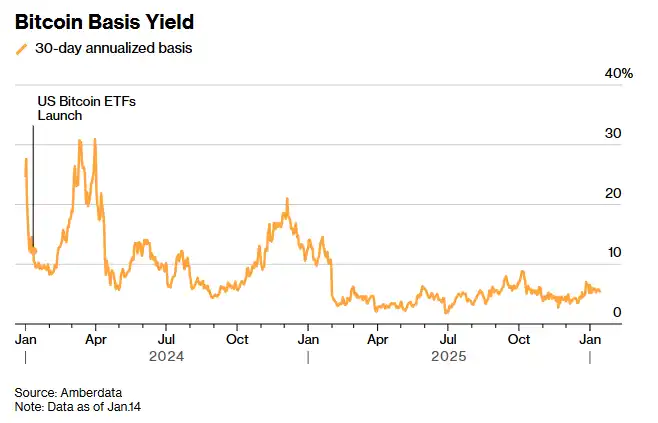
According to data compiled by Amberdata, the current one-month term annualized yield is hovering around 5%, reaching a recent low. Greg Magadini, Derivatives Lead at Amberdata, stated that just a year ago at this time, the basis was close to 17%, but has now dropped to around 4.7%, barely enough to cover funding and execution costs. At the same time, the one-year U.S. Treasury bond yield is about 3.5%, diminishing the attractiveness of this trade rapidly.
Against the backdrop of a narrowing basis, data aggregated by Coinglass shows that the open interest of CME Bitcoin futures has plummeted from a peak of over $21 billion to below $10 billion; meanwhile, Binance's open interest has remained relatively stable, at around $11 billion. James Harris, CEO of digital asset management firm Tesseract, stated that this change more so reflects withdrawals from hedge funds and large U.S. accounts, rather than a wholesale retreat from the crypto market since Bitcoin's price peak in October.
Crypto exchanges like Binance are the primary venues for perpetual contracts trading. Settlement, pricing, and margin calculations for such contracts are ongoing and often updated multiple times a day. Perpetual contracts are commonly referred to as "perps," and their trading volume dominates the crypto market. Last year, CME also introduced futures contracts with smaller face values and longer maturities, covering both the crypto asset and equity index markets, offering futures positions closely aligned with the spot market, allowing investors to hold contracts for up to five years without frequent rollovers.
Harris from Tesseract indicated that historically, CME has been the preferred venue for institutional funds and cash-and-carry trades. He added that Binance overtaking CME in open interest is "a significant signal that the market participant structure is shifting." He described the current situation as a "tactical reset," driven by decreasing returns and thinning liquidity rather than a crisis of market confidence.
According to a statement from CME Group, 2025 marks a pivotal point for the market: as regulatory frameworks become clearer, investor expectations improve for the sector, and institutional funds begin to diversify from a sole Bitcoin bet to tokens such as Ethereum, Ripple's XRP, and Solana.
CME Group stated: "Our average daily open interest for Ethereum futures was around $1 billion in 2024, and by 2025, this number had grown to nearly $5 billion."
Despite the Fed's rate cut lowering the cost of funds, the crypto market has not seen a sustained rebound since the collective crash of various tokens on October 10, with weakened lending demand, low DeFi yields, and traders preferring options and hedging tools over direct leveraged directional bets.
Le Shi, Managing Director of Auros Hong Kong, stated that as the market gradually matures, traditional participants now have more channels to express directional views, from ETFs to direct exchange access. This increased choice has narrowed the price differences between different trading venues, naturally compressing the arbitrage space that once boosted CME's open interest.
Le said: "There is a self-balancing effect here." He believes that as market participants continue to concentrate on the lowest-cost trading venues, spreads will tighten, and the impetus to engage in cash and carry trades will weaken.
On Wednesday, Bitcoin briefly fell by 2.4% to $87,188 before narrowing its losses. This decline briefly wiped out all gains since the beginning of the year.
Bohumil Vosalik, Chief Investment Officer of 319 Capital, stated that the era of nearly risk-free high returns may have ended, forcing traders to adopt more complex strategies in the decentralized market. For high-frequency and arbitrage-oriented institutions, this means they need to look elsewhere for opportunities.
You may also like

The large models in the United States are moving towards closure in the name of security

Morning Report | CoinEx becomes a key hub for Iran to evade sanctions, involving over $3.8 billion in funds; Kalshi seeks a new round of financing, with a valuation potentially rising to $40 billion

From the white-haired stock god to the billionaire fund mogul, the smart people shorting Nvidia are all getting rich using the same framework

Why do cryptocurrency projects always like to change their names?

Global Launch: As predictions become the most scarce asset in the AI era, Manadia is defining the next generation of the value internet

Who is footing the bill for the $64 billion accounting frenzy?
I never expected that the first application of AI x Crypto would be in security auditing

What is your view on Binance's competitive advantages?

ETH has entered a non-consensus phase, and the turning point is approaching!
The shift in the cloud of the air: from despising stablecoins a year ago to the high-profile entry of capital today
The survival dilemma of small and medium exchanges behind the withdrawal anomalies exposed by AscendEX
Why Is Bitcoin Falling Below $60K? 5 Key Market Drivers Explained
Bitcoin has dropped sharply amid ETF outflows, Strategy stock weakness, AI stock rallies, and changing Fed expectations. Explore the key forces driving BTC’s latest correction and what traders should watch next.

Bitcoin vs. Gold in 2026: Which Asset Performs Better in Different Markets?

Morning News | The draft amendment to the People's Bank of China Law aims to clarify the legal status of digital renminbi; South Korea will transfer about 40 unregistered virtual asset service providers to law enforcement agencies
The cryptocurrency industry has entered the "Show Me" era: merely relying on vision is no longer enough

Interpreting the Ethereum Foundation's new structure: Reaffirming self-sovereignty amid institutional trends
Former SpaceX engineer reconstructs the financial execution system using first principles
Standard Chartered Bank sings a 50x rhapsody again, aiming for AAVE to reach 3500 USD
The large models in the United States are moving towards closure in the name of security
Morning Report | CoinEx becomes a key hub for Iran to evade sanctions, involving over $3.8 billion in funds; Kalshi seeks a new round of financing, with a valuation potentially rising to $40 billion
From the white-haired stock god to the billionaire fund mogul, the smart people shorting Nvidia are all getting rich using the same framework
Why do cryptocurrency projects always like to change their names?
Global Launch: As predictions become the most scarce asset in the AI era, Manadia is defining the next generation of the value internet
Who is footing the bill for the $64 billion accounting frenzy?


