
Bet on LUNA, $1.8 Billion on the Line in Do Kwon's High-Stakes Gamble


Original Article Title: "On the Eve of Do Kwon's Sentencing, $1.8 Billion Is Betting on His Jail Time"
Original Article Author: David, DeepTech TechFlow
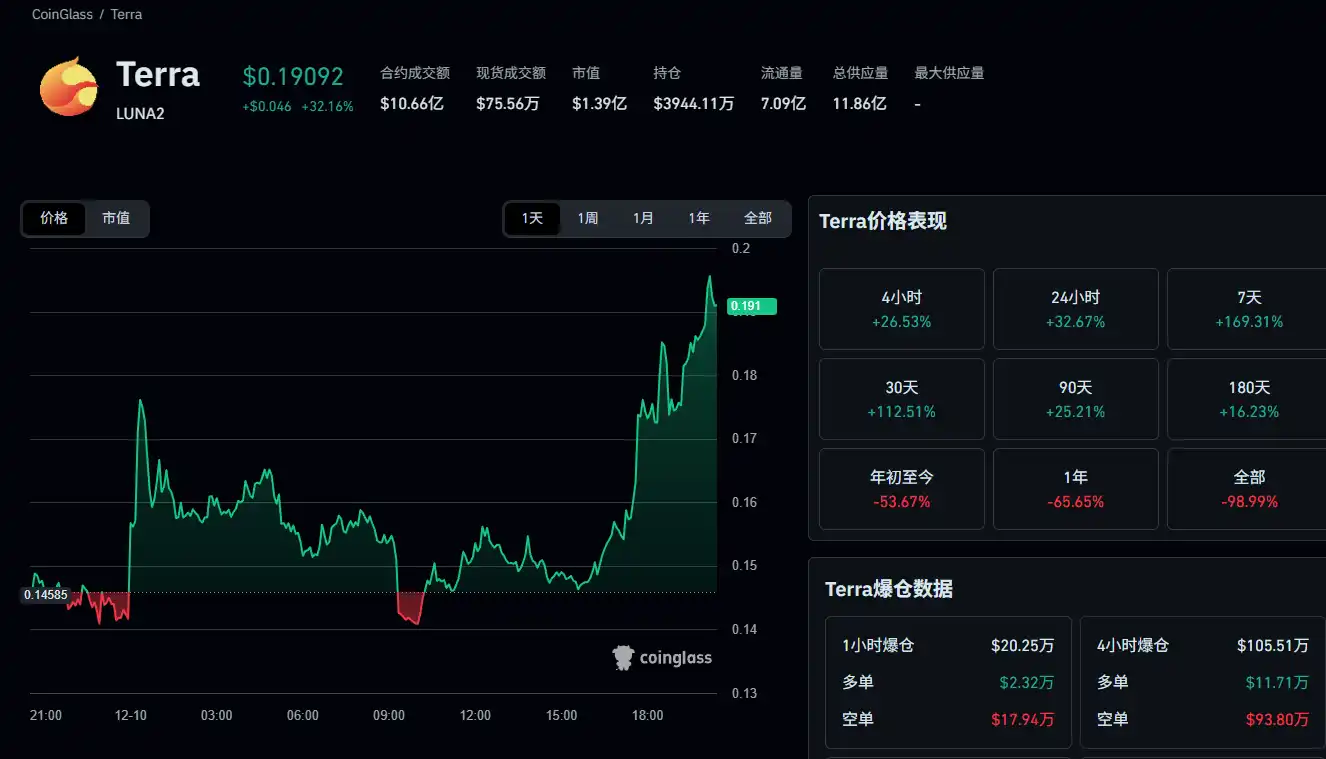
As of the evening of December 10th, what you might not have noticed is how absurd the contract data for the LUNA token has been.
In a scenario with no technical upgrades and no ecosystem-positive news, the total 24-hour trading volume of the LUNA series contracts (including LUNA and LUNA2) has reached nearly $1.8 billion USD across the entire market.
Moreover, LUNA itself has also surged by 150% in the past week.

For comparison, the combined trading volume of LUNA and LUNA2 can now almost rank in the top ten of the entire market's contract trading volume, second only to the HYPE at $18.8 billion USD.
And their funding rates are -0.0595% and -0.0789%, respectively.
A high negative funding rate implies that the market is not only crowded but is in an extreme state of divergence: a significant amount of funds are shorting, while another, even larger amount of funds are exploiting this congestion to force a short squeeze.
We all know that LUNA doesn't really have any fundamentals left. This $1.8 billion liquidity is essentially trading on a bet that is about to be settled:
Tomorrow, on December 11th at midnight, the former "Stablecoin King" Do Kwon will face the final sentencing hearing at the 1305 courtroom of the Southern District Federal Court in New York.
The market is wagering in cold hard cash on the jail time of this former version of a crypto bigwig.
Sentences Can Vary, Speculation Never Rests
To understand this $1.8 billion in contract trading volume, we need to take a look at the current state of this case.
For most people, the name Do Kwon faded from view after the epic crash of 2022.
However, in reality, this former crypto tycoon was extradited to New York, USA, by the end of 2024. And in August of this year, he formally pleaded guilty in a Manhattan Federal Court, admitting to multiple charges including securities fraud.
Tomorrow's hearing is not a debate about "guilty or innocent," but rather a final ruling on the length of the sentence. According to the latest court documents, there is a significant gap between the prosecution and defense in sentencing recommendations:
The prosecution is advocating for a 12-year prison term.
The U.S. Attorney's Office is taking a tough stance, citing the billions of dollars in losses caused by the Terra collapse, as well as Do Kwon's fraudulent on-chain activities regarding the Chai payment application prior to the collapse.
In the market's eyes, 12 years symbolize a complete end. Following the four-year crypto cycle, three cycles would have passed with no relation to Do Kwon.
The defense is seeking a 5-year prison term.
The defense team is playing the "sympathy card," emphasizing that Do Kwon has already been detained in Montenegro for some time, has shown a good attitude of remorse, and has cooperated with the SEC's fine enforcement.
A 7-year difference is enough to conduct a day-trading speculation and fund game around the LUNA token.
The normal logic would be that if the founder is heavily sentenced, the LUNA token is certainly destined to approach zero again. Therefore, the market is flooded with short positions, and we see negative funding rates;
However, the main funds or whales do not necessarily need to believe that Do Kwon will actually receive a light 5-year sentence. They only need to utilize the uncertainty of this ruling to push the price up and hunt down those overly crowded short positions.
This may also explain why LUNA experienced a surge on the eve of Do Kwon's trial. The market is definitely not celebrating justice but speculating on the judgment itself.
Originally, the crypto market had no hotspots and was overall weak, but tomorrow's hearing has created one of the few localized volatilities.
From Victim to Predator
Wake up, it's 2022.
If we were to open the LUNA holdings distribution chart in May 2022, what we would see is a more tragic scene:
It would be filled with Korean retail investors who lost their life savings, crypto funds that were severely hit, and speculators who tried to buy the dip but got buried. The trades at that time were more filled with anger, despair, and irrational self-rescue.
Three years later, the market's microstructure has undergone a complete overhaul.
The victims of yesteryear have long sold off and left the scene. Now, sitting across the table, are perhaps a wholly different set of participants. This may include high-frequency trading teams, Event-Driven Funds, and speculators specialized in hunting down "junk assets."
For these new players, whether Do Kwon is innocent, or if the Terra ecosystem has a future, these issues are not only irrelevant but are actually considered noise. The only metric they care about is Event Beta, which is the asset price's sensitivity to specific legal news.
In this scenario, the asset properties of LUNA have actually transformed into a derivative note revolving around the law, much like the volatility of certain Meme coins is centered around the actions of a public figure.
This represents an extremely brutal maturity in the crypto market, where death or imprisonment can themselves be "monetized".
Currently, even LUNA is mainly trading as a mere shell of tokens, essentially a disaster pricing. The big players are well aware that the fundamentals have hit rock bottom. However, as long as there is disagreement, as long as there is room for a long-short game, this "empty shell" remains a perfect trading target.
It can even be said that precisely because there is no fundamental anchor, the token price's fluctuations are no longer constrained, entirely dependent on the release of emotions.
It also confirms the saying that most tokens in the crypto market are actually memes.
Pricing Everything
After the verdict tomorrow, whether Do Kwon hears "5 years" or "12 years," for LUNA as a trading target, the outcome may lead to the same result.
After the event concludes, the token will likely return to being non-volatile; not only will bad news kill the market sentiment, confirmed good news will also.
If it's a harsh sentence, logic will regress to the fundamentals, and the price will go to zero; if it's a light sentence, good news will be priced in, leading to a Sell the News scenario, where profit-taking will recede like the tide.
Realistically, LUNA is actually a great observation mirror.
It has reflected a narrative of algorithmic stablecoin technology, as well as revealed the extremely mature and ruthless side of this market.
In today's crypto market, even a dead coin and a founder who has already pleaded guilty, as long as there is a hint of news value, can be efficiently repackaged into a chip on the gambling table.
The liquidity efficiency of the crypto market has evolved to the extreme, where it can price anything: emotions, bugs, memes... Of course, this also includes one's freedom and a form of righteous judgment.
In the face of this extreme efficiency, moral judgment seems somewhat redundant.
The rest of Do Kwon's life may be spent in sadness in prison, but there is no sadness in the crypto market, only volatility that has not yet been priced.
You may also like

Mastercard Launches Agent Pay for AI, Plans to Record AI Agent Payment Authorizations on Polygon
Mastercard launched Agent Pay for AI, a new payment protocol designed to help AI agents make small payments such as pay-per-use access to data and APIs. The system plans to record human-granted AI agent permissions on Polygon, focusing on verifiable authorization, identity, and payment controls.

Curve Deploys Llamalend v2 on Optimism With 250,000 OP Incentives
Curve launched Llamalend v2 on Optimism with 250,000 OP incentives from the Optimism Foundation. The upgrade expands Llamalend beyond its earlier crvUSD-focused model, adding broader collateral support, LlamaRisk market reviews, and the ability to use Curve LP tokens as collateral.

Raydium Old Liquidity Pool Reportedly Exploited, With $1.34 Million Moved to Ethereum and Tornado Cash
An old Raydium liquidity pool was reportedly exploited for around $1.34 million in USDC, RAY, and wSOL, with the stolen funds bridged to Ethereum and deposited into Tornado Cash. The incident highlights the tail risks of legacy DeFi pools, old contracts, and cross-chain fund laundering paths.

Kalshi Executive Challenges “SBF Backed AI Unicorns” Narrative, Says Leopold Aschenbrenner Was Key Figure
Kalshi executive John Wang questioned the “SBF backed AI unicorns” narrative, saying Leopold Aschenbrenner was the key figure behind major AI investment decisions.

Pantera Capital Partner: How Tokenization is Restructuring the Private Equity and Early Investment Ecosystem?

New York Proposes Stricter Stablecoin Issuer Rules Aligned With Federal GENIUS Act
NYDFS proposed stricter stablecoin issuer rules aligned with the GENIUS Act, covering reserves, custody, redemption timelines, audits, and capital buffers.
Every exchange is a "Universal Exchange."

The counterattack of traditional finance: Alliance chains are quietly reviving

CryptoQuant Says Bitcoin Profitable Supply Is Near 45% Pressure Zone as On-Chain Data Points to Market Repricing
CryptoQuant said Bitcoin’s profitable supply is nearing the 45% pressure zone, signaling rising market stress, unrealized losses, and a possible on-chain repricing phase.

Bitcoin Falls Below 200-Week Moving Average as On-Chain Data Shows Over Half of Supply in Loss
Bitcoin dropped below its 200-week moving average as on-chain data showed over 50% of circulating supply is now in loss, signaling rising market stress.

CFTC Reportedly Plans New Prediction Market Rules Focused on Manipulation Risk and Public Interest Review
The CFTC is reportedly preparing new prediction market rules focused on manipulation risk, public interest review, and retail trader protections.

Meet the new WEEX trial fund—your gateway to greater profits

WEEX Labs Lands at Dutch Blockchain Week: A Disruptive Crypto × AI Conversation Sets Sail in Amsterdam
SK Hynix Reportedly Plans U.S. ADR Listing as Early as August, With SEC Approval Possible in Late June
SK Hynix may pursue a U.S. ADR listing as early as August, with SEC approval reportedly possible in late June amid strong AI chip supply chain demand.

SpaceX vs Tesla vs xAI: Which Elon Musk Trade Has the Biggest Upside in 2026?
OpenAI Reveals It Has Confidentially Submitted an S-1 to the SEC, Keeping the Door Open for a Future IPO
On June 9, according to an OpenAI announcement, the company recently confidentially submitted a draft S-1 registration statement to the U.S. Securities and Exchange Commission (SEC), beginning the preliminary compliance process for a potential initial public offering. OpenAI said it chose to disclose this proactively because it expected the news might leak; however, the company has not yet set a specific listing timeline, and related arrangements may still take some time.
Latest research from 13 top universities including Cornell University: The current state, challenges, and misconceptions of the fusion of Crypto and AI
Deconstructing Anthropic: The Best AI Company, Possibly Also a Type of Organizational Invention
Mastercard Launches Agent Pay for AI, Plans to Record AI Agent Payment Authorizations on Polygon
Mastercard launched Agent Pay for AI, a new payment protocol designed to help AI agents make small payments such as pay-per-use access to data and APIs. The system plans to record human-granted AI agent permissions on Polygon, focusing on verifiable authorization, identity, and payment controls.
Curve Deploys Llamalend v2 on Optimism With 250,000 OP Incentives
Curve launched Llamalend v2 on Optimism with 250,000 OP incentives from the Optimism Foundation. The upgrade expands Llamalend beyond its earlier crvUSD-focused model, adding broader collateral support, LlamaRisk market reviews, and the ability to use Curve LP tokens as collateral.
Raydium Old Liquidity Pool Reportedly Exploited, With $1.34 Million Moved to Ethereum and Tornado Cash
An old Raydium liquidity pool was reportedly exploited for around $1.34 million in USDC, RAY, and wSOL, with the stolen funds bridged to Ethereum and deposited into Tornado Cash. The incident highlights the tail risks of legacy DeFi pools, old contracts, and cross-chain fund laundering paths.
Kalshi Executive Challenges “SBF Backed AI Unicorns” Narrative, Says Leopold Aschenbrenner Was Key Figure
Kalshi executive John Wang questioned the “SBF backed AI unicorns” narrative, saying Leopold Aschenbrenner was the key figure behind major AI investment decisions.
Pantera Capital Partner: How Tokenization is Restructuring the Private Equity and Early Investment Ecosystem?
New York Proposes Stricter Stablecoin Issuer Rules Aligned With Federal GENIUS Act
NYDFS proposed stricter stablecoin issuer rules aligned with the GENIUS Act, covering reserves, custody, redemption timelines, audits, and capital buffers.


