
Bitcoin briefly fell below $71,000, how much HODL faith is left in the crypto community?

Original Title: "Bitcoin Dips Below $72,000, How Much Faith Is Left in the Crypto Space?"
Original Author: Yang Chen, Wall Street News
Bitcoin dipping below the $72,000 mark (Update: Bitcoin has now dipped below $71,000) has brought the "faith" issue in the crypto market to the forefront. Against the backdrop of a sharp decline in global risk appetite, investors are reevaluating Bitcoin's position in the market turbulence, and the narrative of crypto assets as a hedge is being questioned.
According to Bloomberg, Bitcoin on Wednesday dipped to $71,739 in New York's closing, marking the first dip below $72,000 in about 15 months. Compared to its peak in October last year, Bitcoin has retraced over 42%, with a year-to-date decline of around 17%, falling to its lowest level since November 6, 2024.
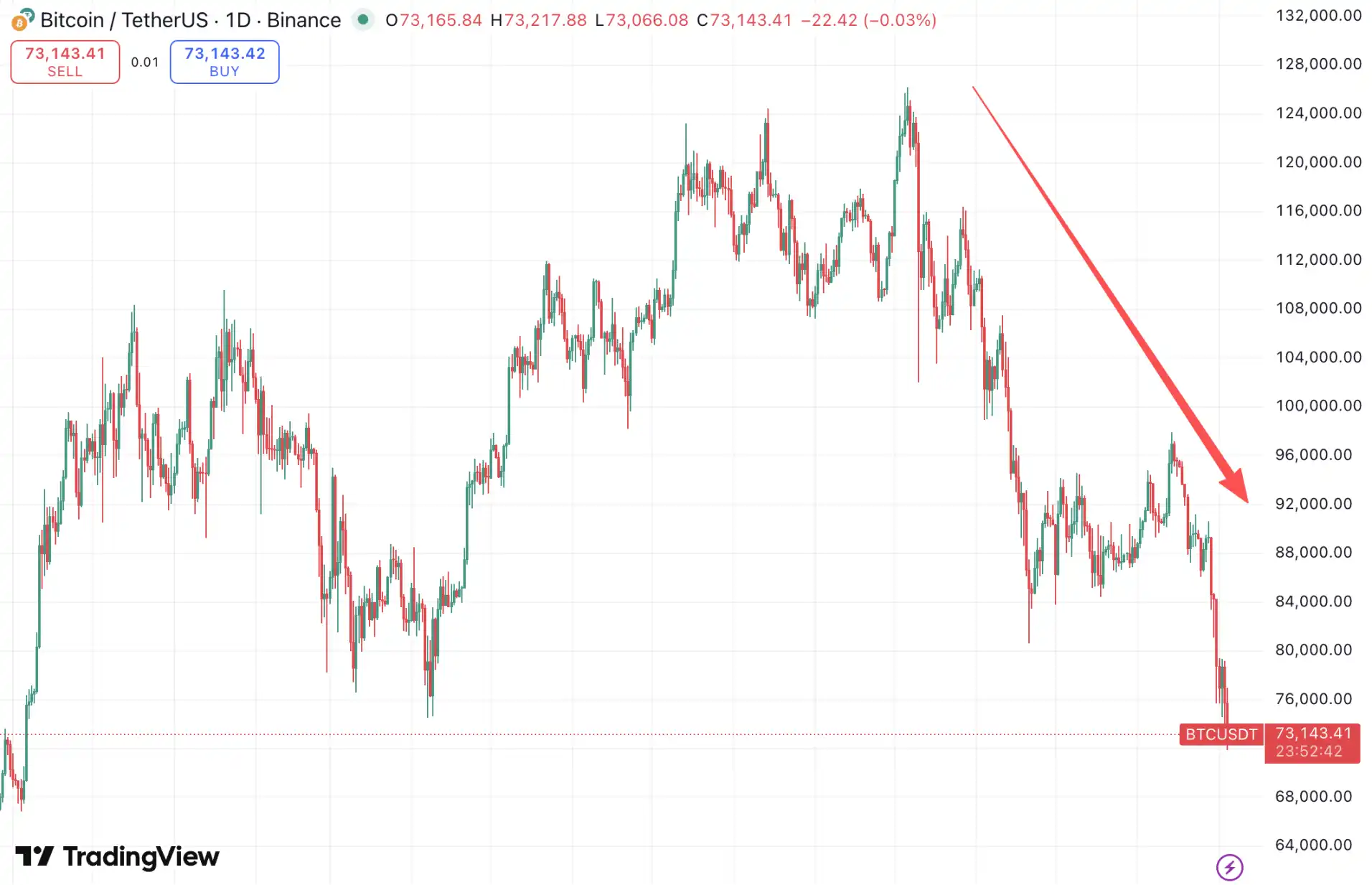
This round of decline is no longer just a deleveraging within the crypto market but is due to broader cross-asset pressure. On Wednesday, global markets experienced synchronous selling, with the Nasdaq 100 index dropping over 2%, sectors more sensitive to interest rates such as software and chips were generally under pressure, dragging Bitcoin down along with them.
On an emotional level, a "crisis of faith" is brewing. Shiliang Tang, managing partner at Monarq Asset Management, stated that the market is undergoing a "crisis of faith."
Andrew Tu, Head of Business Development at Efficient Frontier, also noted that market sentiment in the crypto space is currently at "extreme fear," and if $72,000 is breached, Bitcoin could drop to $68,000 or even fall back to the low range before the initial bounce in early 2024.
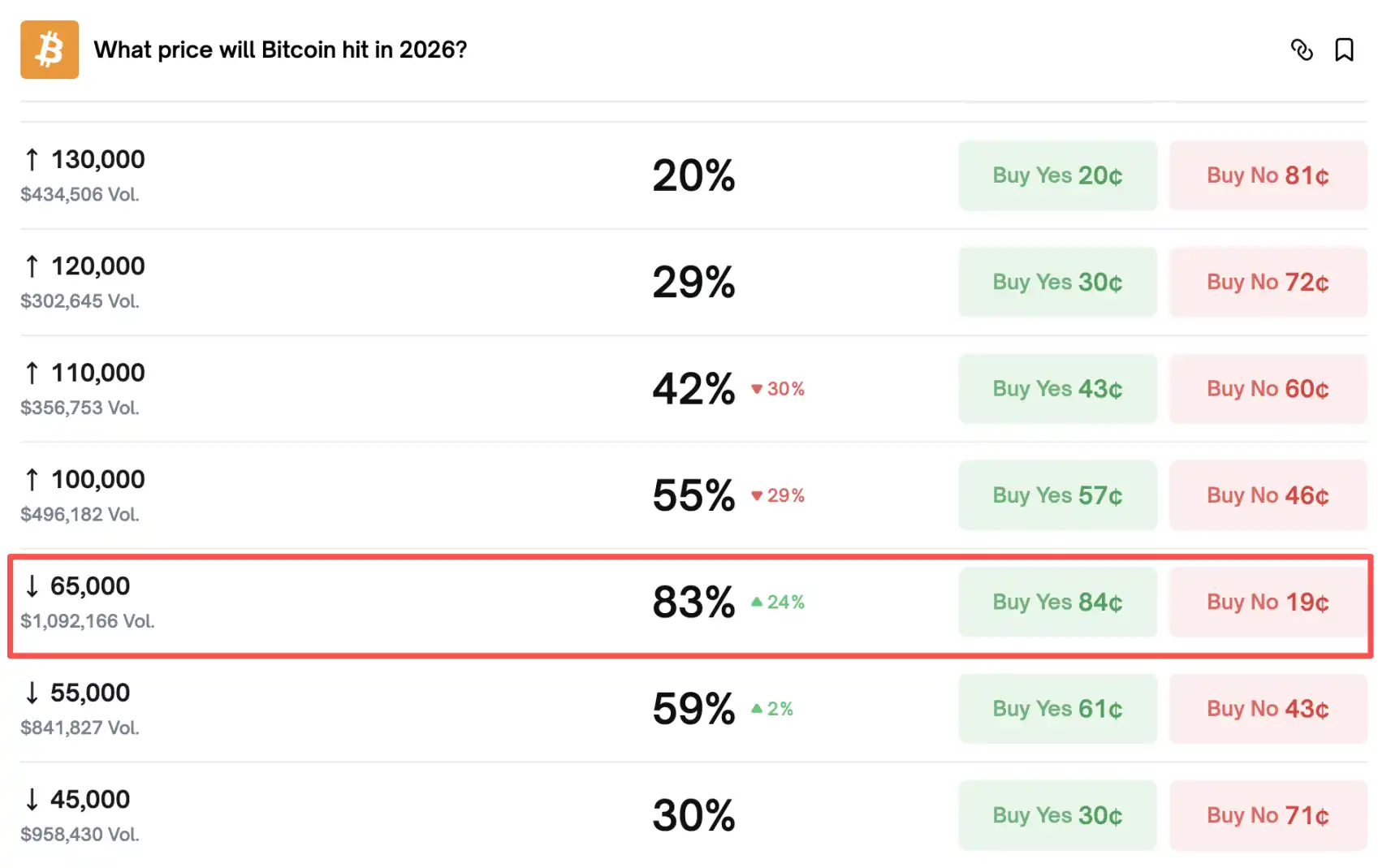
According to Polymarket, there is an 83% probability that Bitcoin will drop to $65,000 this year, and the probability of falling below $55,000 has risen to about 59%.
Risk Aversion Sudden Turn, Bitcoin Labelled as "High-Volatility Risk Asset"
According to Bloomberg, the pressure on Bitcoin on Wednesday was related to broader cross-asset tension rather than solely being driven by internal crypto asset liquidation. This is significant for investors because as the market entered a phase of synchronous selling, Bitcoin did not demonstrate resilience independent of risky assets but rather resembled a high-volatility long tail risk asset.
The Nasdaq 100 Index experienced a daily decline of over 2%, dragging down sectors such as software and semiconductors. On the same trading day, Bitcoin dropped below a key psychological level, reinforcing its market perception as being correlated with risk appetite.
With a 42% Retreat from Peak, the Crypto Market Evaporated Over $460 Billion in a Week
Price retracement is rapidly transmitting through market cap contraction. According to CoinGecko data, the total market capitalization of crypto assets has shrunk by around $1.7 trillion since last October's peak. In just the past week, the crypto market cap has decreased by over $460 billion.
As the largest cryptocurrency, Bitcoin's magnitude and speed of decline have a "anchoring effect" on market sentiment. When Bitcoin's year-to-date decline widens to around 17%, risk control, margin management, and fund redemption pressure often rise simultaneously, further intensifying overall volatility.
How the "Crisis of Faith" Emerges: From Liquidation Shock to Sentiment Dissipation
Market participants' expressions indicate that emotional shifts are becoming a core variable. The "crisis of faith" as described by Shiliang Tang points to investors' simultaneous doubts about the long-term narrative and short-term pricing mechanism of crypto assets.
More importantly, there has been a shift in the driving force behind the decline. According to Bloomberg, the earlier downward phase was more driven by crypto-specific liquidation, while Wednesday's pressure came from broader cross-market tension.
This means that even if the internal leverage unwinding in the crypto market comes to a halt, as long as external risk assets remain under pressure, Bitcoin may still lack an independent catalyst for a rebound.
72000 as a Short-Term Watershed, Market Predicts a Fall to 65000 by Year-End
Many traders view $72,000 as a key short-term price level. Andrew Tu points out that if this level cannot hold, Bitcoin is "likely" to fall to $68,000 and may revisit the low range before the initial rebound in early 2024.
According to Polymarket, Bitcoin has an 83% probability of falling to $65,000 this year, while the likelihood of dropping below $55,000 has risen to around 59%.
The funding side is also sending out mixed signals. According to Bloomberg compilation data, a U.S.-listed Bitcoin spot ETF recorded around $562 million in net inflows on Monday, but quickly turned into net outflows of $272 million on Tuesday, indicating that incremental funds are not stable.
Amid price declines and fund flow fluctuations, skepticism in the market about Bitcoin's role as a "safe-haven asset in times of pressure" is on the rise.
You may also like

The survival dilemma of small and medium exchanges behind the withdrawal anomalies exposed by AscendEX

Why Is Bitcoin Falling Below $60K? 5 Key Market Drivers Explained
Bitcoin has dropped sharply amid ETF outflows, Strategy stock weakness, AI stock rallies, and changing Fed expectations. Explore the key forces driving BTC’s latest correction and what traders should watch next.

The shift in the cloud of the air: from despising stablecoins a year ago to the high-profile entry of capital today

ETH has entered a non-consensus phase, and the turning point is approaching!

Bitcoin vs. Gold in 2026: Which Asset Performs Better in Different Markets?

What is your view on Binance's competitive advantages?
I never expected that the first application of AI x Crypto would be in security auditing

Global Launch: As predictions become the most scarce asset in the AI era, Manadia is defining the next generation of the value internet

Who is footing the bill for the $64 billion accounting frenzy?

Morning Report | CoinEx becomes a key hub for Iran to evade sanctions, involving over $3.8 billion in funds; Kalshi seeks a new round of financing, with a valuation potentially rising to $40 billion

Why do cryptocurrency projects always like to change their names?

From the white-haired stock god to the billionaire fund mogul, the smart people shorting Nvidia are all getting rich using the same framework

Morning News | The draft amendment to the People's Bank of China Law aims to clarify the legal status of digital renminbi; South Korea will transfer about 40 unregistered virtual asset service providers to law enforcement agencies

The cryptocurrency industry has entered the "Show Me" era: merely relying on vision is no longer enough

Interpreting the Ethereum Foundation's new structure: Reaffirming self-sovereignty amid institutional trends

Former SpaceX engineer reconstructs the financial execution system using first principles
Standard Chartered Bank sings a 50x rhapsody again, aiming for AAVE to reach 3500 USD
Tidal Investment: We still have a positive outlook on the AI industry chain, but the reasons have changed
The survival dilemma of small and medium exchanges behind the withdrawal anomalies exposed by AscendEX
Why Is Bitcoin Falling Below $60K? 5 Key Market Drivers Explained
Bitcoin has dropped sharply amid ETF outflows, Strategy stock weakness, AI stock rallies, and changing Fed expectations. Explore the key forces driving BTC’s latest correction and what traders should watch next.
The shift in the cloud of the air: from despising stablecoins a year ago to the high-profile entry of capital today
ETH has entered a non-consensus phase, and the turning point is approaching!
Bitcoin vs. Gold in 2026: Which Asset Performs Better in Different Markets?
What is your view on Binance's competitive advantages?


