
Bitcoin getting ‘stable’? 2025 volatility lower than Nvidia

Original Title: Bitcoin is now less volatile than Nvidia, a statistical anomaly that completely changes your risk calculation
Original Author: Gino Matos, CryptoSlate
Original Translation: Saoirse, Foresight News
As Bitcoin closed out 2025, its actual daily volatility dropped to 2.24%, marking the lowest annual figure recorded for the asset.
K33 Research's volatility chart dates back to 2012 when Bitcoin's daily volatility was at 7.58%. The data reveals that in each subsequent cycle, Bitcoin's volatility has been steadily decreasing: 3.34% in 2022, 2.80% in 2024, and down to 2.24% in 2025.
However, there is a discrepancy between market perception and data. In October 2025, Bitcoin's price plummeted from $126,000 to $80,500, causing anxiety. On October 10, a liquidation event triggered by tariff policies wiped out $19 billion of leveraged long positions in a single day.
The paradox lies in this: while Bitcoin's volatility has indeed decreased by traditional standards, the inflows it attracts are larger compared to previous cycles, and the absolute price swings are higher.
Low volatility does not mean a "quiet market" but rather indicates that the market has matured enough to handle institutional-sized capital flows without relapsing into the "chain reaction" feedback loops seen in earlier cycles.
Today, ETFs, corporate treasuries, and regulated custodial institutions have become the "ballast" of market liquidity, with long-term hodlers continuously reallocating assets into this infrastructure.
The end result is that Bitcoin's daily returns are more stable, but market cap fluctuations still reach hundreds of billions of dollars — a level of volatility that would have caused an 80% collapse if seen in 2018 or 2021.
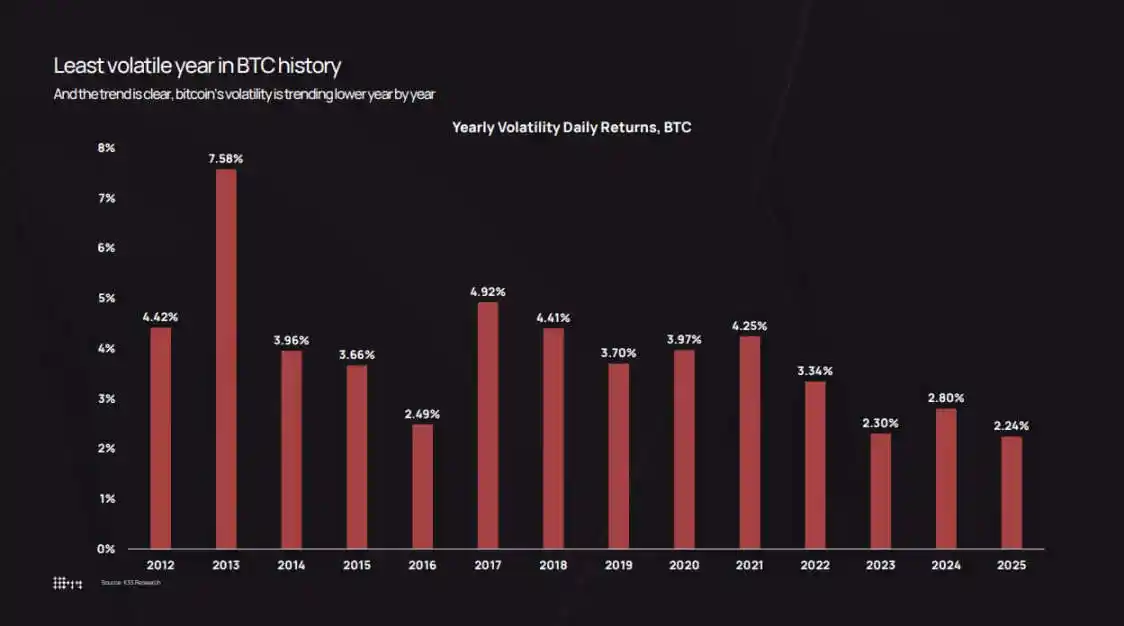
According to K33 Research data, Bitcoin's annual volatility has dropped from a peak of 7.58% in 2013 to a historic low of 2.24% in 2025.
Continued Decrease in Volatility
The annual volatility data for K33 has documented this transition process.
In 2013, the Bitcoin daily return rate had an average of 7.58%, reflecting a market characterized by thin order books and speculative frenzy. By 2017, this value had decreased to 4.81%; in 2020, it was 3.98%; during the 2021 pandemic bull market, it saw a slight increase to 4.13%. In 2022, with the collapse of the Luna project, Three Arrows Capital, and the FTX trading platform, the volatility surged to 3.34%.
Subsequently, the volatility continued to decline: it was 2.94% in 2023, 2.80% in 2024, and dropped to 2.24% in 2025.
A logarithmic scale price chart further confirms this trend. From 2022 to 2025, Bitcoin did not experience extreme price swings of "rapid surge followed by a steep decline" but rather steadily rose within an upward channel.
While there were pullbacks during this period—for example, the price fell below $50,000 in August 2024 and dropped to $80,500 in October 2025—there was no scenario of a "parabolic surge followed by a systemic collapse."
Analysis indicates that the approximately 36% decline in October 2025 still falls within the normal range of Bitcoin's historical retracements. The difference is that a 36% retracement in the past often occurred at the end of a high-volatility period around 7%, whereas this time, it occurred in a low-volatility environment of 2.2%.
This has led to a "perceptual gap": a 36% decline in six weeks may still feel drastic, but compared to earlier cycles (when daily 10% fluctuations were normal), the volatility in 2025 is relatively mild.
Asset management firm Bitwise points out that Bitcoin's actual volatility is now lower than that of Nvidia, a change that has shifted Bitcoin's positioning from a "pure speculative tool" to a "high-beta macro asset."
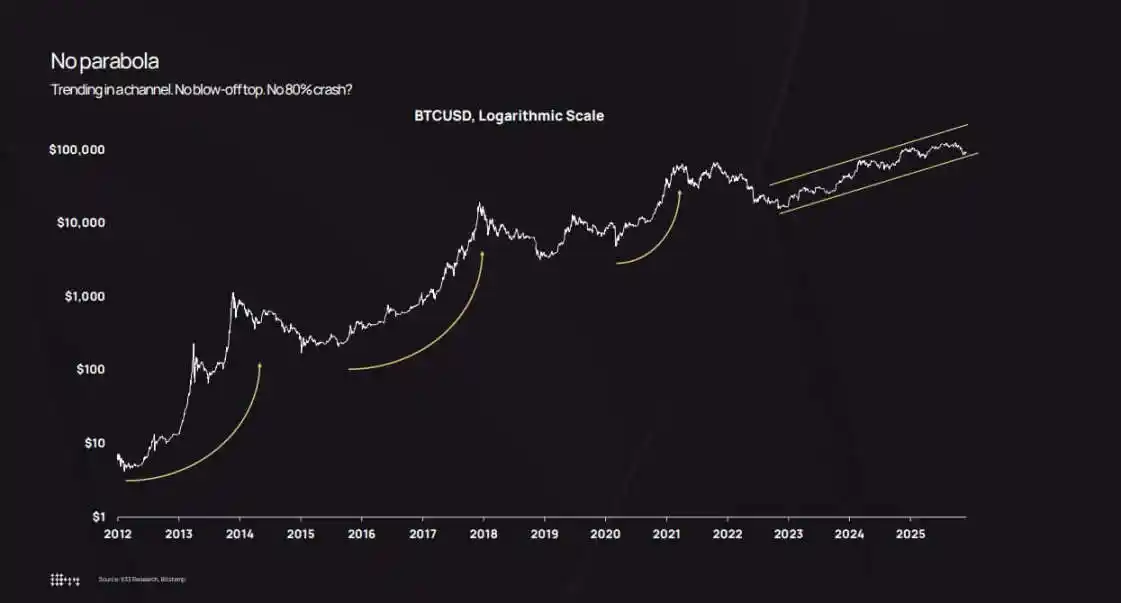
The logarithmic price chart of Bitcoin shows that since 2022, its price has been slowly rising within an upward channel, avoiding the parabolic surges and 80% crashes seen in earlier cycles.
Market Cap Expansion, Institutional Entry, and Asset Reallocation
K33's core viewpoint is that the actual decrease in volatility is not due to reduced capital inflows but because a much larger capital base is now needed to drive price changes.
The "Bitcoin Market Cap Three-Month Change Chart" produced by the institution shows that even during a low volatility period, the market cap can still fluctuate by billions of dollars.
During the retracement from October to November 2025, Bitcoin's market cap plummeted by around $570 billion, nearly on par with the retracement of $56.8 billion in July 2021.
The magnitude of the fluctuations has not changed; what has changed is the market's ability to absorb these fluctuations, known as "depth."
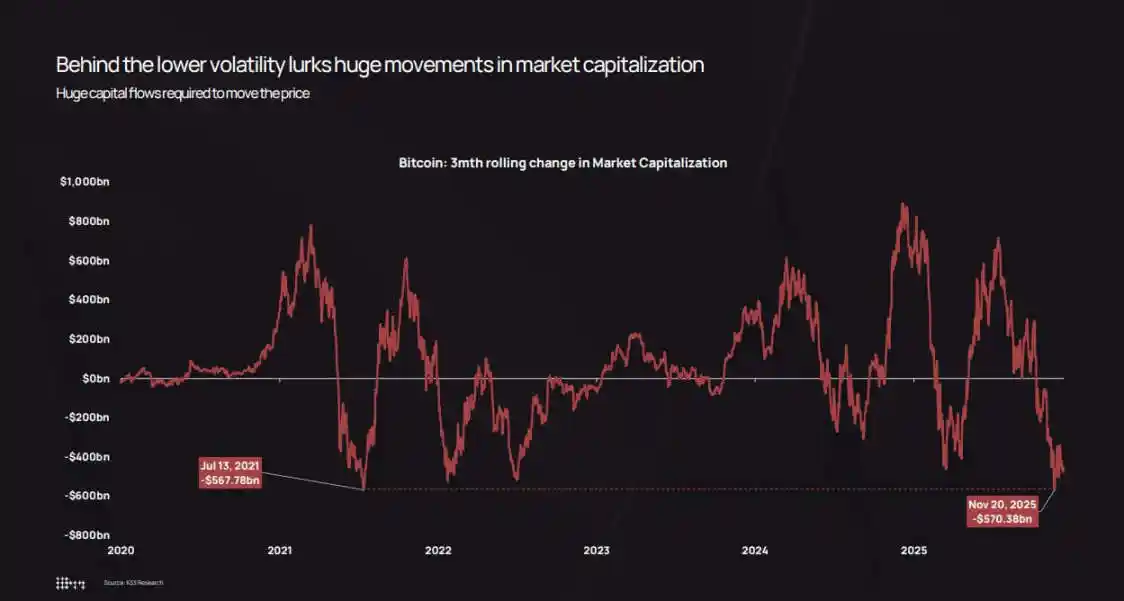
In November 2025, Bitcoin's market cap fluctuation over three months reached $570 billion. Despite lower volatility, this drop was comparable to the $56.8 billion drop in July 2021.
Three major structural factors have driven the decrease in volatility:
First is the "buying the dip" effect of ETFs and institutions. K33 statistics show that in 2025, ETFs net purchased around 160,000 bitcoins (lower than the 630,000+ bitcoins in 2024 but still significant). ETFs and corporate treasuries collectively increased their holdings by about 650,000 bitcoins, accounting for over 3% of the circulating supply. These funds entered the market through "programmatic rebalancing" rather than being driven by retail FOMO emotions.
K33 specifically notes that even with a price drop of around 30%, ETF holdings only decreased by single-digit percentages, without experiencing panic redemptions or forced liquidations.
Second is corporate treasuries and structural issuance. By the end of 2025, corporate treasuries collectively held around 473,000 bitcoins (with the pace of accumulation slowing in the second half of the year). The new demand mainly came from preferred stock and convertible bond issuances rather than direct cash purchases—financial teams execute capital structure strategies quarterly rather than chasing short-term market trends like traders.
Third is the redistribution of assets from early holders to a wider audience. K33's "Asset Holding Duration Analysis" shows that since early 2023, bitcoins held idle for over two years have begun to steadily "activate," with around 1.6 million long-held bitcoins entering circulation over the past two years.
2024 and 2025 were the two years with the largest scale of "dormant asset" activations. The report mentions that in July 2025, Galaxy Digital sold 80,000 bitcoins, and Fidelity sold 20,400 bitcoins.
This selloff neatly aligns with the "structural demand" from ETFs, corporate treasuries, and regulated custodians — the latter will gradually accumulate positions over a period of months.
This redistribution is crucial: early adopters accumulated Bitcoin at prices ranging from $100 to $10,000, with the asset mostly concentrated in a few wallets; when they sell, the asset flows to ETF shareholders, corporate balance sheets, and high-net-worth clients who enter through diversified portfolio small buys.
The end result is: Bitcoin ownership concentration decreases, order book depth increases, and the "feedback loop" weakens. In early cycles, a selloff of 10,000 Bitcoin could cause a price drop of 5% to 10% if faced with a illiquid market, triggering stop-losses and liquidations; but by 2025, such selloffs will attract buying interest from multiple institutional channels, potentially even driving a 2% to 3% price increase, weakening the feedback loop, and reducing daily volatility.
Portfolio Construction, Leverage Impact, and the End of the "Parabolic Cycle"
The actual volatility decline has altered institutions' calculation logic for "Bitcoin holding size."
Modern portfolio theory argues that asset allocation weights should be based on "risk contribution" rather than "return potential." With a 4% Bitcoin allocation: if the daily volatility is 7%, its contribution to the portfolio risk is much higher than in a 2.2% volatility scenario.
This mathematical fact forces asset allocators to make a choice: either increase the Bitcoin allocation or use options and structured products (assuming the underlying asset has smoother volatility).
K33's cross-asset performance table shows that in 2025, Bitcoin ranks near the bottom in asset return rankings—although it had outperformed for many years in the previous cycles, in 2025, it lagged behind gold and stocks.
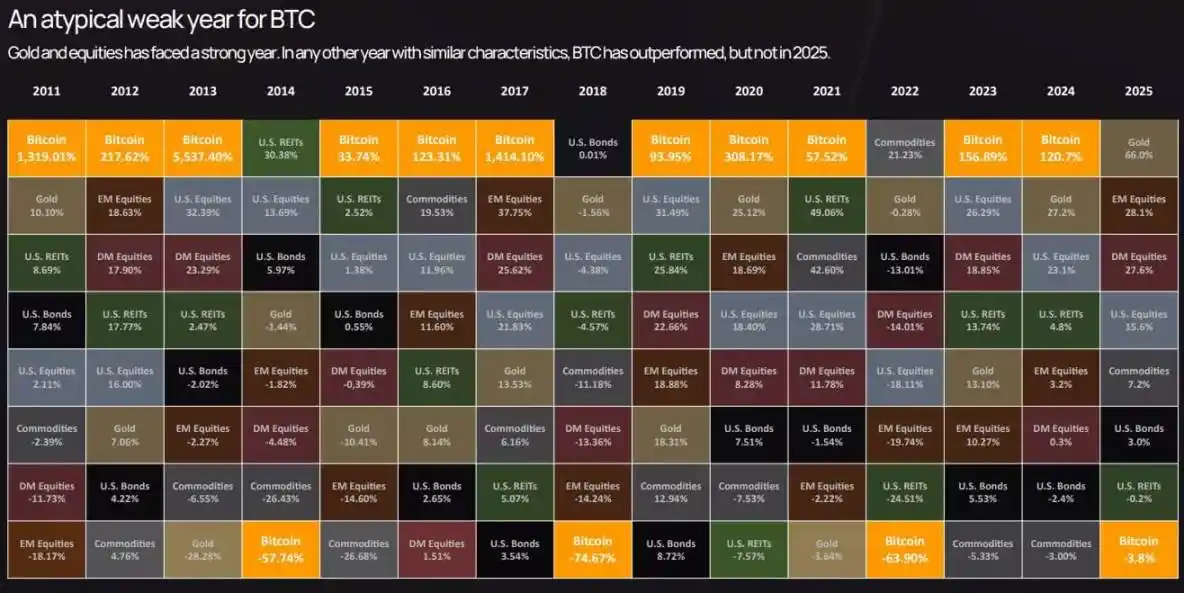
Bitcoin ranks near the bottom in asset performance in 2025, with a decline of 3.8%; in this atypical year for Bitcoin, its performance lags behind gold and stocks.
This "underperformance" coupled with low volatility shifts Bitcoin's positioning from a "speculative satellite asset" to a "core macro asset" — with risk similar to stocks, but driven by factors unrelated to other assets' returns.
The options market also reflects this shift: the implied volatility of Bitcoin options has synchronously decreased with actual volatility, reducing hedging costs and making synthetic structured products more attractive.
Previously, compliance departments often used "high volatility" as a reason to restrict financial advisor allocation to Bitcoin; now, advisors have quantitative evidence: by 2025, Bitcoin's volatility is lower than Nvidia's, lower than many tech stocks, and comparable to high-beta stock sectors.
This has opened up new investment channels for Bitcoin: inclusion in 401(k) retirement plans, Registered Investment Advisor (RIA) allocations, and insurance company investment portfolios subject to strict volatility constraints.
K33's forward-looking data predicts that as these channels open up, ETF net inflows in 2026 will surpass those in 2025, forming a "self-reinforcing cycle": more institutional funds flow in → reduced volatility → unlocking more institutional mandates → more funds flow in.
However, the market's "calm" is conditional. K33's derivative analysis shows that throughout 2025, Bitcoin perpetual futures open interest steadily rose in a "low volatility, strong uptrend" environment, eventually leading to a liquidation event on October 10th - wiping out $19 billion in leveraged longs in a single day.
This sell-off was related to President Trump's tariff statement and widespread "risk-off sentiment," but the core mechanism remains a derivative issue: excessive leveraged longs, thin weekend liquidity, cascading margin calls.
Even with an actual annualized volatility of 2.2%, there may still be "extreme volatility days triggered by leveraged liquidations" hidden. The difference is that these events are now resolved in a matter of hours, not weeks; and with ETF and corporate treasury spot demand providing a "price floor," the market can quickly recover.
The structural backdrop of 2026 supports the view of "maintaining low volatility or further decline": K33 expects that as the two-year Bitcoin supply stabilizes, early holders' sell-offs will decrease; furthermore, there are positive signals at the regulatory level - the U.S. "CLARITY Act," full implementation of Europe's MiCA, and JPMorgan Chase and Bank of America opening up 401(k) and wealth management channels.
K33's "Golden Opportunity" data forecast predicts that in 2026, Bitcoin will outperform stock indices and gold - due to the impact of regulatory breakthroughs and new fund inflows, surpassing the selling pressure from existing holders.
Whether this prediction will materialize is still uncertain, but the mechanisms driving the forecast - deepening liquidity, improving institutional infrastructure, and clear regulation - indeed provide support for low volatility.
Ultimately, the Bitcoin market will move away from the "speculative frontier" attributes of 2013 or 2017, closer to a "high liquidity, institutionally anchored macro asset."
This doesn't mean Bitcoin has become "boring" (e.g., low returns or lack of narrative), but rather that the "game has changed": the price path is more stable, the options market and ETF flows matter more than retail sentiment, and the market's core shifts are reflected in structure, leverage levels, and counterparty composition.
By 2025, despite Bitcoin undergoing the largest regulatory and structural transformation in history, from a volatility perspective, it has become an "institutionalized stable asset."
The value of understanding this shift is that low realized volatility is not a signal of "asset lethargy" but a sign that the "market is mature enough to handle institutional capital without collapsing."
The cycle is not over; it's just that the "cost" of driving market volatility has become higher.
You may also like

Morning Report | BitMine increased its holdings by 126,971 ETH last week; trader Eugene announced his exit from the crypto market

Wang Chuan: How can one not feel anxious after the neighbor Old Wang made thirty times profit by investing in storage stocks? (Seven) - A quarter-century cycle

Cryptocurrency CEXs are flocking to sell US stocks, and traditional brokerages are facing an "uninvited guest."

$75 billion in foreign capital has fled, and South Korean retail investors have absorbed it all using leverage

Japan’s Three Megabanks Plan Joint Stablecoin Issuance in Fiscal 2026
MUFG, SMBC, and Mizuho reportedly plan to jointly issue fiat-pegged stablecoins in fiscal 2026, signaling Japan’s growing push into bank-led digital payment infrastructure.

Humanity Discloses H Token Dual-Chain Attack Details, With Losses on Ethereum and BSC Exceeding $36 Million
Humanity said the H token attack across Ethereum and BSC caused more than $36 million in losses after leaked ProxyAdmin keys enabled malicious contract upgrades and token minting.
White House Discusses CLARITY Act With Law Enforcement Ahead of Senate Vote
The White House discussed the CLARITY Act with law enforcement ahead of a Senate vote, focusing on illicit finance risks and developer protections.

Bitcoin Trading Guide 2026: Strategies for Experienced Traders

What Is XAUT and PAXG? Why Tokenized Gold Is Booming in 2026

Will the SpaceX IPO Hurt Bitcoin? Here's What Traders Are Watching

Foreign selling in the South Korean stock market accelerates, with cumulative net sales reportedly reaching $75 billion this year
On June 9, The Kobeissi Letter, citing Goldman Sachs data, reported that global investors are selling South Korean stocks at an unusually rapid pace. In the latest trading session, foreign investors sold about $801 million worth of Kospi constituent stocks again; total foreign outflows last week reached about $10 billion, and the market has been in net foreign selling on nearly every trading day over the past month. According to the data cited in the report, foreign investors have sold about $75 billion worth of South Korean stocks so far this year. Meanwhile, South Korean retail and institutional investors together recorded roughly $69 billion in net buying over the same period, suggesting that the market’s main buying support has come from domestic capital rather than returning overseas funds. The information currently disclosed still mainly comes from The Kobeissi Letter’s retelling and Goldman Sachs data summaries, while public details on the statistical period and the specific definition of “selling” remain relatively limited.

Fortune Warns of Strategy’s Financing Structure Risks as Bitcoin Premium Narrows
Fortune warned that Strategy’s Bitcoin treasury model faces growing financing risks as MSTR’s net asset premium narrows and preferred stock dividend pressure increases.

Ferrari Challenge Le Mans: Carl Moon to Dominate in WEEX Livery

Sahara AI Responds to SAHARA’s Sharp Drop: No Contract or Product Security Issues Found, Internal Investigation Underway
Sahara AI responded to SAHARA’s 60% price drop, saying no token contract or product security issues have been found and an internal investigation is underway.

WEEX Deposit/Withdrawal Dynamic Island: Your Asset Status, Always in Sight
Scaling Crypto Derivatives: The Digital Asset Infrastructure Behind High-Volume Trading
In the fast-moving digital asset ecosystem, derivatives platforms face an extreme architectural test. High-leverage futures markets demand more than just standard security—they require absolute operational precision, zero-latency matching engines, and ironclad structural scalability, all while navigating intense market volatility.
As global platforms scale to meet these demands, the industry is shifting away from rigid, monolithic setups toward a more agile, "decoupled" infrastructure philosophy.
The Blueprint for High-Volume Copy TradingFor elite global exchanges like WEEX (founded in 2018), this architectural choice becomes critical when scaling high-volume retail features like social copy trading. When thousands of users automatically mirror the real-time strategies of elite traders simultaneously, it triggers sudden, monumental spikes in concurrent transactional volume.
To prevent execution latency or settlement bottlenecks during these peak volatility events, a platform's primary engine must remain entirely dedicated to risk management, copy-trade synchronization, and order matching.
The Architectural Rule: New-generation platforms must separate front-end user execution engines from heavy backend infrastructural overhead to eliminate operational friction.
By separating these layers, platforms can maintain complete sovereignty over their trading environments and user experiences while strategically aligning with institutional-grade infrastructure ecosystems. This strategic framework allows modern exchanges to leverage advanced Digital Asset Custody infrastructure such as Cobo’s behind the scenes, ensuring that backend wallet management scales elastically alongside trading spikes.
Capitalizing on Market Momentum and 400× LeverageIn a derivatives arena where platforms offer up to 400× leverage on perpetual contracts, capital efficiency and market agility are core business metrics. To capture market momentum, an exchange needs the ability to rapidly expand its asset offerings, supporting everything from legacy crypto assets to sudden, trending altcoins across a massive library of trading pairs.
Adopting a flexible, scalable Wallet-as-a-Service (WaaS) solution such as Cobo’s could completely rewrite the development timeline for high-growth exchanges. Instead of spending months of engineering capital building out custom backend wallet architectures for every new blockchain network, platforms can deploy localized infrastructure in days.
This agility allows platforms to instantly scale their listings to over a thousand trading pairs without compromising security or delaying time-to-market. It mirrors the exact operational advantages seen during high-velocity market events, similar to how advanced wallet infrastructure empowers platforms during sudden asset surges; allowing exchanges to pass that speed and liquidity directly to their global user base.
A Mature Foundation for GrowthThe synergy between trusted infrastructure ecosystems and global trading platforms represents the natural evolution of a maturing crypto market. As WEEX continues to scale its global spot and derivatives offerings for over 6 million users, adopting robust backend paradigms proves that platforms no longer have to compromise between cutting-edge trading velocity and uncompromised structural security.

Get Paid to Onboard? Try WEEX’s New Homepage with Rewards for Registration, Deposit & Trade
WEEX Custom Layout: Build Your Perfect Trading Workspace in Seconds
Morning Report | BitMine increased its holdings by 126,971 ETH last week; trader Eugene announced his exit from the crypto market
Wang Chuan: How can one not feel anxious after the neighbor Old Wang made thirty times profit by investing in storage stocks? (Seven) - A quarter-century cycle
Cryptocurrency CEXs are flocking to sell US stocks, and traditional brokerages are facing an "uninvited guest."
$75 billion in foreign capital has fled, and South Korean retail investors have absorbed it all using leverage
Japan’s Three Megabanks Plan Joint Stablecoin Issuance in Fiscal 2026
MUFG, SMBC, and Mizuho reportedly plan to jointly issue fiat-pegged stablecoins in fiscal 2026, signaling Japan’s growing push into bank-led digital payment infrastructure.
Humanity Discloses H Token Dual-Chain Attack Details, With Losses on Ethereum and BSC Exceeding $36 Million
Humanity said the H token attack across Ethereum and BSC caused more than $36 million in losses after leaked ProxyAdmin keys enabled malicious contract upgrades and token minting.


