
Bitcoin Plunges, Gold Hits New High, Dollar Collapse Unfolding


Original Title: 'It is Now Happening'—Urgent U.S. Dollar 'Collapse' Warning Issued As Markets Brace For Gold And Bitcoin Price Shocks
Original Author: Billy Bambrough, Forbes
Translation: Peggy, BlockBeats
Editor's Note: With the resurgence of Trump's tariff threats, the weakening of the U.S. dollar, gold hitting a historical high, and Bitcoin falling below $90,000, almost erasing its year-to-date gains, market concerns about stagflation have intensified. Funds are once again flowing into "store of value" assets. This article examines why gold and Bitcoin have taken divergent paths under this macro shock.
The following is the original text:
In recent months, there has been a clear divergence in the trends of Bitcoin and gold: gold has continued to soar, while Bitcoin's price has experienced a sharp decline. At the same time, the trade war sparked by U.S. President Donald Trump has escalated once again, posing potential pressure on the U.S. dollar.
Bitcoin's price saw a sudden drop overnight, falling from nearly $96,000 to just above $90,000 in a matter of minutes. Meanwhile, following Trump's threats to increase tariffs on eight NATO allies and his request for Denmark to reach an agreement on the Greenland issue, the price of gold hit a historic high.
Now, as the CEO of Bank of America issues a grave "trillion-dollar" cryptocurrency warning and traders begin to prepare for this week's inflation data, which may exceed previous expectations, concerns about "unprecedented stagflation" have been further triggered.
Billionaire investor and hedge fund giant Bridgewater Associates founder Ray Dalio warned that the recent weakening of the U.S. dollar indicates that the "collapse of the U.S. dollar as the world's reserve currency" that he has long predicted is "happening now."
Dalio wrote on X, "The existing fiat currency order, domestic political order, and international geopolitical order are all unraveling, so we are on the edge of war."
Last year, the U.S. dollar, as measured by the U.S. Dollar Index, fell by nearly 10%. It is widely expected that the dollar will weaken further this year, while gold, silver, and Bitcoin prices may experience significant increases.
Ray Dalio wrote: "All this is happening because a big cycle driven by five key forces is at play." The five key forces he refers to, from his work "Principles for Dealing with the Changing World Order," are: economic cycles, domestic unrest, great power conflicts, natural disasters, and technological developments.
Dalio also referenced a video showing that the era dominated by the U.S. and the U.S. dollar is on the decline, being replaced by a new era dominated by China.
In this 2023 video, Dalio states: "When a new rising power is strong enough to compete with the dominant power, and the latter is experiencing internal disorder and intensified external conflicts, the most typical result is often the outbreak of war."
He further says: "These internal and external wars give birth to new winners and losers. Subsequently, the winners come together to establish a new world order, and thus a new cycle begins anew."
Meanwhile, as the U.S. dollar faces its largest single-day drop in over a month, Bitcoin falls below $90,000, nearly erasing all gains since 2026; while gold once again hits a new all-time high. FxPro Chief Market Analyst Alex Kuptsikevich commented in an email, stating: "Bitcoin is facing a double blow from tariffs."
He points out: "Trump's desire to make the U.S. the global capital of crypto has made crypto assets to some extent 'American assets.' Therefore, when the 'sell America' trading logic reemerges, the bottom support for Bitcoin longs is quickly pulled away."

Jerome Powell, Chair of the Federal Reserve, faced pressure last year from the so-called 'debasement trade,' which drove strength in gold and Bitcoin prices. (Image source: Getty Images)
Barclays and Morgan Stanley economists have raised their forecast for the U.S. December Personal Consumption Expenditures (PCE) price index to 2.8% or 2.9%. Meanwhile, Andy Schneider of BNP Paribas wrote in a report seen by Reuters that this data will be "significantly" higher than the 2.7% Consumer Price Index (CPI) released last week.
The latest PCE data will be released on Thursday. PCE is the Fed's preferred inflation gauge, excluding volatile food and energy prices. This data may reignite market concerns about so-called "stagflation," where weak economic growth coexists with price surges.
Gold investor Peter Schiff posted on X, stating, "The upcoming collapse of the US dollar will drive consumer prices higher." He has always been bearish on the dollar and critical of Bitcoin. "Get ready for unprecedented stagflation."
Ahead of the latest inflation data release, the dollar weakened due to the return of last year's "currency debasement trade," where investors bet on a weaker dollar while flowing into scarce assets like Bitcoin, gold, silver, copper, and stocks.
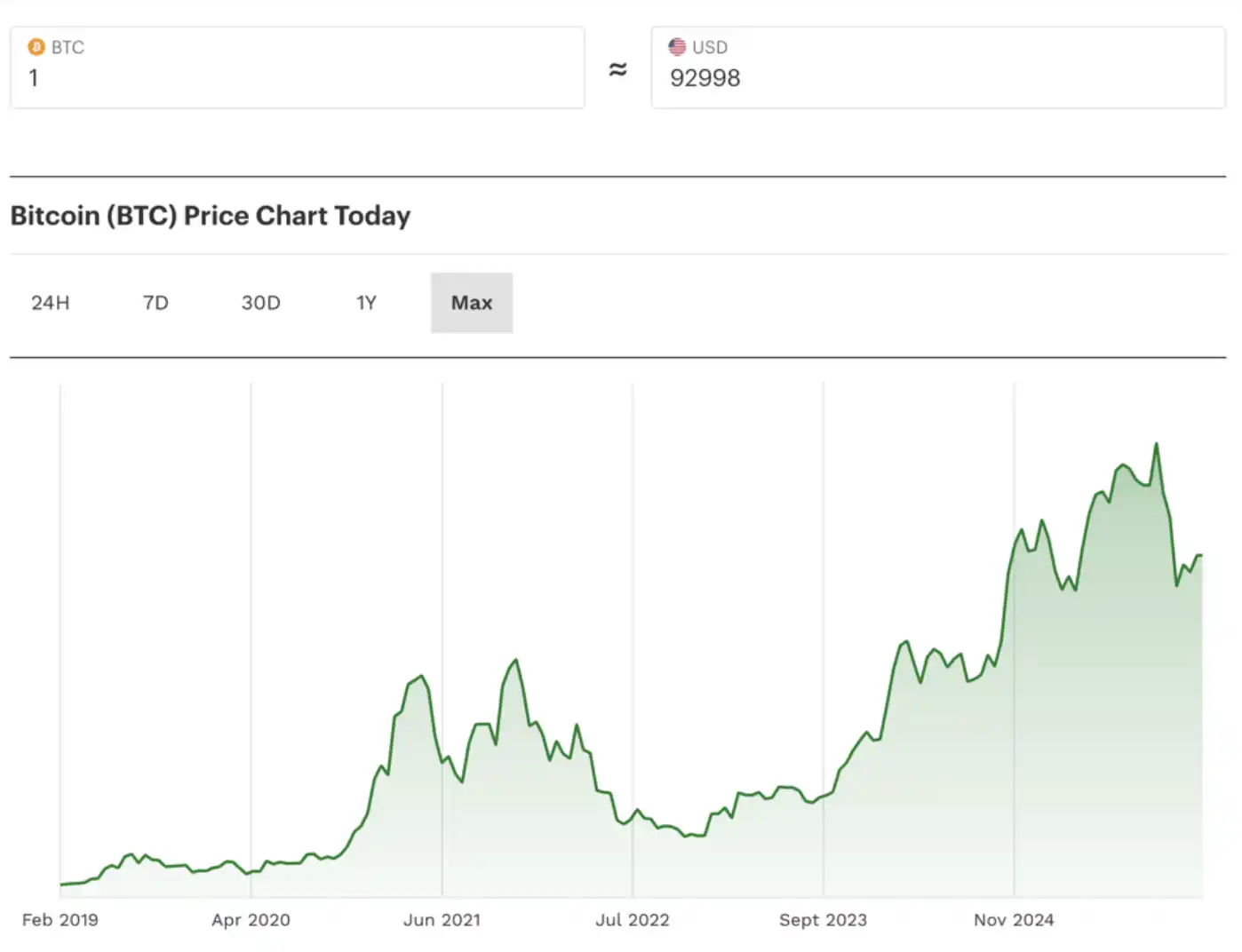
This year's Bitcoin rally has been impacted by the latest round of Trump's trade war. This conflict has not only suppressed the dollar but also boosted gold. Source: Forbes Digital Assets
Trade Nation's Chief Market Analyst David Morrison commented via email, saying, "President Trump's new tariff threat to trade partners and NATO allies over the Greenland issue triggered a dollar sell-off in the markets." He added, "The US Dollar Index plummeted rapidly back below 99.00. Last weekend, the index hit a six-week high."
With the dollar weakening, both gold and silver prices hit all-time highs. David Wilson, Head of Commodity Strategy at BNP Paribas, told Bloomberg that not long ago the market thought reaching $5,000 per ounce for gold was a "big target," but that level is now within reach.
Meanwhile, traders are betting that Bitcoin's weak trend will continue as geopolitical uncertainties suppress risk appetite.
Nic Puckrin, Co-Founder of Coin Bureau and digital asset analyst, commented via email, "From the current standpoint, unless there's buying interest, we are likely to see further declines, with strong support around $88,000. Geopolitical uncertainty and concerns around Greenland are likely to deteriorate in the short term before gradually improving."
You may also like

Bitcoin Trading Guide 2026: Strategies for Experienced Traders

What Is XAUT and PAXG? Why Tokenized Gold Is Booming in 2026

Cryptocurrency CEXs are flocking to sell US stocks, and traditional brokerages are facing an "uninvited guest."

Will the SpaceX IPO Hurt Bitcoin? Here's What Traders Are Watching
Foreign selling in the South Korean stock market accelerates, with cumulative net sales reportedly reaching $75 billion this year
On June 9, The Kobeissi Letter, citing Goldman Sachs data, reported that global investors are selling South Korean stocks at an unusually rapid pace. In the latest trading session, foreign investors sold about $801 million worth of Kospi constituent stocks again; total foreign outflows last week reached about $10 billion, and the market has been in net foreign selling on nearly every trading day over the past month. According to the data cited in the report, foreign investors have sold about $75 billion worth of South Korean stocks so far this year. Meanwhile, South Korean retail and institutional investors together recorded roughly $69 billion in net buying over the same period, suggesting that the market’s main buying support has come from domestic capital rather than returning overseas funds. The information currently disclosed still mainly comes from The Kobeissi Letter’s retelling and Goldman Sachs data summaries, while public details on the statistical period and the specific definition of “selling” remain relatively limited.

Fortune Warns of Strategy’s Financing Structure Risks as Bitcoin Premium Narrows
Fortune warned that Strategy’s Bitcoin treasury model faces growing financing risks as MSTR’s net asset premium narrows and preferred stock dividend pressure increases.

Ferrari Challenge Le Mans: Carl Moon to Dominate in WEEX Livery

Sahara AI Responds to SAHARA’s Sharp Drop: No Contract or Product Security Issues Found, Internal Investigation Underway
Sahara AI responded to SAHARA’s 60% price drop, saying no token contract or product security issues have been found and an internal investigation is underway.

WEEX Deposit/Withdrawal Dynamic Island: Your Asset Status, Always in Sight

Scaling Crypto Derivatives: The Digital Asset Infrastructure Behind High-Volume Trading
In the fast-moving digital asset ecosystem, derivatives platforms face an extreme architectural test. High-leverage futures markets demand more than just standard security—they require absolute operational precision, zero-latency matching engines, and ironclad structural scalability, all while navigating intense market volatility.
As global platforms scale to meet these demands, the industry is shifting away from rigid, monolithic setups toward a more agile, "decoupled" infrastructure philosophy.
The Blueprint for High-Volume Copy TradingFor elite global exchanges like WEEX (founded in 2018), this architectural choice becomes critical when scaling high-volume retail features like social copy trading. When thousands of users automatically mirror the real-time strategies of elite traders simultaneously, it triggers sudden, monumental spikes in concurrent transactional volume.
To prevent execution latency or settlement bottlenecks during these peak volatility events, a platform's primary engine must remain entirely dedicated to risk management, copy-trade synchronization, and order matching.
The Architectural Rule: New-generation platforms must separate front-end user execution engines from heavy backend infrastructural overhead to eliminate operational friction.
By separating these layers, platforms can maintain complete sovereignty over their trading environments and user experiences while strategically aligning with institutional-grade infrastructure ecosystems. This strategic framework allows modern exchanges to leverage advanced Digital Asset Custody infrastructure such as Cobo’s behind the scenes, ensuring that backend wallet management scales elastically alongside trading spikes.
Capitalizing on Market Momentum and 400× LeverageIn a derivatives arena where platforms offer up to 400× leverage on perpetual contracts, capital efficiency and market agility are core business metrics. To capture market momentum, an exchange needs the ability to rapidly expand its asset offerings, supporting everything from legacy crypto assets to sudden, trending altcoins across a massive library of trading pairs.
Adopting a flexible, scalable Wallet-as-a-Service (WaaS) solution such as Cobo’s could completely rewrite the development timeline for high-growth exchanges. Instead of spending months of engineering capital building out custom backend wallet architectures for every new blockchain network, platforms can deploy localized infrastructure in days.
This agility allows platforms to instantly scale their listings to over a thousand trading pairs without compromising security or delaying time-to-market. It mirrors the exact operational advantages seen during high-velocity market events, similar to how advanced wallet infrastructure empowers platforms during sudden asset surges; allowing exchanges to pass that speed and liquidity directly to their global user base.
A Mature Foundation for GrowthThe synergy between trusted infrastructure ecosystems and global trading platforms represents the natural evolution of a maturing crypto market. As WEEX continues to scale its global spot and derivatives offerings for over 6 million users, adopting robust backend paradigms proves that platforms no longer have to compromise between cutting-edge trading velocity and uncompromised structural security.

Morning Report | BitMine increased its holdings by 126,971 ETH last week; trader Eugene announced his exit from the crypto market

Wang Chuan: How can one not feel anxious after the neighbor Old Wang made thirty times profit by investing in storage stocks? (Seven) - A quarter-century cycle

Get Paid to Onboard? Try WEEX’s New Homepage with Rewards for Registration, Deposit & Trade

WEEX Custom Layout: Build Your Perfect Trading Workspace in Seconds

See “Buy Walls” & “Sell Walls” Instantly: WEEX Launches the Depth Chart for Smarter Trades

What Is Quick Trade on WEEX? 2 Ways WEEX Ends Chart-Panel Jumping
Morning News | Five major virtual asset platforms in South Korea have experienced 57 incidents of hacking and system failures in six years; Grayscale submits registration application for Canton ETF
Should we escape the peak? The principle of the tail-end market in the stock market
Bitcoin Trading Guide 2026: Strategies for Experienced Traders
What Is XAUT and PAXG? Why Tokenized Gold Is Booming in 2026
Cryptocurrency CEXs are flocking to sell US stocks, and traditional brokerages are facing an "uninvited guest."
Will the SpaceX IPO Hurt Bitcoin? Here's What Traders Are Watching
Foreign selling in the South Korean stock market accelerates, with cumulative net sales reportedly reaching $75 billion this year
On June 9, The Kobeissi Letter, citing Goldman Sachs data, reported that global investors are selling South Korean stocks at an unusually rapid pace. In the latest trading session, foreign investors sold about $801 million worth of Kospi constituent stocks again; total foreign outflows last week reached about $10 billion, and the market has been in net foreign selling on nearly every trading day over the past month. According to the data cited in the report, foreign investors have sold about $75 billion worth of South Korean stocks so far this year. Meanwhile, South Korean retail and institutional investors together recorded roughly $69 billion in net buying over the same period, suggesting that the market’s main buying support has come from domestic capital rather than returning overseas funds. The information currently disclosed still mainly comes from The Kobeissi Letter’s retelling and Goldman Sachs data summaries, while public details on the statistical period and the specific definition of “selling” remain relatively limited.
Fortune Warns of Strategy’s Financing Structure Risks as Bitcoin Premium Narrows
Fortune warned that Strategy’s Bitcoin treasury model faces growing financing risks as MSTR’s net asset premium narrows and preferred stock dividend pressure increases.


