
Bitwise Chief Investment Officer: The Long Night Has Entered Its Deepest Hour, the Flicker of Light for the Crypto Market Is Just Ahead




Original Title: The Depths of Crypto Winter
Original Author: Matt Hougan, Chief Investment Officer at Bitwise
Translation: Chopper, Foresight News
The bad news is: We've been in a crypto winter since January 2025. The good news is: We are likely closer to the end of the winter than we are to the beginning.
I want to state the obvious because I believe it can help you make informed decisions in the months ahead: We are in the midst of a full-blown crypto winter.
I find it surprising that few people online and in the mainstream media are talking about this, but it is an undeniable fact. Bitcoin is down 39% from its all-time high in October 2025, Ethereum is down 53%, and many other crypto assets have seen even more significant declines.
It is important to recognize its nature. This is not a bull market correction or a brief dip. This is a full-blown, reminiscent of 2022, brutal winter, akin to what Leonardo DiCaprio's character endured in "The Revenant," with causes ranging from excessive leverage to early players taking massive profits and more.
For me, acknowledging and accepting this fact has brought clarity to everything.
Why is the crypto price falling despite continued positive news in areas like adoption and regulation? Because we are in the deep waters of crypto winter. Why is the new Fed Chair a Bitcoin supporter while the Crypto Fear and Greed Index is in the fear zone at historic highs? Because we are in the crypto winter.
Those who lived through the crypto winters of 2018 or 2022 will remember that deep in the winter, positive news is meaningless. We will not see a rebound because Wall Street is hiring massively or Morgan Stanley is doubling down on crypto. These things matter in the long run, but not right now. Crypto winter will not end in euphoria; it will end in exhaustion.
So when will the winter end? The good news is: I believe we are nearing the finish line.
Historical Patterns of Crypto Winter
Crypto winters typically last around 13 months. For example, Bitcoin peaked in December 2017 and bottomed in December 2018; it peaked again in October 2021 and bottomed in November 2022.
Based on this cycle projection, we still have a challenging period ahead of us. After all, Bitcoin peaked in October 2025, are we supposed to wait until November 2026? I don't think so.
Upon further analysis of the current winter, I increasingly realize that it actually began in January 2025. The reason we didn't see it is because the inflow of funds from ETFs and Digital Asset Treasury (DAT) companies obscured the truth.
ETF and DAT Fund Flows Masked the Winter of 2025
Take a close look at this chart showing the performance of the Bitwise Top 10 Large-Cap Crypto Index constituents since January 1, 2025.
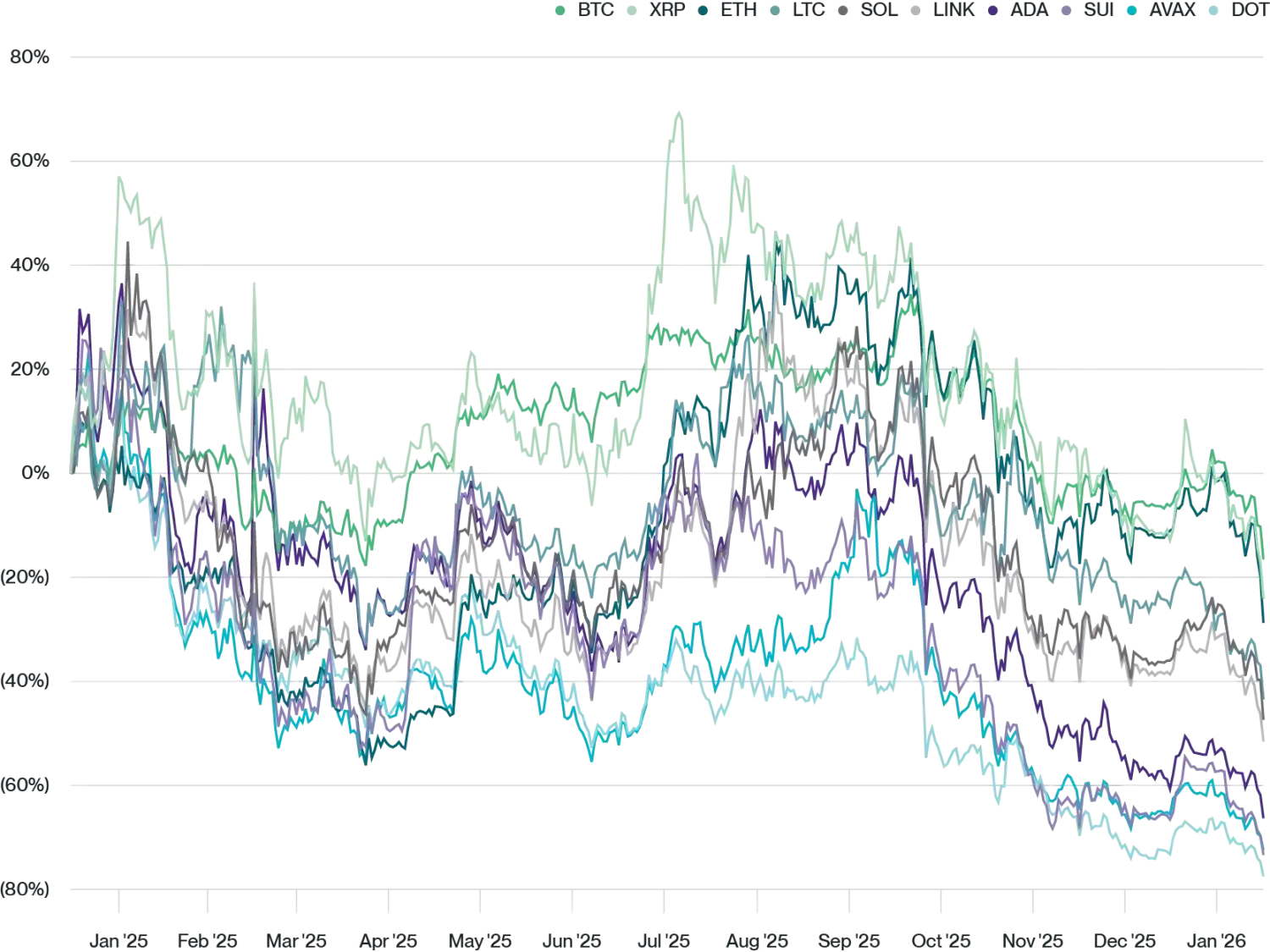
Year-to-date performance of the Bitwise Top 10 Large-Cap Crypto Index constituents. Data Source: Bitwise Asset Management
They are clearly divided into three categories:
· The first category of assets (BTC, ETH, XRP) performed reasonably well, decreasing by 10.3% to 19.9%
· The second category of assets (SOL, LTC, LINK) went through a typical bear market, falling by 36.9% to 46.2%
· The third category of assets (ADA, AVAX, SUI, DOT) were heavily sold off, dropping by 61.9% to 74.7%
The core difference between these three categories of assets lies in whether institutions had channels to invest in them. The first category of assets received massive ETF/DAT funding throughout the year; the second category of assets received ETF approval in 2025; the third category of assets never did. (Note: XRP is an exception, as it did not have an ETF in early 2025 but performed well. This may be because XRP was facing a life-or-death lawsuit from the U.S. SEC in early 2025, which was dropped in early 2025, leading to a sharp rebound in the asset.)
The scale of institutional funding support is astonishing. For example, during the period shown in the chart, ETFs and DAT accumulated purchases of 744,417 Bitcoins, worth around $75 billion. Just imagine, without this $75 billion floor, where would Bitcoin have dropped to? I guess it would have fallen by about 60%.
The retail market has been in a brutal winter since January 2025. It's just that institutional funds once masked this fact for some assets.
The Darkest Hour Is Just Before Dawn
What we need to remember right now is that there are plenty of real-world positives in the crypto space. Regulatory progress is real, institutional adoption is real, stablecoins and asset tokenization are real, and Wall Street's embrace is real.
In a bear market, positives may be overlooked but they don't disappear. They are stored up as potential energy. Once the storm clouds clear and market sentiment normalizes, this stored energy will be unleashed in a retaliatory manner. What can clear the storm clouds? Robust economic growth triggering a broad-based risk asset rally, positive signals from the Clarity Act, signs of sovereign nations adopting Bitcoin, or simply the passage of time.
As a veteran of multiple crypto winters, I can tell you that the feeling before the end of a winter is very similar to now: despair, helplessness, gloom. But the current market retreat has not changed the fundamentals of the crypto market at all.
I believe we will bounce back faster and stronger. After all, the winter started in January 2025. Spring is surely not far away.
You may also like

The large models in the United States are moving towards closure in the name of security

Morning Report | CoinEx becomes a key hub for Iran to evade sanctions, involving over $3.8 billion in funds; Kalshi seeks a new round of financing, with a valuation potentially rising to $40 billion

From the white-haired stock god to the billionaire fund mogul, the smart people shorting Nvidia are all getting rich using the same framework

Why do cryptocurrency projects always like to change their names?

Global Launch: As predictions become the most scarce asset in the AI era, Manadia is defining the next generation of the value internet

Who is footing the bill for the $64 billion accounting frenzy?
I never expected that the first application of AI x Crypto would be in security auditing

What is your view on Binance's competitive advantages?

ETH has entered a non-consensus phase, and the turning point is approaching!
The shift in the cloud of the air: from despising stablecoins a year ago to the high-profile entry of capital today
The survival dilemma of small and medium exchanges behind the withdrawal anomalies exposed by AscendEX

Why Is Bitcoin Falling Below $60K? 5 Key Market Drivers Explained
Bitcoin has dropped sharply amid ETF outflows, Strategy stock weakness, AI stock rallies, and changing Fed expectations. Explore the key forces driving BTC’s latest correction and what traders should watch next.

Bitcoin vs. Gold in 2026: Which Asset Performs Better in Different Markets?

Morning News | The draft amendment to the People's Bank of China Law aims to clarify the legal status of digital renminbi; South Korea will transfer about 40 unregistered virtual asset service providers to law enforcement agencies
The cryptocurrency industry has entered the "Show Me" era: merely relying on vision is no longer enough

Interpreting the Ethereum Foundation's new structure: Reaffirming self-sovereignty amid institutional trends
Former SpaceX engineer reconstructs the financial execution system using first principles
Standard Chartered Bank sings a 50x rhapsody again, aiming for AAVE to reach 3500 USD
The large models in the United States are moving towards closure in the name of security
Morning Report | CoinEx becomes a key hub for Iran to evade sanctions, involving over $3.8 billion in funds; Kalshi seeks a new round of financing, with a valuation potentially rising to $40 billion
From the white-haired stock god to the billionaire fund mogul, the smart people shorting Nvidia are all getting rich using the same framework
Why do cryptocurrency projects always like to change their names?
Global Launch: As predictions become the most scarce asset in the AI era, Manadia is defining the next generation of the value internet
Who is footing the bill for the $64 billion accounting frenzy?


