
Delphi Digital's Top 10 Predictions for 2026: Perp DEX Eats Wall Street, AI Agents Usher in Era of Autonomous Trading

Original Title: 10 Predictions for 2026
Original Source: Delphi Digital
Original Translation: Plain Blockchain
Perpetual Decentralized Exchange (Perp DEXs) will become the new Wall Street, AI Agents will achieve autonomous trading, and trading platforms will evolve into "super apps." Here are the core predictions from the report:
1. AI Agents Begin Autonomous Trading
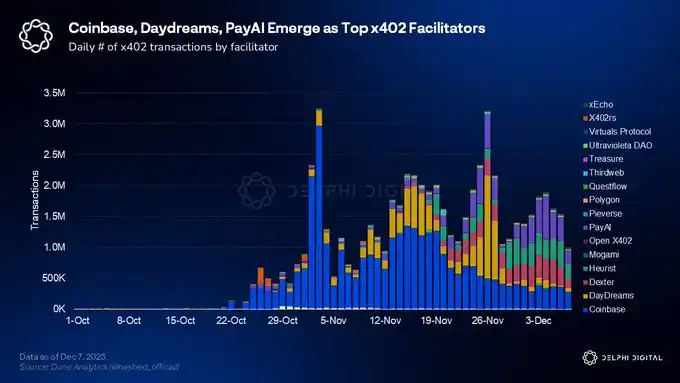
The x402 protocol allows any API to set access permissions through cryptocurrency payments. When an AI Agent needs a service, it can make instant payments with stablecoins, consume a shopping cart, or subscribe. The ERC-8004 standard increases trust by establishing reputation (including performance history and staking collateral). The combination of these two forms the autonomous agent economy. Users can delegate travel plans, and the AI Agent will automatically subcontract to miner search agents, complete data fees through x402 payments, and book on-chain tickets, all without human intervention.
2. Perp DEXs Swallow Traditional Finance
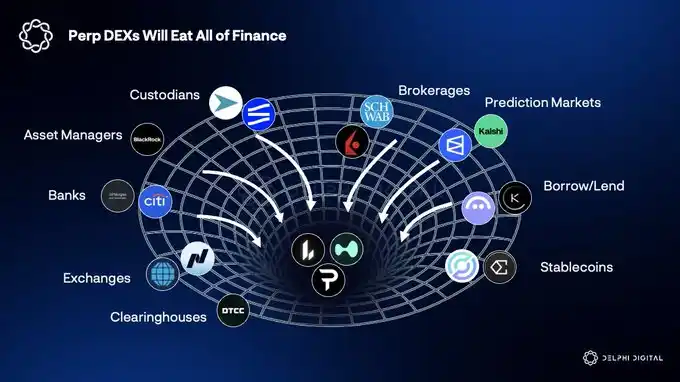
Traditional finance is expensive due to fragmentation: trading on exchanges, settling in New York, and custody in banks. Blockchain will compress all of this into a single smart contract. Hyperliquid is currently building the restructuring feature. Perp DEXs may simultaneously act as a merchant, exchange, custodian, bank, and Manhattan Exchange. Dockyards such as Aster_DEX, Lighter_xyz, and paradex are rapidly catching up.
3. Prediction Markets Upgrade to Traditional Financial Infrastructure

Interactive Brokers (IBKR) Chairman Thomas Peterffy sees prediction markets as a real-time information layer for portfolios. Early demand focused on weather consistency in energy, logistics, and insurance risks. 2026 will usher in new categories: stock event markets for financial performance, macro value indicator markets like CPI and Fed decisions, and cross-asset relative markets. Traders holding Tokenized Apple (AAPL) stock can hedge earnings risks with simple binary contracts or engage in complex options. Prediction markets will become tier-one derivatives.
4. Ecosystem Recaptures Stablecoin Issuer Revenue
Last year, Coinbase alone earned over $900 million in USDC reserve revenue through the issuance channel. Public blockchains like Solana, BSC, and Arbitrum generate approximately $800 million in total annual fees, yet have over $30 billion of idle USDC and USDT locked up on their networks. This trend is shifting. Hyperliquid secured USDH reserve revenue through bidding. Ethena's "Stablecoin Instant Service" model is being adopted by Sui, MegaETH, and Jupiter. The specific flow of lost revenue back to the issuer is being reclaimed by platforms creating demand.
5. DeFi Cracks Undercollateralized Borrowing

While DeFi borrowing protocols have massive Total Value Locked (TVL), almost all require overcollateralization. zkTLS (Zero-Knowledge Transport Layer Security) is the breakthrough: users can prove they have sufficient bank balance without revealing identity accounts. 3jane offers instant USDC undercollateralized credit based on verified Web2 financial data and dynamically adjusts interest rates through real-time monitoring. This framework can also provide direct funding based on AI agent performance history (credit score). Maple Finance, Centrifuge, and USDai have been at the forefront in this area. 2026 will be the year undercollateralized debt shifts from experiments to infrastructure.
6. Onchain FX Seeks Product-Market Fit
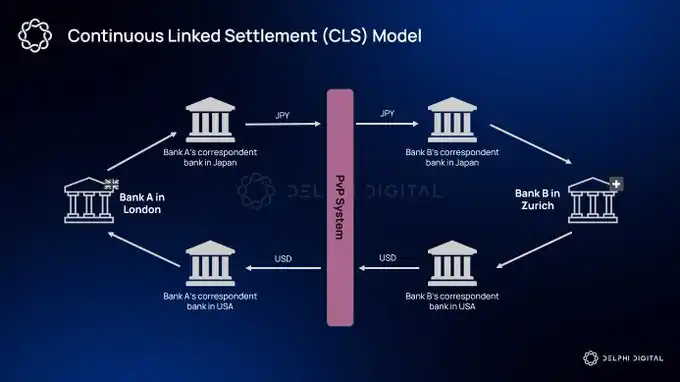
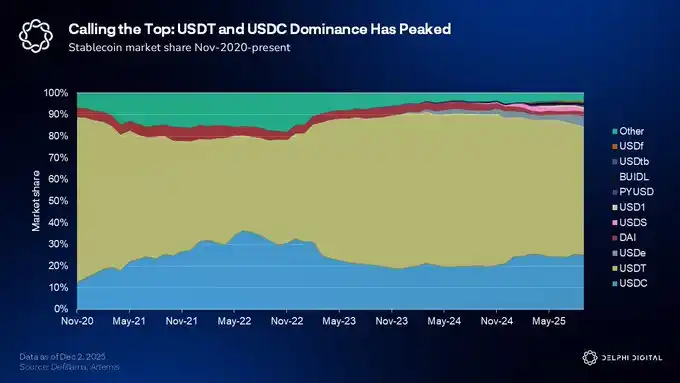
USD stablecoins represent 99.7% of the supply, but this may be the peak of their dominance. The traditional forex market is massive but riddled with frictions, leading to low settlement efficiency. Onchain FX eliminates intermediaries by tokenizing all currencies as on-chain assets, paving the way for emerging market currency pairs to thrive, as traditional forex there is most expensive and inefficient. These overlooked areas are where cryptocurrency demonstrates its most significant value proposition.
7. Gold and Bitcoin Lead the Currency Debasement Trade
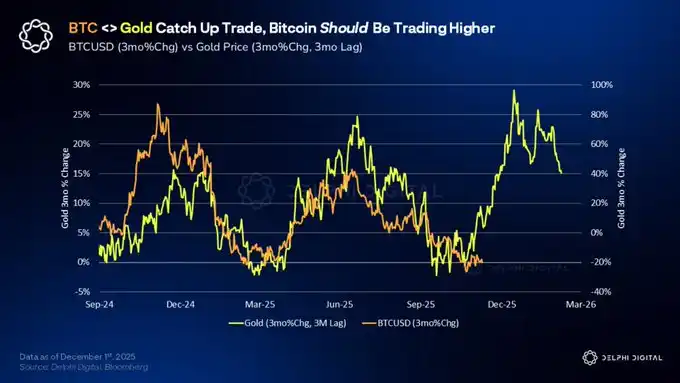
Gold, after being bullish, surged by 60%. Despite gold hitting an all-time high, central banks around the world still bought over 600 tons. The macro background supports continued strength: global interest rate cuts, ongoing fiscal deficits, and global M2 hitting an all-time high. Gold usually outperforms Bitcoin by three to four months. With devaluation becoming a key theme around 2026, both gold and Bitcoin will attract safe haven inflows.
8. Trading Platforms Evolve into "Super Apps" (Everything Apps)
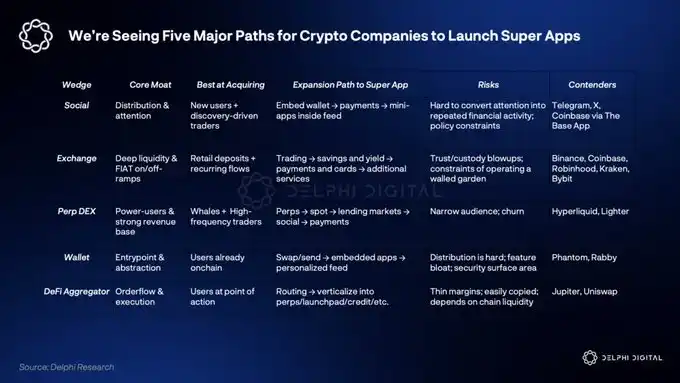
Coinbase, Robinhood, Binance, and Kraken no longer function solely as trading platforms. Coinbase acts as the platform, Base App as the interface, and USDC provides revenue supplementation. Robinhood's Gold members grew by 77%, becoming a retention engine. Binance has over 270 million users, with a payment volume of $250 billion. As the cost of decentralization decreases, platforms with users will gain the most value. In 2026, winners will start to pull away.
9. Privacy Infrastructure Catching Up with Market Demand
Privacy is under immense pressure: the EU passed the "Chat Control Act," and cash transactions are limited to €10,000. Privacy infrastructure is on the rise. payy_link launches a private encryption card, SeismicSys offers protocol-level encryption for fintech, and KeetaNetwork achieves anonymous KYC. If there is no public payment track, stablecoin adoption will reach mass awareness.
10. Altcoins Embrace Decentralization (Non-Uniform Rise)
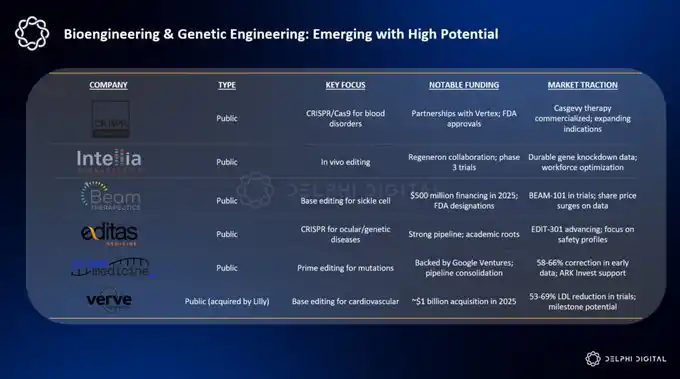
The "uniform rise" bull market will not return. Over $30 billion in token unlocks are pausing at the top and facing competition from AI, robotics, and biotech funding. Capital will flock to structural demand: tokens with ETF inflows, protocols with real income and buybacks, and applications with clear product-market fit. Winners will focus on teams that have built moats in real economic activities.
Conclusion
Cryptocurrency is entering a new phase: institutionalization has arrived. Prediction markets, on-chain lending, agent-based economics, and stablecoin infrastructure represent a true paradigm shift. Cryptocurrency is becoming the infrastructure layer of the global financial system.
You may also like

What you bought on CEX is really not US stocks: Analyzing the 94% liquidation monopoly and the evaporation of equity under a five-layer pipeline
In such a crowded cross-border payment arena, where is the next stop for the future?
Why Is Bitcoin Down in 2026? What We Can Learn From 2022
The large models in the United States are moving towards closure in the name of security
From the white-haired stock god to the billionaire fund mogul, the smart people shorting Nvidia are all getting rich using the same framework
Morning Report | CoinEx becomes a key hub for Iran to evade sanctions, involving over $3.8 billion in funds; Kalshi seeks a new round of financing, with a valuation potentially rising to $40 billion
Global Launch: As predictions become the most scarce asset in the AI era, Manadia is defining the next generation of the value internet
Why do cryptocurrency projects always like to change their names?
Who is footing the bill for the $64 billion accounting frenzy?
I never expected that the first application of AI x Crypto would be in security auditing
What is your view on Binance's competitive advantages?
ETH has entered a non-consensus phase, and the turning point is approaching!
The shift in the cloud of the air: from despising stablecoins a year ago to the high-profile entry of capital today
The survival dilemma of small and medium exchanges behind the withdrawal anomalies exposed by AscendEX
Why Is Bitcoin Falling Below $60K? 5 Key Market Drivers Explained
Bitcoin has dropped sharply amid ETF outflows, Strategy stock weakness, AI stock rallies, and changing Fed expectations. Explore the key forces driving BTC’s latest correction and what traders should watch next.
Bitcoin vs. Gold in 2026: Which Asset Performs Better in Different Markets?
The cryptocurrency industry has entered the "Show Me" era: merely relying on vision is no longer enough
Morning News | The draft amendment to the People's Bank of China Law aims to clarify the legal status of digital renminbi; South Korea will transfer about 40 unregistered virtual asset service providers to law enforcement agencies
What you bought on CEX is really not US stocks: Analyzing the 94% liquidation monopoly and the evaporation of equity under a five-layer pipeline
In such a crowded cross-border payment arena, where is the next stop for the future?
Why Is Bitcoin Down in 2026? What We Can Learn From 2022
The large models in the United States are moving towards closure in the name of security
From the white-haired stock god to the billionaire fund mogul, the smart people shorting Nvidia are all getting rich using the same framework
Morning Report | CoinEx becomes a key hub for Iran to evade sanctions, involving over $3.8 billion in funds; Kalshi seeks a new round of financing, with a valuation potentially rising to $40 billion


