
Final Federal Reserve Chair Candidate Rick Rieder, How Does He View Cryptocurrency?


Original Title: "The Last Seat in the List of Federal Reserve Chair Candidates, What Is Rick Rieder's Stance on Crypto?"
Original Author: CryptoLeo, Odaily Planet Daily
The full list of Federal Reserve Chair candidates was finalized yesterday. Yesterday, Trump stated that he will interview Rick Rieder, BlackRock's Global Chief Investment Officer, on Thursday to consider him as a potential candidate for the next Federal Reserve Chair. This will be the fourth and final interview of candidates to succeed the current Federal Reserve Chair, Powell. In addition to Rieder, the final shortlist also includes former Federal Reserve Governor Kevin Warsh, National Economic Council Director Kevin Hassett, and Federal Reserve Governor Christopher Waller. Trump stated that he will make the final decision in January.
Among the four candidates, everyone should be relatively familiar with Rieder except for Rieder. Odaily has previously written articles about other candidates. Today, we will introduce this potential Federal Reserve Chair candidate.
The "Old BlackRock Man" Deeply Involved in Fixed Income
Born in October 1961, according to LinkedIn data, Rieder attended Emory University and the University of Pennsylvania's Wharton School, graduating with a Bachelor of Business Administration (BBA) in Finance from Emory University in 1983, and an MBA from Wharton School in 1987.
After graduating, Rieder worked at Lehman Brothers for 20 years from 1987 to 2008, holding executive positions such as Head of Global Credit Business at Lehman Brothers and Head of the Global Principal Strategies Team.
After Lehman Brothers' bankruptcy in 2008, Rieder started his own venture, founding R3 Capital (mainly focused on multi-strategy credit investing) and serving as its CEO. The firm was acquired by BlackRock in 2009. In other words, Rick Rieder brought his entrepreneurial firm to BlackRock, where he became a Managing Director and led the Fixed Income Alternatives Portfolio Team.
Today, Rieder has been with BlackRock for 17 years, holding positions such as BlackRock's Global Chief Investment Officer for Fixed Income, Head of Basic Fixed Income Business, and Head of Global Allocation Investment Team. Rieder is responsible for managing trillions of dollars in assets and is a member of BlackRock's Global Executive Committee (GEC) and its GEC Investment Subcommittee. He also serves as Chairman of the BlackRock Investment Committee at the company level. He is currently a member of the Alphabet/Google Investment Advisory Committee and the UBS Research Advisory Board.
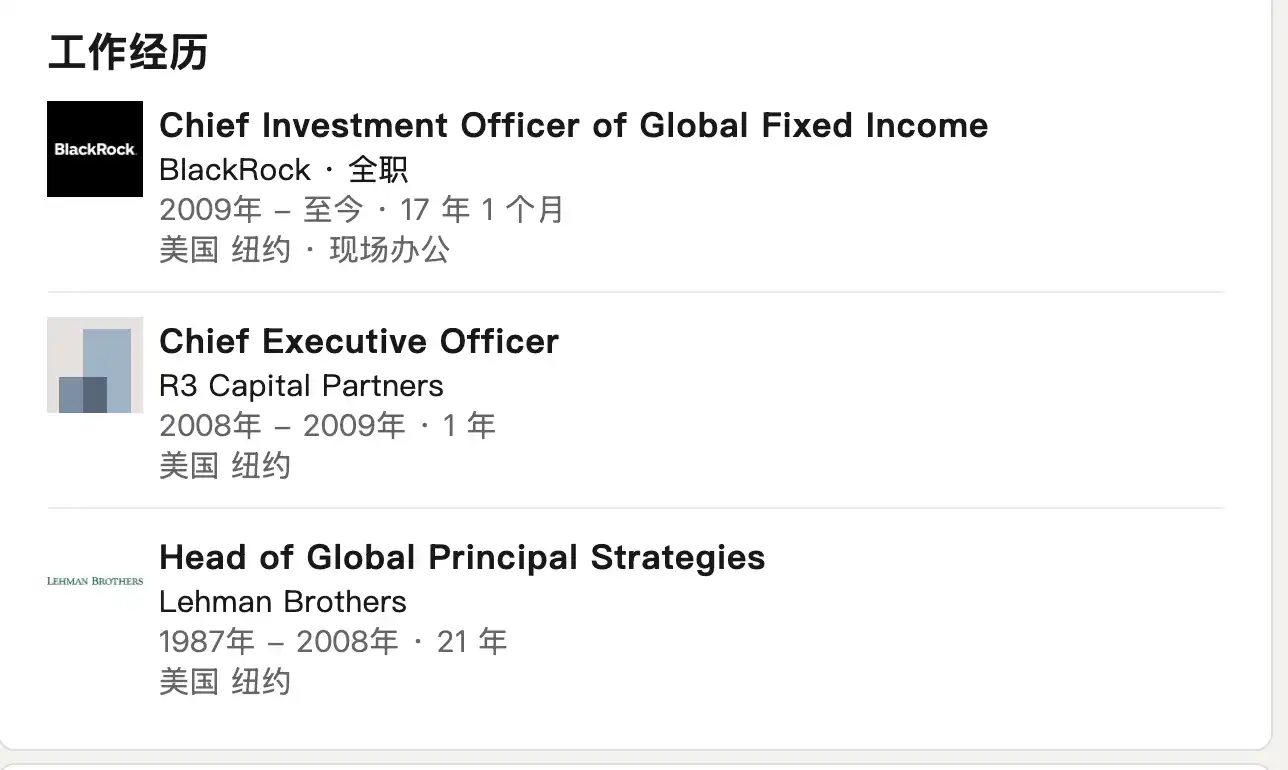
It is worth noting that Rieder has also served as the Vice Chairman of the U.S. Treasury Borrowing Advisory Committee and as a member of the Federal Reserve Bank of New York's Financial Markets Advisory Committee.
Differences Between Rieder and Other Candidates
Compared to the other three candidates, Rieder does not have as much experience in U.S. government-related roles. However, when it comes to the crypto industry, the point worth noting is: Rieder is a staunch proponent of crypto. Over the past few years, Rieder has repeatedly expressed positive views on cryptocurrencies (especially Bitcoin) in public, transitioning from an early cautious stance to recognizing Bitcoin as a durable asset and a valuable investment. Here are some of his public statements on crypto:
November 2020: Rieder made comments on CNBC stating that digital payment systems are a reality, and cryptocurrencies will also exist in the long term. The mechanism of Bitcoin is durable, more functional, and more traceable, and to a large extent, it can replace gold, especially as the millennial generation has a high acceptance of digital payments.
2021: In an interview with CNBC, Rieder stated that Bitcoin is a durable asset and will become a long-term part of the investment space. BlackRock has started to "dabble" in it. Although Bitcoin faces challenges such as high volatility and regulation, these will be overcome over time.
In addition, Rieder also mentioned that he personally holds Bitcoin, but did not disclose his holdings. He believes that Bitcoin will see a significant increase in value in the future and that holding Bitcoin as a speculative tool is cost-effective.
2022: In an interview with Yahoo Finance, Rieder likened the crypto market crash to the early days of the internet. Rieder still believes that Bitcoin and cryptocurrency are durable assets, but there was just too much speculative investment around it. The crash was just a realignment for the industry, eliminating some excessive leverage, and he remains optimistic in the long run, saying, "Just give it 2 to 3 years, and the crypto market will be higher than today."
September 2025: In an interview with CNBC, Rieder stated that an ideal investment portfolio should hold "hard assets" such as gold and Bitcoin to hedge against fiat devaluation. Rieder mentioned that BlackRock has a gold allocation of 3-5%, but the investment in cryptocurrency is "much lower than this." He believes that Bitcoin will rise, but a 5% investment allocation seems too high.
From the changes in his public statements, it can be seen that from Rieder's investment professional perspective, he is optimistic about Bitcoin, affirming Bitcoin's long-term value, and holding Bitcoin as an institution is also a very good investment method.
The Impact of Rieder's Election on Crypto
Between 2020 and 2025, Rieder has repeatedly evaluated Bitcoin from the perspectives of institutional portfolio, macro hedging (such as against inflation, fiat devaluation), and liquidity. Recently, after being listed as a Federal Reserve Chair candidate, his statements are worth revisiting. Compared to several other candidates, Rieder is an absolute proponent of crypto. If elected as the Federal Reserve Chair, it will indirectly bring many benefits to the crypto industry:
1. Macro Policy, Advocating for a Significant Rate Cut
In recent months, Rieder has consistently expressed the desire for interest rates to fall to 3%, which means a reduction of at least 50 basis points from the current level. Rieder stated, "For many months now, my attitude has been very clear. The Fed must cut rates, and I don't think it needs to cut by too much, ultimately landing at 3%—which is closer to the neutral rate."
In addition, Rieder also stated that regardless of who takes on the Federal Reserve Chair position, the entire Federal Open Market Committee (FOMC) will make decisions based on economic data assessment.
2. Professional Perspective, More Institutional Participation
As BlackRock's Global Chief Investment Officer for Fixed Income, Rieder started leading and promoting BlackRock's allocation to Bitcoin futures as early as 2021, and the subsequent launch of IBIT was also very successful. Rieder's investment track record is publicly available. If elected as the Federal Reserve Chair, his pro-crypto stance will attract more institutional investors.
3. Personal Perspective, Bullish on Crypto and Driving Development
Although Rieder has not publicly disclosed his Bitcoin holdings, the development from early Bitcoin futures at BlackRock to crypto ETFs shows that Rieder is not just talking. He is very bullish on the long-term value of Bitcoin, emphasizing Bitcoin's "upside convexity," which can amplify crypto returns in a loose environment.
Moreover, as a professional fixed income analyst, Rieder seeks returns in high-yield/volatile environments, which are areas where the crypto market can excel. There is a high probability that he will promote asset tokenization in the crypto industry, stablecoins, and DeFi development.
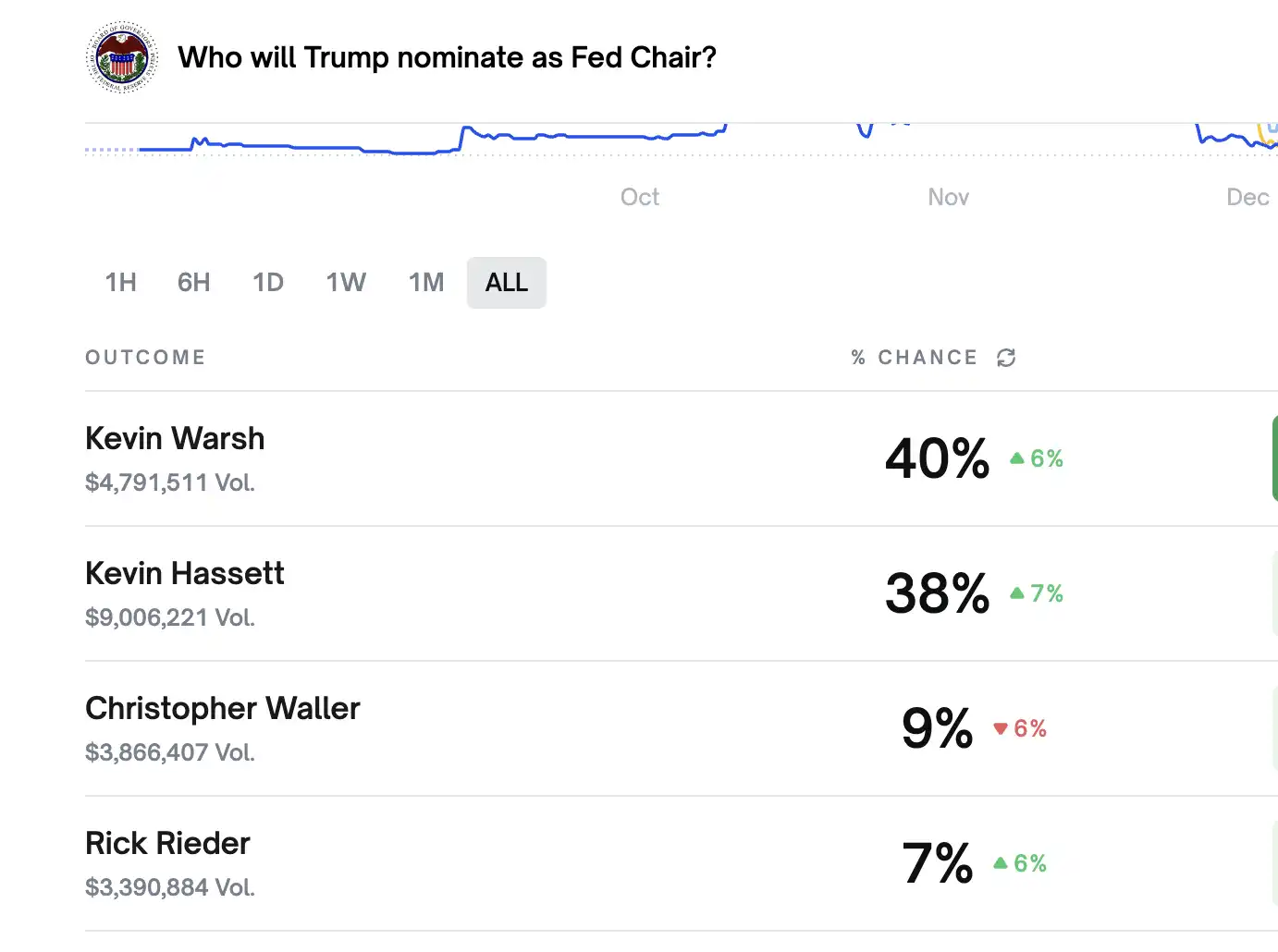
As of the time of writing, Polymarket data shows that the probability of Kevin Warsh being elected Chair of the Federal Reserve is currently at 40% (up 6%), Kevin Hassett at 38% (up 7%), Christopher Waller at 9% (down 9%), and Rick Rieder has the lowest probability of being elected Chair of the Federal Reserve, currently at 7% (up 6%). Although his chances are relatively lower compared to Warsh and Hassett, at least a 6-point increase has been observed, positioning Waller to be swiftly removed from the race.
Furthermore, if the individual chosen by Trump is currently not a member of the Federal Reserve Board of Governors, that person must first join the Board of Governors. For Rieder, if he were to become Chair, he would also need Trump's nomination + Senate confirmation to become a member of the Federal Reserve Board of Governors — a process that could take several months before becoming Chair of the Federal Reserve.
Specifically, the outcome will depend on the situation after their meeting with Trump and Bassett on Thursday. Odaily will promptly follow up on related developments, and everyone can also closely monitor the data changes in the corresponding contracts on Polymarket.
You may also like

Japan’s Three Megabanks Plan Joint Stablecoin Issuance in Fiscal 2026
MUFG, SMBC, and Mizuho reportedly plan to jointly issue fiat-pegged stablecoins in fiscal 2026, signaling Japan’s growing push into bank-led digital payment infrastructure.

Humanity Discloses H Token Dual-Chain Attack Details, With Losses on Ethereum and BSC Exceeding $36 Million
Humanity said the H token attack across Ethereum and BSC caused more than $36 million in losses after leaked ProxyAdmin keys enabled malicious contract upgrades and token minting.

White House Discusses CLARITY Act With Law Enforcement Ahead of Senate Vote
The White House discussed the CLARITY Act with law enforcement ahead of a Senate vote, focusing on illicit finance risks and developer protections.

$75 billion in foreign capital has fled, and South Korean retail investors have absorbed it all using leverage

Bitcoin Trading Guide 2026: Strategies for Experienced Traders

What Is XAUT and PAXG? Why Tokenized Gold Is Booming in 2026

Cryptocurrency CEXs are flocking to sell US stocks, and traditional brokerages are facing an "uninvited guest."

Will the SpaceX IPO Hurt Bitcoin? Here's What Traders Are Watching
Foreign selling in the South Korean stock market accelerates, with cumulative net sales reportedly reaching $75 billion this year
On June 9, The Kobeissi Letter, citing Goldman Sachs data, reported that global investors are selling South Korean stocks at an unusually rapid pace. In the latest trading session, foreign investors sold about $801 million worth of Kospi constituent stocks again; total foreign outflows last week reached about $10 billion, and the market has been in net foreign selling on nearly every trading day over the past month. According to the data cited in the report, foreign investors have sold about $75 billion worth of South Korean stocks so far this year. Meanwhile, South Korean retail and institutional investors together recorded roughly $69 billion in net buying over the same period, suggesting that the market’s main buying support has come from domestic capital rather than returning overseas funds. The information currently disclosed still mainly comes from The Kobeissi Letter’s retelling and Goldman Sachs data summaries, while public details on the statistical period and the specific definition of “selling” remain relatively limited.

Fortune Warns of Strategy’s Financing Structure Risks as Bitcoin Premium Narrows
Fortune warned that Strategy’s Bitcoin treasury model faces growing financing risks as MSTR’s net asset premium narrows and preferred stock dividend pressure increases.

Ferrari Challenge Le Mans: Carl Moon to Dominate in WEEX Livery

Sahara AI Responds to SAHARA’s Sharp Drop: No Contract or Product Security Issues Found, Internal Investigation Underway
Sahara AI responded to SAHARA’s 60% price drop, saying no token contract or product security issues have been found and an internal investigation is underway.

WEEX Deposit/Withdrawal Dynamic Island: Your Asset Status, Always in Sight
Scaling Crypto Derivatives: The Digital Asset Infrastructure Behind High-Volume Trading
In the fast-moving digital asset ecosystem, derivatives platforms face an extreme architectural test. High-leverage futures markets demand more than just standard security—they require absolute operational precision, zero-latency matching engines, and ironclad structural scalability, all while navigating intense market volatility.
As global platforms scale to meet these demands, the industry is shifting away from rigid, monolithic setups toward a more agile, "decoupled" infrastructure philosophy.
The Blueprint for High-Volume Copy TradingFor elite global exchanges like WEEX (founded in 2018), this architectural choice becomes critical when scaling high-volume retail features like social copy trading. When thousands of users automatically mirror the real-time strategies of elite traders simultaneously, it triggers sudden, monumental spikes in concurrent transactional volume.
To prevent execution latency or settlement bottlenecks during these peak volatility events, a platform's primary engine must remain entirely dedicated to risk management, copy-trade synchronization, and order matching.
The Architectural Rule: New-generation platforms must separate front-end user execution engines from heavy backend infrastructural overhead to eliminate operational friction.
By separating these layers, platforms can maintain complete sovereignty over their trading environments and user experiences while strategically aligning with institutional-grade infrastructure ecosystems. This strategic framework allows modern exchanges to leverage advanced Digital Asset Custody infrastructure such as Cobo’s behind the scenes, ensuring that backend wallet management scales elastically alongside trading spikes.
Capitalizing on Market Momentum and 400× LeverageIn a derivatives arena where platforms offer up to 400× leverage on perpetual contracts, capital efficiency and market agility are core business metrics. To capture market momentum, an exchange needs the ability to rapidly expand its asset offerings, supporting everything from legacy crypto assets to sudden, trending altcoins across a massive library of trading pairs.
Adopting a flexible, scalable Wallet-as-a-Service (WaaS) solution such as Cobo’s could completely rewrite the development timeline for high-growth exchanges. Instead of spending months of engineering capital building out custom backend wallet architectures for every new blockchain network, platforms can deploy localized infrastructure in days.
This agility allows platforms to instantly scale their listings to over a thousand trading pairs without compromising security or delaying time-to-market. It mirrors the exact operational advantages seen during high-velocity market events, similar to how advanced wallet infrastructure empowers platforms during sudden asset surges; allowing exchanges to pass that speed and liquidity directly to their global user base.
A Mature Foundation for GrowthThe synergy between trusted infrastructure ecosystems and global trading platforms represents the natural evolution of a maturing crypto market. As WEEX continues to scale its global spot and derivatives offerings for over 6 million users, adopting robust backend paradigms proves that platforms no longer have to compromise between cutting-edge trading velocity and uncompromised structural security.

Morning Report | BitMine increased its holdings by 126,971 ETH last week; trader Eugene announced his exit from the crypto market

Wang Chuan: How can one not feel anxious after the neighbor Old Wang made thirty times profit by investing in storage stocks? (Seven) - A quarter-century cycle

Get Paid to Onboard? Try WEEX’s New Homepage with Rewards for Registration, Deposit & Trade
WEEX Custom Layout: Build Your Perfect Trading Workspace in Seconds
Japan’s Three Megabanks Plan Joint Stablecoin Issuance in Fiscal 2026
MUFG, SMBC, and Mizuho reportedly plan to jointly issue fiat-pegged stablecoins in fiscal 2026, signaling Japan’s growing push into bank-led digital payment infrastructure.
Humanity Discloses H Token Dual-Chain Attack Details, With Losses on Ethereum and BSC Exceeding $36 Million
Humanity said the H token attack across Ethereum and BSC caused more than $36 million in losses after leaked ProxyAdmin keys enabled malicious contract upgrades and token minting.
White House Discusses CLARITY Act With Law Enforcement Ahead of Senate Vote
The White House discussed the CLARITY Act with law enforcement ahead of a Senate vote, focusing on illicit finance risks and developer protections.
$75 billion in foreign capital has fled, and South Korean retail investors have absorbed it all using leverage
Bitcoin Trading Guide 2026: Strategies for Experienced Traders
What Is XAUT and PAXG? Why Tokenized Gold Is Booming in 2026


