
For the first time in three years, a new Bitcoin Core maintainer has been added to the ranks,



Original Title: "For the First Time in Three Years, Bitcoin Welcomes 6th Core Maintainer"
Original Author: Golem, Odaily Planet Daily
On January 8, the Bitcoin Core team promoted developer TheCharlatan (X: @sedited) to a Core Maintainer, making them the sixth member holding Trusted Keys. The other five Core Maintainers holding Trusted Keys are: Marco Falke (promoted in 2016), Gloria Zhao (promoted in 2022), Ryan Ofsky (promoted in 2023), Hennadii Stepanov (promoted in 2021), and Ava Chow (promoted in 2021).
This appointment marks the first addition of a Trusted Key holder since 2023. In the past decade, only 13 people have been granted this permission, underscoring its importance and the strictness of the selection process.
Bitcoin Core Core Maintainers: The "Editors" of Bitcoin Developers
Bitcoin Core is currently the most significant development and maintenance team for the Bitcoin mainnet. It is responsible for writing, maintaining, testing, and releasing the majority of the full-node software, as well as related tools and documentation. Bitcoin Core operates on a non-profit basis, relying mainly on external company funding.
The Bitcoin Core development team consists of 41 members, who have contributed the vast majority of the project's code. Among them, only 6 developers have been granted the title of "Core Maintainer," who are the only 6 people in the world authorized to merge code into Bitcoin Core, sign the released binaries, and sign.
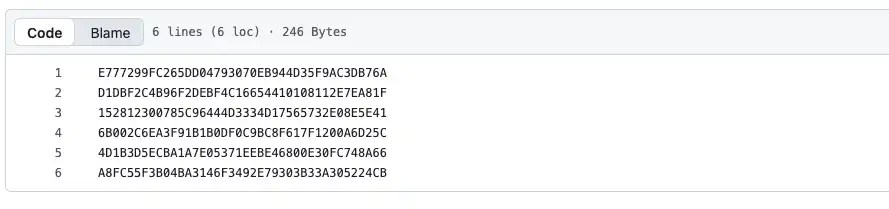
6 Core Maintainers' Signatures
By analogy, Bitcoin Core Core Maintainers are like the "editors" of Bitcoin network developers; everyone can contribute code to the codebase and submit pull requests, but only Core Maintainers have the authority to merge code into the official codebase and sign releases, similar to editors reviewing and deciding whether developers' code should be accepted for release or sent back for revisions.
The signature of Bitcoin Core Core Maintainers ensures security, allowing all nodes and users to trust that this is an "official, untampered" release. However, Bitcoin Core Core Maintainers do not have the direct authority to trigger on-chain rule changes, For example, Bitcoin Core Core Maintainers have signed and released program files for Bitcoin network upgrades through soft or hard forks, but whether the upgrade can be successful ultimately depends on the adoption and consensus of users and miners, rather than being solely determined by the signature of Bitcoin Core Core Maintainers.
When Bitcoin was first created, Satoshi Nakamoto was the sole Core Maintainer, with the exclusive right to alter the core codebase. Later, Satoshi Nakamoto passed this privilege to Gavin Andresen, who then passed it on to Wladimir van der Laan. This means that for a long time, the power to maintain/change the Bitcoin network code was in the hands of one person. It wasn't until 2022 when Wladimir van der Laan stepped down and got embroiled in a lawsuit with Fake Satoshi (Craig Wright claiming to be Satoshi) that this power started to decentralize.
Nevertheless, even now, Bitcoin Core Core Maintainers continue to play a crucial role. Those who become Core Maintainers usually have a high level of trust and reputation in the community or have made significant contributions to the Bitcoin network.
For instance, one of the Core Maintainers, Ava Chow, a transgender female developer, in 2024, when one of the Bitcoin Core developers, Luke Dashjr, proposed to restrict Ordinals transactions at the consensus level, he/she rejected Luke Dashjr's pull request citing "lacks consensus and creates noise," thereby preventing a potential major Bitcoin network consensus split and becoming an unsung hero.
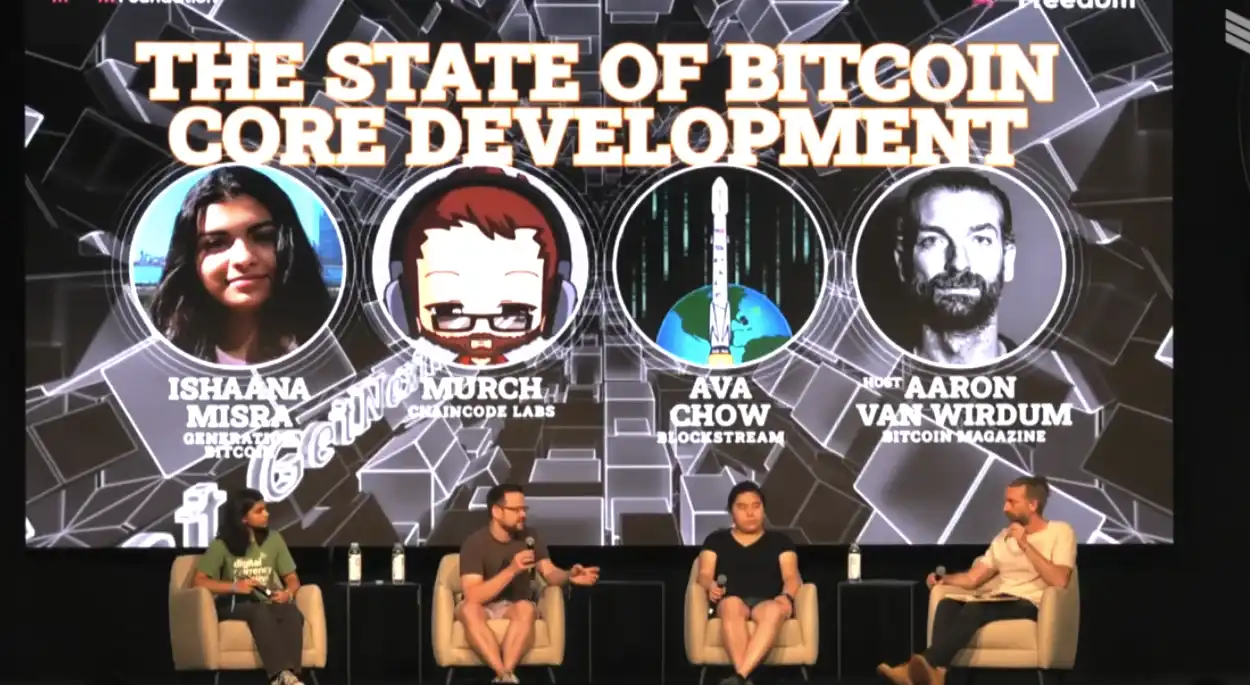
Ava Chow attended Bitcoin 2024 event
For introductions and contributions of other Core Maintainers, refer to the previous article (Related Reading: Who is safeguarding Satoshi Nakamoto's legacy? Insights into the legion of 41 behind Bitcoin's trillion-dollar market cap). Next, we will introduce why TheCharlatan became the 6th Core Maintainer.
TheCharlatan: A Decade of Cryptographic Development Experience
TheCharlatan graduated from the University of Zurich with a degree in Computer Science, hailing from South Africa, focusing on reproducibility and Bitcoin Core's validation logic, claiming in a 2024 blog post to have been developing this project for over two years. TheCharlatan's work systematically breaks down, organizes, and modularizes Bitcoin Core's validation logic, allowing other users to safely reuse it.

TheCharlatan
TheCharlatan is well-regarded among Bitcoin Core core developers, with at least 20 members expressing their agreement during this promotion to core maintainer. When nominated by glozow, it was praised: "He is a reliable reviewer with extensive experience in critical areas of the codebase, thoughtful about what we deliver to users and developers, and very knowledgeable about the technical consensus process."
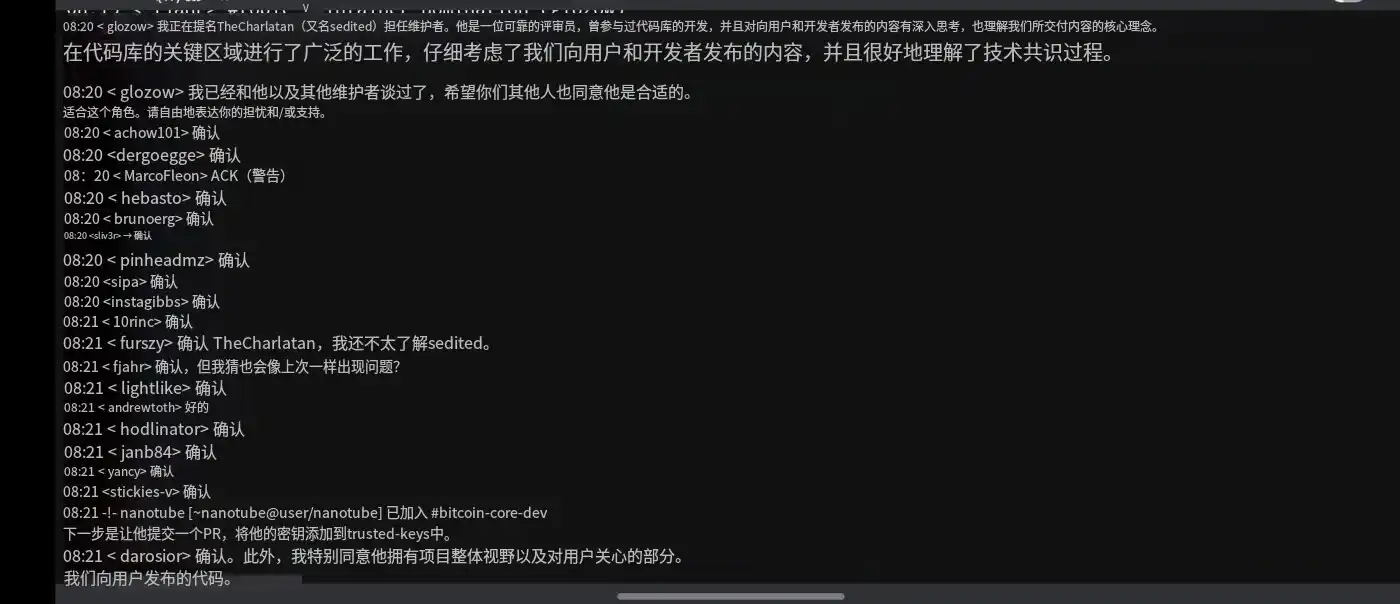
Bitcoin Core Core Developer Group Chat Content (Translated)
According to his Github account information, TheCharlatan started his encryption development in 2015 by creating a cryptocurrency price ticker tool, which was a simple Linux desktop widget with built-in price alert functionality that triggers when a set threshold is reached. After 2017, his encryption development activities became more frequent, officially contributing code to Bitcoin Core starting in 2018, suggesting that TheCharlatan first interacted with Bitcoin Core 8 years ago, making him a seasoned developer.
It is also worth noting that in 2021-2022, TheCharlatan contributed to a Farcaster project's codebase. The project enables people to exchange Bitcoin and Monero peer-to-peer with anyone running a Farcaster node.
TheCharlatan does have a fondness for Monero, having researched in 2020 the burn issue that could arise from transferring Monero using a hardware wallet, as well as discussing Monero's timelock vulnerability.
Of course, a true tech geek may be somewhat inscrutable. TheCharlatan on the X platform often retweets other technical tweets but rarely expresses his own views (in May 2025, he posted that he disliked NFTs even more), but starting from June 2025, every month he repeats a tweet with the content "Cash on the internet. No auto-updates."

I'm afraid this might be some kind of inside joke among Bitcoin tech geeks, or a cultural slogan that I'm unaware of, so I asked AI to help me understand the meaning of these two sentences. The AI said that these two sentences actually express a very extreme form of Bitcoin maximalist view:
“True internet-native cash should be as simple and brutal as cash, and tamper-proof. Once you start doing automatic upgrades, governance voting, and frequent rule changes, it's no longer cash; it becomes another centralized/semi-centralized/controllable 'digital bank account.'”
You may also like
What you bought on CEX is really not US stocks: Analyzing the 94% liquidation monopoly and the evaporation of equity under a five-layer pipeline
In such a crowded cross-border payment arena, where is the next stop for the future?
Why Is Bitcoin Down in 2026? What We Can Learn From 2022
The large models in the United States are moving towards closure in the name of security
From the white-haired stock god to the billionaire fund mogul, the smart people shorting Nvidia are all getting rich using the same framework
Morning Report | CoinEx becomes a key hub for Iran to evade sanctions, involving over $3.8 billion in funds; Kalshi seeks a new round of financing, with a valuation potentially rising to $40 billion
Global Launch: As predictions become the most scarce asset in the AI era, Manadia is defining the next generation of the value internet
Why do cryptocurrency projects always like to change their names?
Who is footing the bill for the $64 billion accounting frenzy?
I never expected that the first application of AI x Crypto would be in security auditing
What is your view on Binance's competitive advantages?
ETH has entered a non-consensus phase, and the turning point is approaching!
The shift in the cloud of the air: from despising stablecoins a year ago to the high-profile entry of capital today
The survival dilemma of small and medium exchanges behind the withdrawal anomalies exposed by AscendEX
Why Is Bitcoin Falling Below $60K? 5 Key Market Drivers Explained
Bitcoin has dropped sharply amid ETF outflows, Strategy stock weakness, AI stock rallies, and changing Fed expectations. Explore the key forces driving BTC’s latest correction and what traders should watch next.
Bitcoin vs. Gold in 2026: Which Asset Performs Better in Different Markets?
The cryptocurrency industry has entered the "Show Me" era: merely relying on vision is no longer enough
Morning News | The draft amendment to the People's Bank of China Law aims to clarify the legal status of digital renminbi; South Korea will transfer about 40 unregistered virtual asset service providers to law enforcement agencies
What you bought on CEX is really not US stocks: Analyzing the 94% liquidation monopoly and the evaporation of equity under a five-layer pipeline
In such a crowded cross-border payment arena, where is the next stop for the future?
Why Is Bitcoin Down in 2026? What We Can Learn From 2022
The large models in the United States are moving towards closure in the name of security
From the white-haired stock god to the billionaire fund mogul, the smart people shorting Nvidia are all getting rich using the same framework
Morning Report | CoinEx becomes a key hub for Iran to evade sanctions, involving over $3.8 billion in funds; Kalshi seeks a new round of financing, with a valuation potentially rising to $40 billion


