
Next year's biggest IPO, how will SpaceX, valued at $1.5 trillion, participate?

On-chain stock trading has rapidly evolved in the US market. Apart from stocks that are already listed and can be directly traded on the secondary market, many high-quality companies now receive significant funding through private placements without the need for an IPO, such as OpenAI and SpaceX.
For these private placement equity holdings, retail investors often find it difficult to participate. Investment opportunities usually only arise after an IPO, with a few institutional investors monopolizing pre-IPO investment opportunities. Although in the traditional finance field, platforms like Ustockplus under Korea's Dunamu, as well as Forge and EquityZen in the US, allow retail investors to purchase private placement equity within existing regulatory frameworks, these traditional financial platforms operate on a peer-to-peer matching basis. If no one is willing to sell, buyers still have limited access, leading to poor liquidity due to unpredictable transaction volumes.
So, would the situation improve with pre-IPO private equity + blockchain? Currently, there are three platforms on-chain—Ventuals, PreStocks, and Jarsy—that provide pre-IPO private equity trading. Let's take a look at their respective characteristics.
Ventuals
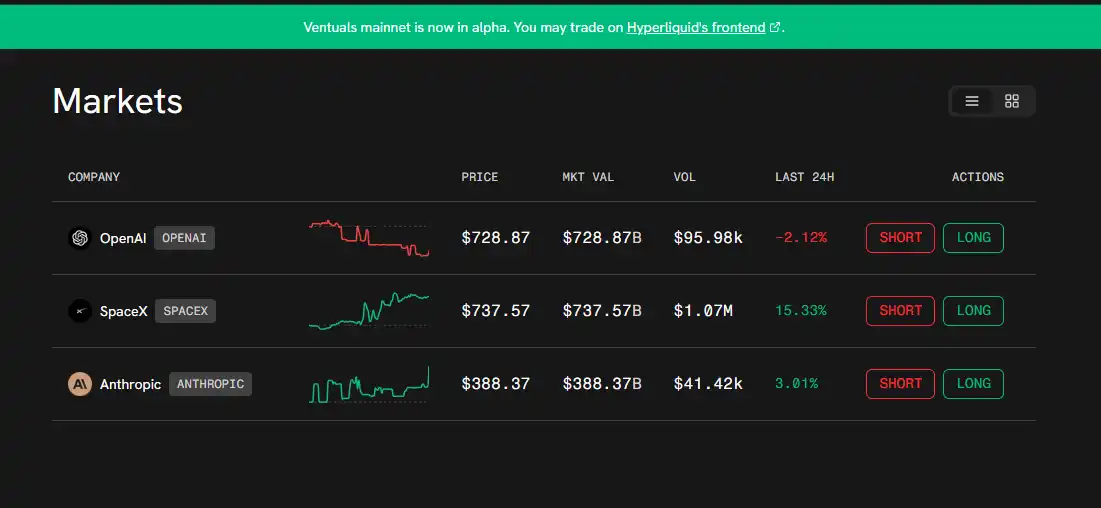
Ventuals is an IPO pre-equity perpetual contract platform built on HIP-3. On Ventuals, traders do not trade based on stock prices but on their expectations of the company's total valuation fluctuations. Holding a position on a pre-IPO company on Ventuals does not imply actual ownership of the company—only speculation on its valuation changes.
As it is not tied to actual equity, Ventuals is essentially a platform for speculating on company valuations. The advantage of this model is that Ventuals can quickly list a large number of pre-IPO company targets and respond to market trends. Moreover, having no underlying assets to a certain extent can help avoid traditional regulations.
However, Ventuals' drawback is that price manipulation is easily facilitated due to reliance on oracle feeds. Private company valuation data is inherently opaque, with low update frequencies. Additionally, Ventuals recently reduced the weight of external oracle feeds to 0.25 and increased the marking price weight to 0.75, raising concerns among some players about potential market manipulation.

PreStocks
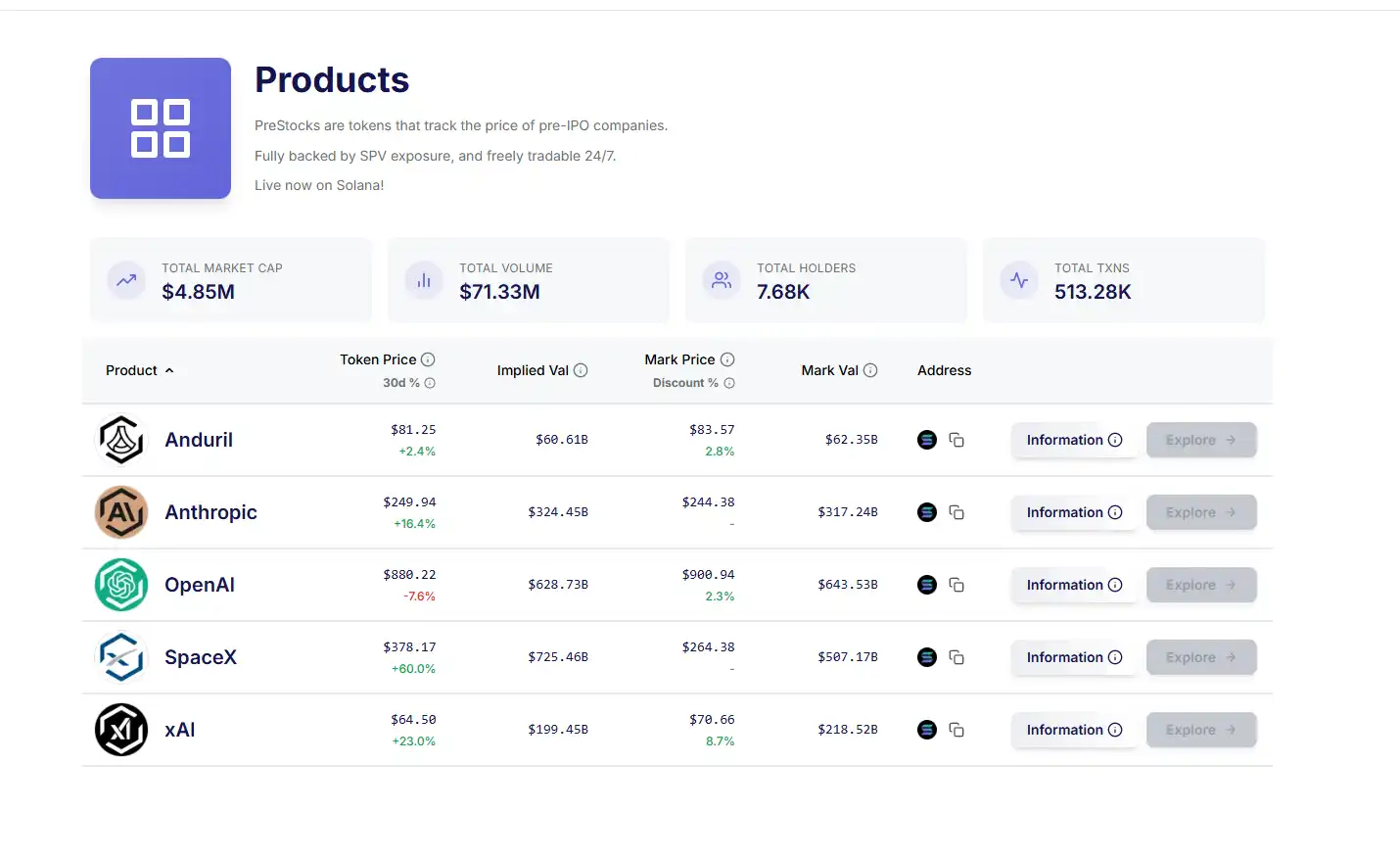
PreStocks is built on the Solana network. Unlike Ventuals, PreStocks truly tokenizes pre-IPO equity held directly or indirectly by entities investing in the underlying company. The team mentioned on their website that they will regularly release third-party verification reports to ensure that the token supply corresponds to the actual equity held and will also publish them upon active requests that can cover audit fees.
Due to the involvement of actual equity, users from countries such as China, the United States, Canada, etc., cannot practically use the platform's minting and redemption services. While it is still possible to buy and sell these equity tokens on-chain without KYC, if one wants to buy and wait for listing before redeeming these tokens for USDC, KYC is required. Additionally, despite having actual equity backing, holding equity tokens does not imply ownership, voting rights, dividend rights, or similar privileges.
PreStocks' main advantage lies in its good integration with the DeFi ecosystem, allowing direct trading in wallets such as Jupiter, OKX, and participation in low-cost lending or leverage trading within some dApps in the Solana ecosystem.
Jarsy
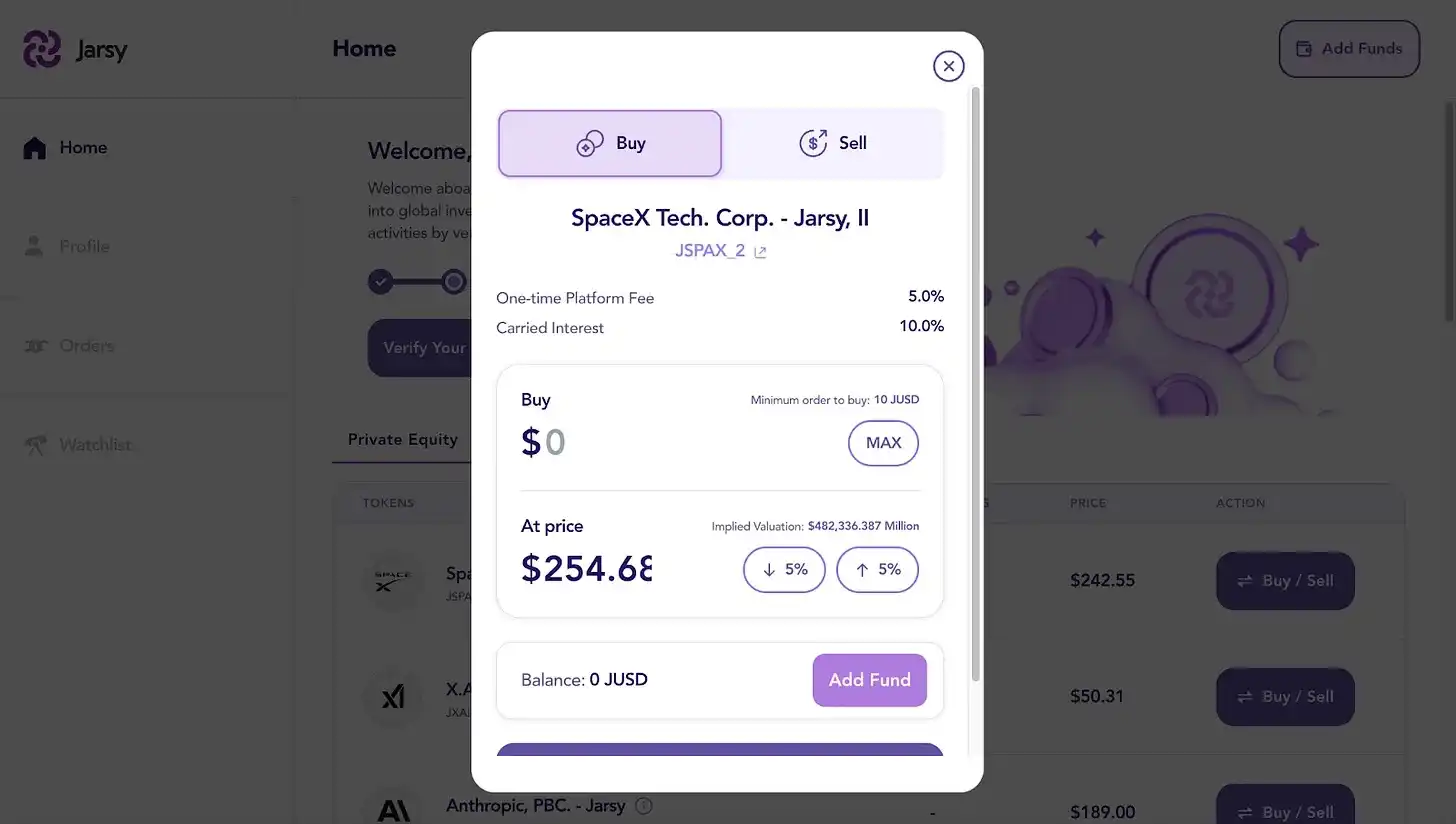
Similar to PreStocks, Jarsy also has actual equity support. However, compared to PreStocks, Jarsy is more like a blockchain-technology-based pre-IPO equity investment platform rather than a trading platform. This is because equity tokens on Jarsy are non-transferable and cannot be used in DeFi; they have their own built-in trading system and trading can only occur on the platform.
Nevertheless, Jarsy currently provides better transparency and disclosure compared to PreStocks.
Jarsy and PreStocks share some similarities and differences. Firstly, the minimum investment amounts for both platforms are very low, with Jarsy at $10 and PreStocks having none, which is beneficial for users worldwide as it lowers the barrier to entry for pre-IPO equity investments. However, a downside is that the amount of equity they can hold is relatively low; for example, xAI's equity token TVL on Jarsy is only about $1.1 million, whereas SpaceX's is approximately $1.7 million. The limited scale of actual pre-IPO equity holdings can directly lead to liquidity issues, where even seemingly small orders can cause significant price fluctuations.
Conclusion
Looking at the three companies above, liquidity remains a challenging issue for pre-IPO equity tokenization, making it difficult for large on-chain funds to enter this space.
However, the benefits are also obvious. Retail investors previously had almost no way to invest in companies like SpaceX and OpenAI before their IPOs. Now, through blockchain technology, a door that has always been closed is opened.
In fact, Echo, the on-chain funding platform created by Cobie and acquired by Coinbase for $375 million, is doing something similar. They have previously conducted a $10 million 1X Technologies Series C round of financing in a private group, although they did not tokenize equity.
It's all still early days.
You may also like

Mastercard Launches Agent Pay for AI, Plans to Record AI Agent Payment Authorizations on Polygon
Mastercard launched Agent Pay for AI, a new payment protocol designed to help AI agents make small payments such as pay-per-use access to data and APIs. The system plans to record human-granted AI agent permissions on Polygon, focusing on verifiable authorization, identity, and payment controls.

Curve Deploys Llamalend v2 on Optimism With 250,000 OP Incentives
Curve launched Llamalend v2 on Optimism with 250,000 OP incentives from the Optimism Foundation. The upgrade expands Llamalend beyond its earlier crvUSD-focused model, adding broader collateral support, LlamaRisk market reviews, and the ability to use Curve LP tokens as collateral.

Raydium Old Liquidity Pool Reportedly Exploited, With $1.34 Million Moved to Ethereum and Tornado Cash
An old Raydium liquidity pool was reportedly exploited for around $1.34 million in USDC, RAY, and wSOL, with the stolen funds bridged to Ethereum and deposited into Tornado Cash. The incident highlights the tail risks of legacy DeFi pools, old contracts, and cross-chain fund laundering paths.

Kalshi Executive Challenges “SBF Backed AI Unicorns” Narrative, Says Leopold Aschenbrenner Was Key Figure
Kalshi executive John Wang questioned the “SBF backed AI unicorns” narrative, saying Leopold Aschenbrenner was the key figure behind major AI investment decisions.

Pantera Capital Partner: How Tokenization is Restructuring the Private Equity and Early Investment Ecosystem?

New York Proposes Stricter Stablecoin Issuer Rules Aligned With Federal GENIUS Act
NYDFS proposed stricter stablecoin issuer rules aligned with the GENIUS Act, covering reserves, custody, redemption timelines, audits, and capital buffers.
Every exchange is a "Universal Exchange."

The counterattack of traditional finance: Alliance chains are quietly reviving

CryptoQuant Says Bitcoin Profitable Supply Is Near 45% Pressure Zone as On-Chain Data Points to Market Repricing
CryptoQuant said Bitcoin’s profitable supply is nearing the 45% pressure zone, signaling rising market stress, unrealized losses, and a possible on-chain repricing phase.

Bitcoin Falls Below 200-Week Moving Average as On-Chain Data Shows Over Half of Supply in Loss
Bitcoin dropped below its 200-week moving average as on-chain data showed over 50% of circulating supply is now in loss, signaling rising market stress.

CFTC Reportedly Plans New Prediction Market Rules Focused on Manipulation Risk and Public Interest Review
The CFTC is reportedly preparing new prediction market rules focused on manipulation risk, public interest review, and retail trader protections.

Meet the new WEEX trial fund—your gateway to greater profits

WEEX Labs Lands at Dutch Blockchain Week: A Disruptive Crypto × AI Conversation Sets Sail in Amsterdam
SK Hynix Reportedly Plans U.S. ADR Listing as Early as August, With SEC Approval Possible in Late June
SK Hynix may pursue a U.S. ADR listing as early as August, with SEC approval reportedly possible in late June amid strong AI chip supply chain demand.

SpaceX vs Tesla vs xAI: Which Elon Musk Trade Has the Biggest Upside in 2026?
OpenAI Reveals It Has Confidentially Submitted an S-1 to the SEC, Keeping the Door Open for a Future IPO
On June 9, according to an OpenAI announcement, the company recently confidentially submitted a draft S-1 registration statement to the U.S. Securities and Exchange Commission (SEC), beginning the preliminary compliance process for a potential initial public offering. OpenAI said it chose to disclose this proactively because it expected the news might leak; however, the company has not yet set a specific listing timeline, and related arrangements may still take some time.
Latest research from 13 top universities including Cornell University: The current state, challenges, and misconceptions of the fusion of Crypto and AI
Deconstructing Anthropic: The Best AI Company, Possibly Also a Type of Organizational Invention
Mastercard Launches Agent Pay for AI, Plans to Record AI Agent Payment Authorizations on Polygon
Mastercard launched Agent Pay for AI, a new payment protocol designed to help AI agents make small payments such as pay-per-use access to data and APIs. The system plans to record human-granted AI agent permissions on Polygon, focusing on verifiable authorization, identity, and payment controls.
Curve Deploys Llamalend v2 on Optimism With 250,000 OP Incentives
Curve launched Llamalend v2 on Optimism with 250,000 OP incentives from the Optimism Foundation. The upgrade expands Llamalend beyond its earlier crvUSD-focused model, adding broader collateral support, LlamaRisk market reviews, and the ability to use Curve LP tokens as collateral.
Raydium Old Liquidity Pool Reportedly Exploited, With $1.34 Million Moved to Ethereum and Tornado Cash
An old Raydium liquidity pool was reportedly exploited for around $1.34 million in USDC, RAY, and wSOL, with the stolen funds bridged to Ethereum and deposited into Tornado Cash. The incident highlights the tail risks of legacy DeFi pools, old contracts, and cross-chain fund laundering paths.
Kalshi Executive Challenges “SBF Backed AI Unicorns” Narrative, Says Leopold Aschenbrenner Was Key Figure
Kalshi executive John Wang questioned the “SBF backed AI unicorns” narrative, saying Leopold Aschenbrenner was the key figure behind major AI investment decisions.
Pantera Capital Partner: How Tokenization is Restructuring the Private Equity and Early Investment Ecosystem?
New York Proposes Stricter Stablecoin Issuer Rules Aligned With Federal GENIUS Act
NYDFS proposed stricter stablecoin issuer rules aligned with the GENIUS Act, covering reserves, custody, redemption timelines, audits, and capital buffers.


