
Ranger Fund Takes a New Approach to Public Offering: Can a Grassroots Team Earn Market Trust?

Original Title: "Ranger Public Sale Innovates, Can Grassroots Team Be Trusted?"
Original Author: 1912212.eth, Foresight News
On January 6, the project public sale (ICO) of Solana-based DEX aggregator Ranger Finance was officially launched. This public sale was conducted through the MetaDAO platform to raise funds for Ranger's token RNGR, aimed at expanding team capabilities and accelerating development speed.
Currently, the daily derivatives trading volume on Solana, Arbitrum, and Hyperliquid is approximately $500 billion. However, most trading platforms still lock each order into a single venue, leading to liquidity fragmentation, degraded execution quality, and ultimately providing traders with a worse experience. Ranger features a core smart order routing system. It scans integrated venues in real-time, assesses liquidity depth, intelligently splits large orders, and executes trades at the best price.

Ranger Finance also provides an intuitive interface for managing diversified trading positions, with all operations possible on a single platform. The cross-margin support (to be launched soon) system allows multiple assets in a single wallet to be used as collateral, enabling greater flexibility and capital efficiency.
Public Sale Minimum Target $6 Million, Team Performance-Based Unlock
The public sale runs until January 10, with the officially announced minimum fundraising amount set at $6 million, and a monthly spending limit of $250,000 (this amount can be self-allocated monthly by the project founders without needing to submit a proposal to the DAO. The DAO reserves the right to adjust this amount in the future). Ranger token holders have priority in committing funds to the ICO. This priority is distributed proportionally among all token holders, with any remaining portion allocated proportionally to non-token commitors.
If the fundraising amount exceeds the minimum target ($6 million), Ranger will initiate a buyback plan to repurchase tokens within 90 days based on the price difference between the ICO and post-listing, with the repurchased tokens being burned.
Ranger has a total token supply of 25,625,000 tokens, with 10 million tokens in the ICO pool, and existing investors collectively allocated 4,356,250 tokens (linearly vested over 24 months).
It is worth mentioning that the project has set up a performance-based reward system. Team Performance Reward Pool: 7,600,000 tokens (18-month lock-up period, then unlocked based on price milestones at 2x, 4x, 8x, 16x, and 32x from ICO price over a 3-month TWAP).
Ambassadors and Ecosystem Partners: 768,750 tokens (25% immediate unlock, remaining 25% linearly vested over 6 months).
The remaining token supply is designated for providing liquidity, where 20% of the raised funds and 2 million tokens will be deposited into FutarchyAMM, and 900,000 tokens will be unilaterally deposited into Meteora's liquidity pool.
Previously Raised at a $30 Million Valuation
In December 2024, amidst a bullish crypto market, Ranger secured a $1.9 million investment led by RockawayX, with participation from Asymmetric, Big Brain Holdings, RISE Capital, Anagram, and others.
Throughout this year, Ranger not only launched tokenized stocks based on xStocks but also acquired the Voltr protocol in November.
Ranger's team has limited public information available. Co-founder Fathurrahman Faizal is a graduate of Singapore Management University and previously served as COO at SolanaFM. The other co-founder, Barrett Williams, also a co-founder of mtnCapital, has invested in the on-chain order book trading protocol BULK and MetaDAO.
The team allocation accounts for 29.6% of the total supply, with tokens unlocking only upon reaching ICO price milestones (e.g., 2x, 4x, 8x, 16x, 32x FDV). This incentive structure aligns with investor interests and is one of the few highlights. The team emphasizes "no pre-mining" and transparent governance, but the lack of specific relevant links for verification may raise trust issues. The project claims to be built on TechFlow but has not disclosed core developer experience.
Overall, the team's anonymity aligns with DeFi culture, but for a project seeking a multi-million-dollar public raise, this may be a potential risk factor.
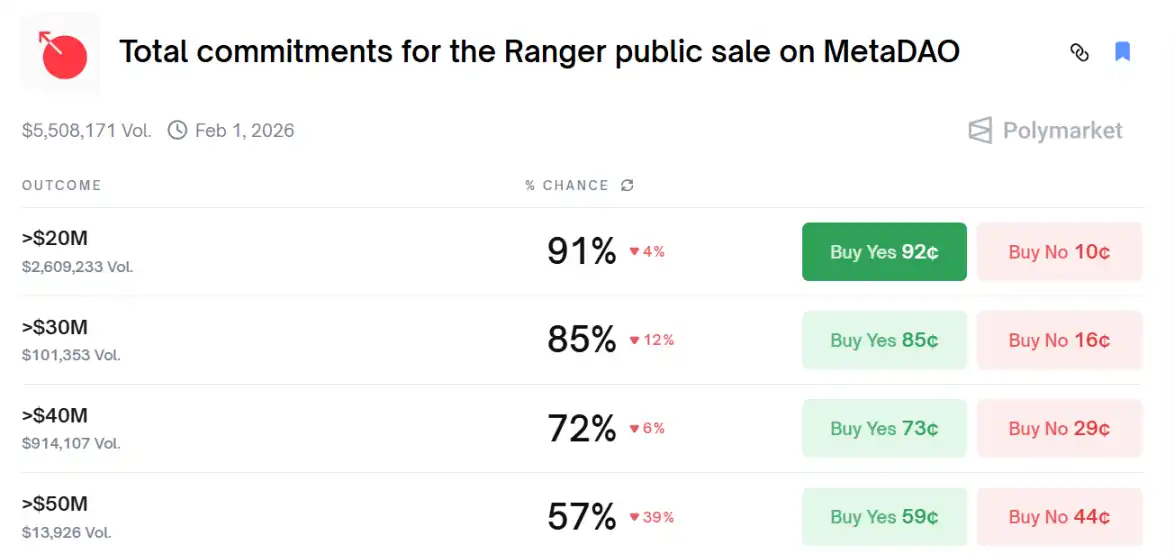
As of now, the official website indicates that their fundraising has reached $2.9 million, with nearly 1,800 investors participating. Polymarket data shows an 85% probability that the public sale subscription amount will exceed $30 million.
You may also like

Japan’s Three Megabanks Plan Joint Stablecoin Issuance in Fiscal 2026
MUFG, SMBC, and Mizuho reportedly plan to jointly issue fiat-pegged stablecoins in fiscal 2026, signaling Japan’s growing push into bank-led digital payment infrastructure.

Humanity Discloses H Token Dual-Chain Attack Details, With Losses on Ethereum and BSC Exceeding $36 Million
Humanity said the H token attack across Ethereum and BSC caused more than $36 million in losses after leaked ProxyAdmin keys enabled malicious contract upgrades and token minting.

White House Discusses CLARITY Act With Law Enforcement Ahead of Senate Vote
The White House discussed the CLARITY Act with law enforcement ahead of a Senate vote, focusing on illicit finance risks and developer protections.

$75 billion in foreign capital has fled, and South Korean retail investors have absorbed it all using leverage

Bitcoin Trading Guide 2026: Strategies for Experienced Traders

What Is XAUT and PAXG? Why Tokenized Gold Is Booming in 2026

Cryptocurrency CEXs are flocking to sell US stocks, and traditional brokerages are facing an "uninvited guest."

Will the SpaceX IPO Hurt Bitcoin? Here's What Traders Are Watching
Foreign selling in the South Korean stock market accelerates, with cumulative net sales reportedly reaching $75 billion this year
On June 9, The Kobeissi Letter, citing Goldman Sachs data, reported that global investors are selling South Korean stocks at an unusually rapid pace. In the latest trading session, foreign investors sold about $801 million worth of Kospi constituent stocks again; total foreign outflows last week reached about $10 billion, and the market has been in net foreign selling on nearly every trading day over the past month. According to the data cited in the report, foreign investors have sold about $75 billion worth of South Korean stocks so far this year. Meanwhile, South Korean retail and institutional investors together recorded roughly $69 billion in net buying over the same period, suggesting that the market’s main buying support has come from domestic capital rather than returning overseas funds. The information currently disclosed still mainly comes from The Kobeissi Letter’s retelling and Goldman Sachs data summaries, while public details on the statistical period and the specific definition of “selling” remain relatively limited.

Fortune Warns of Strategy’s Financing Structure Risks as Bitcoin Premium Narrows
Fortune warned that Strategy’s Bitcoin treasury model faces growing financing risks as MSTR’s net asset premium narrows and preferred stock dividend pressure increases.

Ferrari Challenge Le Mans: Carl Moon to Dominate in WEEX Livery

Sahara AI Responds to SAHARA’s Sharp Drop: No Contract or Product Security Issues Found, Internal Investigation Underway
Sahara AI responded to SAHARA’s 60% price drop, saying no token contract or product security issues have been found and an internal investigation is underway.

WEEX Deposit/Withdrawal Dynamic Island: Your Asset Status, Always in Sight
Scaling Crypto Derivatives: The Digital Asset Infrastructure Behind High-Volume Trading
In the fast-moving digital asset ecosystem, derivatives platforms face an extreme architectural test. High-leverage futures markets demand more than just standard security—they require absolute operational precision, zero-latency matching engines, and ironclad structural scalability, all while navigating intense market volatility.
As global platforms scale to meet these demands, the industry is shifting away from rigid, monolithic setups toward a more agile, "decoupled" infrastructure philosophy.
The Blueprint for High-Volume Copy TradingFor elite global exchanges like WEEX (founded in 2018), this architectural choice becomes critical when scaling high-volume retail features like social copy trading. When thousands of users automatically mirror the real-time strategies of elite traders simultaneously, it triggers sudden, monumental spikes in concurrent transactional volume.
To prevent execution latency or settlement bottlenecks during these peak volatility events, a platform's primary engine must remain entirely dedicated to risk management, copy-trade synchronization, and order matching.
The Architectural Rule: New-generation platforms must separate front-end user execution engines from heavy backend infrastructural overhead to eliminate operational friction.
By separating these layers, platforms can maintain complete sovereignty over their trading environments and user experiences while strategically aligning with institutional-grade infrastructure ecosystems. This strategic framework allows modern exchanges to leverage advanced Digital Asset Custody infrastructure such as Cobo’s behind the scenes, ensuring that backend wallet management scales elastically alongside trading spikes.
Capitalizing on Market Momentum and 400× LeverageIn a derivatives arena where platforms offer up to 400× leverage on perpetual contracts, capital efficiency and market agility are core business metrics. To capture market momentum, an exchange needs the ability to rapidly expand its asset offerings, supporting everything from legacy crypto assets to sudden, trending altcoins across a massive library of trading pairs.
Adopting a flexible, scalable Wallet-as-a-Service (WaaS) solution such as Cobo’s could completely rewrite the development timeline for high-growth exchanges. Instead of spending months of engineering capital building out custom backend wallet architectures for every new blockchain network, platforms can deploy localized infrastructure in days.
This agility allows platforms to instantly scale their listings to over a thousand trading pairs without compromising security or delaying time-to-market. It mirrors the exact operational advantages seen during high-velocity market events, similar to how advanced wallet infrastructure empowers platforms during sudden asset surges; allowing exchanges to pass that speed and liquidity directly to their global user base.
A Mature Foundation for GrowthThe synergy between trusted infrastructure ecosystems and global trading platforms represents the natural evolution of a maturing crypto market. As WEEX continues to scale its global spot and derivatives offerings for over 6 million users, adopting robust backend paradigms proves that platforms no longer have to compromise between cutting-edge trading velocity and uncompromised structural security.

Morning Report | BitMine increased its holdings by 126,971 ETH last week; trader Eugene announced his exit from the crypto market

Wang Chuan: How can one not feel anxious after the neighbor Old Wang made thirty times profit by investing in storage stocks? (Seven) - A quarter-century cycle

Get Paid to Onboard? Try WEEX’s New Homepage with Rewards for Registration, Deposit & Trade
WEEX Custom Layout: Build Your Perfect Trading Workspace in Seconds
Japan’s Three Megabanks Plan Joint Stablecoin Issuance in Fiscal 2026
MUFG, SMBC, and Mizuho reportedly plan to jointly issue fiat-pegged stablecoins in fiscal 2026, signaling Japan’s growing push into bank-led digital payment infrastructure.
Humanity Discloses H Token Dual-Chain Attack Details, With Losses on Ethereum and BSC Exceeding $36 Million
Humanity said the H token attack across Ethereum and BSC caused more than $36 million in losses after leaked ProxyAdmin keys enabled malicious contract upgrades and token minting.
White House Discusses CLARITY Act With Law Enforcement Ahead of Senate Vote
The White House discussed the CLARITY Act with law enforcement ahead of a Senate vote, focusing on illicit finance risks and developer protections.
$75 billion in foreign capital has fled, and South Korean retail investors have absorbed it all using leverage
Bitcoin Trading Guide 2026: Strategies for Experienced Traders
What Is XAUT and PAXG? Why Tokenized Gold Is Booming in 2026


