
Renowned Crypto Influencer Embroiled in "Donation Fraudgate," Accused of Faking Hong Kong Fire Donation Receipt, Sparking Public Outcry


A serious fire at Wang Fuk House in Tai Po, Hong Kong, has caused hundreds of casualties and property damage. Charitable organizations such as Yan Chai Hospital promptly set up an emergency relief fund to support the affected residents. The cryptocurrency industry has also seen many companies and individuals providing assistance, including industry giants like Binance and Matrixport donating millions of Hong Kong dollars. However, on December 1, a prominent figure in the cryptocurrency community, known as KOL @Elizabethofyou, found herself embroiled in a "Donation Fraud" scandal when the community noticed that the proof of her HK$200,000 donation appeared to be photoshopped.
A "Expose the Fraud" Movement Triggered by a Screenshot
On December 1, Elizabeth, a cryptocurrency influencer with 130,000 followers, posted a tweet on the social media platform X (formerly Twitter), stating that she had donated HK$200,000 to Yan Chai Hospital to support the victims of the Tai Po fire. The tweet included a screenshot of the transaction confirmation and a caption urging others to "show kindness in the face of disaster." The act of kindness quickly garnered over 600,000 views and 1500 likes, initially being seen as a demonstration of positive energy in the industry.
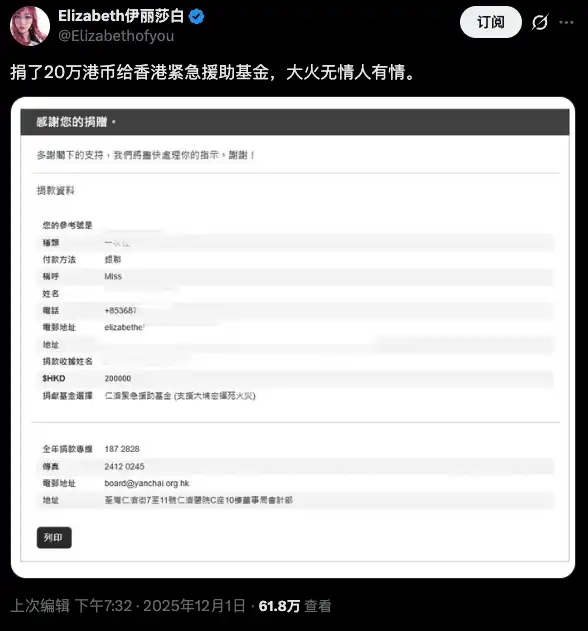
However, public opinion took a sharp turn within hours. Several members of the crypto community on the Twitter platform, such as @CryptoNyaRu and @abyssofgambling, analyzed the screenshot and pointed out multiple suspicious elements:
1. Irregular Font: The number "2" in the amount "200,000" in the screenshot had a noticeably thinner font, inconsistent with the font style of the "Annual Donation Hotline" number below.
2. Misalignment: The amount line and the text below could not be aligned, showing a significant discrepancy in pixel height typical of image editing software (such as Photoshop) manipulation.
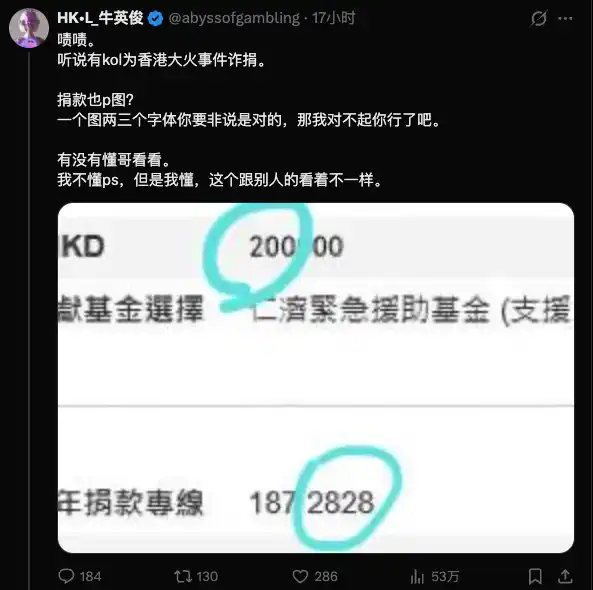
The suspicions quickly escalated, turning the likes into dislikes. The community believed that if this was indeed a fraud, using a significant tragedy to deceive people's compassion was incredibly heinous, and they hoped Elizabeth could provide evidence to prove the authenticity of her donation.
Response from the Involved Party and Escalation of Public Opinion
Faced with overwhelming doubts, Elizabeth released a response video on the evening of the 1st. In the video, she insisted that she had "donated with a clear conscience" and stated that this would be her final response. She then displayed another screenshot as evidence.
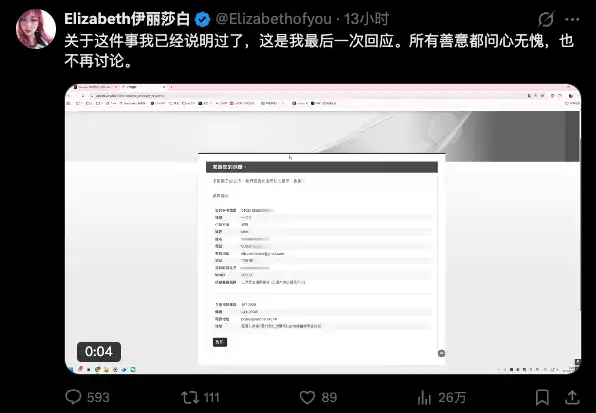
This screenshot is different from the first one. The phone number is different, and the video demonstration is of a static webpage without dynamic refreshing. Additionally, netizens believe that the evidence she provided is not convincing as there is no bank transaction record or an official receipt from Renji Hospital.
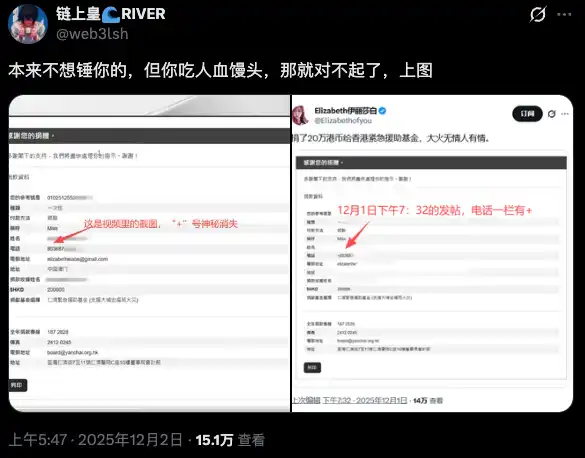
After releasing a response, Elizabeth ignored numerous requests for self-verification in the comments and continued to post commercial ad tweets. This handling of the situation further enraged the public.
According to the Hong Kong Theft Ordinance, if misleading the public through false statements to gain benefits (including advertising collaboration opportunities due to traffic, brand image enhancement, etc.), it may constitute "fraud" or "obtaining property by deception." Upon conviction for such offenses, the maximum penalty can be 10 to 14 years of imprisonment. Netizens have started reaching out to donation organizations for verification and believe that if the fraudulent donation is confirmed, there should be legal consequences. Some Key Opinion Leaders (KOLs) have also compared donation verification evidence for authenticity. As of now, there has been no latest response from donation organizations regarding Elizabeth.
Historical Warning: The Cost of Celebrity "Donation Fraud"
Using charity for false publicity is not uncommon in the history of public figures.
One of the most famous cases is international actress Zhang Ziyi. During the 2008 Wenchuan earthquake, Zhang Ziyi claimed to donate 1 million RMB. However, in 2010, netizens discovered that the actual amount received was only 840,000 RMB, and the whereabouts of the millions of dollars she claimed to have raised in Cannes were unknown.
After the incident broke out, Zhang Ziyi's public image plummeted, facing an unprecedented crisis of trust. Eventually, her agent apologized for "management negligence," made up the shortfall, and hired an auditing firm to audit and disclose the foundation's accounts. Despite taking remedial measures, the "donation fraud" label followed her for many years.
In 2015, well-known actress Yang Mi promised to donate typewriters and white canes to a special education school in Chengdu while promoting the movie "I Am a Witness." However, it wasn't until 2018 that the school stated they never received the supplies.
Yang Mi's studio explained that it was due to the negligence of an "intermediary" that the donation was not fulfilled, and they promptly donated the supplies and publicly apologized. Although it was not legally classified as fraud, the incident was characterized by the public as "hypocritical," greatly undermining her integrity as a public figure.
You may also like

Morning Report | OpenAI has submitted an S-1 registration statement draft to the U.S. SEC; Morpho completes $175 million financing

Galaxy Deep Research Report: How Hyperliquid's HIP-4 Upgrade Changes the Landscape of Prediction Markets?

Latest research from 13 top universities including Cornell University: The current state, challenges, and misconceptions of the fusion of Crypto and AI

Deconstructing Anthropic: The Best AI Company, Possibly Also a Type of Organizational Invention

Every exchange is a "Universal Exchange."

The counterattack of traditional finance: Alliance chains are quietly reviving
Pantera Capital Partner: How Tokenization is Restructuring the Private Equity and Early Investment Ecosystem?

Mastercard Launches Agent Pay for AI, Plans to Record AI Agent Payment Authorizations on Polygon
Mastercard launched Agent Pay for AI, a new payment protocol designed to help AI agents make small payments such as pay-per-use access to data and APIs. The system plans to record human-granted AI agent permissions on Polygon, focusing on verifiable authorization, identity, and payment controls.

Curve Deploys Llamalend v2 on Optimism With 250,000 OP Incentives
Curve launched Llamalend v2 on Optimism with 250,000 OP incentives from the Optimism Foundation. The upgrade expands Llamalend beyond its earlier crvUSD-focused model, adding broader collateral support, LlamaRisk market reviews, and the ability to use Curve LP tokens as collateral.

Raydium Old Liquidity Pool Reportedly Exploited, With $1.34 Million Moved to Ethereum and Tornado Cash
An old Raydium liquidity pool was reportedly exploited for around $1.34 million in USDC, RAY, and wSOL, with the stolen funds bridged to Ethereum and deposited into Tornado Cash. The incident highlights the tail risks of legacy DeFi pools, old contracts, and cross-chain fund laundering paths.
Kalshi Executive Challenges “SBF Backed AI Unicorns” Narrative, Says Leopold Aschenbrenner Was Key Figure
Kalshi executive John Wang questioned the “SBF backed AI unicorns” narrative, saying Leopold Aschenbrenner was the key figure behind major AI investment decisions.

New York Proposes Stricter Stablecoin Issuer Rules Aligned With Federal GENIUS Act
NYDFS proposed stricter stablecoin issuer rules aligned with the GENIUS Act, covering reserves, custody, redemption timelines, audits, and capital buffers.

CryptoQuant Says Bitcoin Profitable Supply Is Near 45% Pressure Zone as On-Chain Data Points to Market Repricing
CryptoQuant said Bitcoin’s profitable supply is nearing the 45% pressure zone, signaling rising market stress, unrealized losses, and a possible on-chain repricing phase.

Bitcoin Falls Below 200-Week Moving Average as On-Chain Data Shows Over Half of Supply in Loss
Bitcoin dropped below its 200-week moving average as on-chain data showed over 50% of circulating supply is now in loss, signaling rising market stress.

CFTC Reportedly Plans New Prediction Market Rules Focused on Manipulation Risk and Public Interest Review
The CFTC is reportedly preparing new prediction market rules focused on manipulation risk, public interest review, and retail trader protections.

Meet the new WEEX trial fund—your gateway to greater profits

WEEX Labs Lands at Dutch Blockchain Week: A Disruptive Crypto × AI Conversation Sets Sail in Amsterdam
SK Hynix Reportedly Plans U.S. ADR Listing as Early as August, With SEC Approval Possible in Late June
SK Hynix may pursue a U.S. ADR listing as early as August, with SEC approval reportedly possible in late June amid strong AI chip supply chain demand.
Morning Report | OpenAI has submitted an S-1 registration statement draft to the U.S. SEC; Morpho completes $175 million financing
Galaxy Deep Research Report: How Hyperliquid's HIP-4 Upgrade Changes the Landscape of Prediction Markets?
Latest research from 13 top universities including Cornell University: The current state, challenges, and misconceptions of the fusion of Crypto and AI
Deconstructing Anthropic: The Best AI Company, Possibly Also a Type of Organizational Invention
Every exchange is a "Universal Exchange."
The counterattack of traditional finance: Alliance chains are quietly reviving


