
They already knew the TGA Game of the Year in advance and made tens of thousands of dollars.

Today, the highly anticipated TGA (The Game Awards) in the gaming world finally came to a close.
Let's rewind to 3 hours before the end of the awards ceremony. At this moment, the "Best Indie Game" had just been awarded to the popular title "Light and Shadow: Expedition 33," but this made many fans worry instead. Never in history has a game won both the "Best Indie Game" and the "Game of the Year (GOTY)" awards at TGA.
As the frontrunner for the GOTY, "Light and Shadow" now needed to break the curse that had existed since TGA's inception, creating an unprecedented moment in the gaming world.
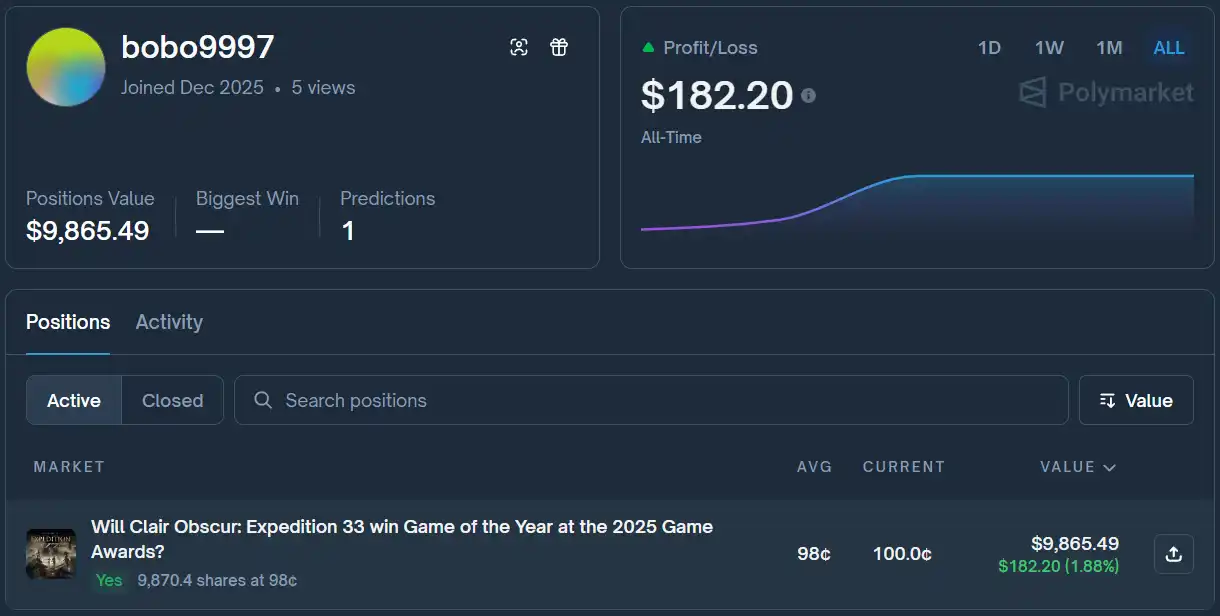
Just as everyone was anxiously concerned, a mysterious individual registered an account on a seemingly unrelated "prediction market" platform and deposited ten thousand dollars. He found the topic on the platform asking, "Will Light and Shadow win the 2025 GOTY?" and placed his entire ten thousand dollar deposit on "yes."
At this time, the price representing the probability of the topic being "yes" was $0.98 per share, which meant that even if "Light and Shadow" did make history by winning both awards, his ten thousand dollar bet would only yield a profit of less than two hundred dollars. However, if "Light and Shadow" failed to break the TGA curse, the probability of this topic would instantly drop to 0, which meant his newly deposited ten thousand dollars would be lost.
Just how much must a fervent fan of "Light and Shadow" love the game to take such a reckless risk? How did the prediction market attract gamers from around the world to speculate in advance on the frontrunners for the awards?
The "Predetermined" Script
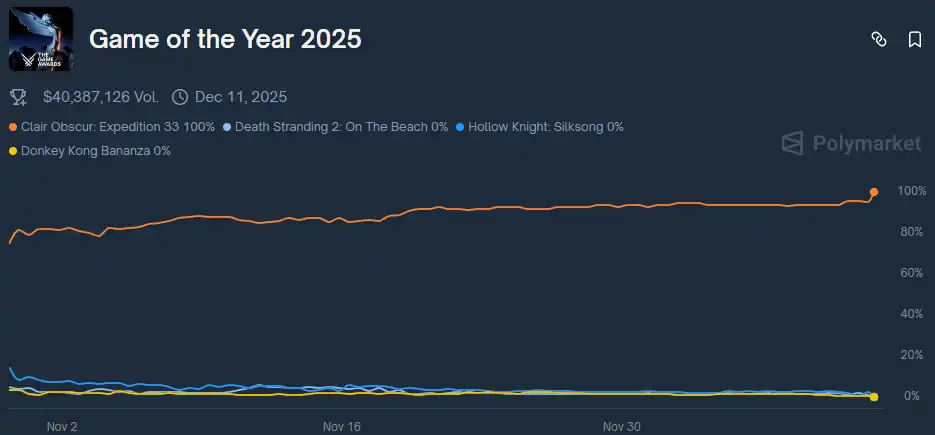
As early as October 30, a month and a half before the awards ceremony, the prediction market Polymarket launched the topic of the "2025 Game of the Year." The odds of "Light and Shadow" winning were firmly above 80% from the start, while the probabilities of other highly anticipated AAA titles winning were kept below 10%. Due to such a one-sided situation, which usually only occurs in events where the outcome is already certain, many traders sensed a hint of unusualness: this was not just optimism, this was certainty.
Among these traders who held a "certain" attitude, there were several whose trading styles were extremely uniform. DieselDiesel, trumpnogo, and kasae all bet on "Light and Shadow winning TGA 2025 GOTY" when the probability was around 85%, with their bets exceeding their usual amounts by tens or even hundreds of times. This highly concentrated, abnormal betting behavior exposed them to significant risks: if Light and Shadow ultimately did not win, they would not only lose all their past profits but also face substantial losses.
As time passed and the odds of winning The Game Awards increased, they did not profit by selling any of their held shares. Even with a significant unrealized gain hours before the award announcement, after the "Best Indie Game" award had already been announced, they remained unfazed as if they could see the future, joining forces with the mysterious figure mentioned at the beginning of this article to wager their entire account balance for a modest profit.
The Awarding of History and the Insider's Payoff
Amidst doubt and anxiety, as if following a script these traders had set over a month ago, The Game Awards dispelled the final suspense: the highly anticipated game, "Light and Shadow," having already won the "Best Indie Game" award, broke a historical curse and won the Best Game of the Year award.
While players on one side rejoiced, on the other side, the prediction market unveiled the final mystery: three traders who were certain a month ago that "Light and Shadow" would win the award solidified their roles as "seers," realizing massive profits:
DieselDiesel made a profit of $5,357 in this event, representing 176% of all their other trading profits;
trumpnogo made a profit of $2,958 in this event, representing 62% of all their other trading profits;
kasae made a profit of $1,658 in this event, representing 220% of all their other trading profits.
As for the mysterious figure mentioned at the beginning (bobo9997), they bet $10,000 on "Light and Shadow" making history to win $200.
Even Soothsayers Have to Eat
The most noteworthy commonality among these four traders is that while many players doubted whether "Light and Shadow" could break the historical curse, they were willing to risk nearly $100,000 in their positions to "bet" that this historic moment would occur. However, the proceeds from this "gamble" amounted to less than $2,000 combined.
At this point, let's assume these "seers" were TGA tally audit officials. For these insider individuals with a $100,000 annual income, if they were to monetize the information in a traditional manner, they would need to sell the insider information to platforms, risking various potential fines, dismissal, or even imprisonment.
Yet, with the advent of prediction markets, they could anonymously exchange the information gap for an amount equivalent to 1 to 3 months of their disposable income.
When we view everything through the lens of an insider who is assumed to already know the outcome, everything becomes clear: In a situation where it is already 100% certain that "Light and Shadow" will be the GOTY, their "wager" at the last moment is simply using the one-hour waiting time before the award ceremony to exchange for a seemingly high-risk yet actually variable-free profit of two thousand dollars.
This type of high-risk, yet variable-free earning "wager" for them was almost impossible to encounter before platforms like prediction markets emerged.
However, with the rise of Polymarket, how many people can resist converting information into tangible rewards in an anonymous manner?
You may also like

Kalshi Executive Challenges “SBF Backed AI Unicorns” Narrative, Says Leopold Aschenbrenner Was Key Figure
Kalshi executive John Wang questioned the “SBF backed AI unicorns” narrative, saying Leopold Aschenbrenner was the key figure behind major AI investment decisions.

Pantera Capital Partner: How Tokenization is Restructuring the Private Equity and Early Investment Ecosystem?

New York Proposes Stricter Stablecoin Issuer Rules Aligned With Federal GENIUS Act
NYDFS proposed stricter stablecoin issuer rules aligned with the GENIUS Act, covering reserves, custody, redemption timelines, audits, and capital buffers.
Every exchange is a "Universal Exchange."

The counterattack of traditional finance: Alliance chains are quietly reviving

CryptoQuant Says Bitcoin Profitable Supply Is Near 45% Pressure Zone as On-Chain Data Points to Market Repricing
CryptoQuant said Bitcoin’s profitable supply is nearing the 45% pressure zone, signaling rising market stress, unrealized losses, and a possible on-chain repricing phase.

Bitcoin Falls Below 200-Week Moving Average as On-Chain Data Shows Over Half of Supply in Loss
Bitcoin dropped below its 200-week moving average as on-chain data showed over 50% of circulating supply is now in loss, signaling rising market stress.

CFTC Reportedly Plans New Prediction Market Rules Focused on Manipulation Risk and Public Interest Review
The CFTC is reportedly preparing new prediction market rules focused on manipulation risk, public interest review, and retail trader protections.

Meet the new WEEX trial fund—your gateway to greater profits

WEEX Labs Lands at Dutch Blockchain Week: A Disruptive Crypto × AI Conversation Sets Sail in Amsterdam

SK Hynix Reportedly Plans U.S. ADR Listing as Early as August, With SEC Approval Possible in Late June
SK Hynix may pursue a U.S. ADR listing as early as August, with SEC approval reportedly possible in late June amid strong AI chip supply chain demand.

SpaceX vs Tesla vs xAI: Which Elon Musk Trade Has the Biggest Upside in 2026?
OpenAI Reveals It Has Confidentially Submitted an S-1 to the SEC, Keeping the Door Open for a Future IPO
On June 9, according to an OpenAI announcement, the company recently confidentially submitted a draft S-1 registration statement to the U.S. Securities and Exchange Commission (SEC), beginning the preliminary compliance process for a potential initial public offering. OpenAI said it chose to disclose this proactively because it expected the news might leak; however, the company has not yet set a specific listing timeline, and related arrangements may still take some time.

Latest research from 13 top universities including Cornell University: The current state, challenges, and misconceptions of the fusion of Crypto and AI
Deconstructing Anthropic: The Best AI Company, Possibly Also a Type of Organizational Invention
Apollo and Blackstone Reportedly Back $35 Billion Anthropic Chip Financing as Deal Details Remain Unclear
On June 9, according to currently available news alerts, Apollo and Blackstone Group participated in a $35 billion financing for an Anthropic “chip project.” Based on the original wording of the report, the funding has already been raised, but public information remains limited. The financing structure, use of proceeds, project entity, and whether Apollo and Blackstone participated through equity, debt, or project financing have not yet been disclosed.

Humanity Protocol Security Incident Escalates: More Than $31 Million Stolen From Related Addresses as Attacker Continues Selling H for ETH
On June 9, according to monitoring by Onchain Lens, more than $31 million has been stolen from addresses linked to Humanity Protocol, and the attack is still ongoing, with the hacker continuously swapping H tokens for ETH. Project founder Terence Kwok later confirmed the security incident on X, saying the issue involved a private key leak.

Bloomberg: As Bitcoin Weakens, Stablecoins and RWA Continue to Drive Expansion in Crypto Businesses
In June, Bloomberg reported that despite Bitcoin falling below $60,000 last week, wiping out about $235 billion in market value within seven days, and dropping close to 50% from last year’s peak, some core businesses in the crypto industry are still expanding, mainly in stablecoins, real-world asset tokenization (RWA), payments, and infrastructure. The report also noted that overall altcoin activity has contracted significantly: altcoin market capitalization has fallen from a peak of about $431 billion in November 2021 to around $170 billion, and among the tens of millions of tokens issued in recent years, fewer than 1,700 still maintain meaningful trading activity.
Kalshi Executive Challenges “SBF Backed AI Unicorns” Narrative, Says Leopold Aschenbrenner Was Key Figure
Kalshi executive John Wang questioned the “SBF backed AI unicorns” narrative, saying Leopold Aschenbrenner was the key figure behind major AI investment decisions.
Pantera Capital Partner: How Tokenization is Restructuring the Private Equity and Early Investment Ecosystem?
New York Proposes Stricter Stablecoin Issuer Rules Aligned With Federal GENIUS Act
NYDFS proposed stricter stablecoin issuer rules aligned with the GENIUS Act, covering reserves, custody, redemption timelines, audits, and capital buffers.
Every exchange is a "Universal Exchange."
The counterattack of traditional finance: Alliance chains are quietly reviving
CryptoQuant Says Bitcoin Profitable Supply Is Near 45% Pressure Zone as On-Chain Data Points to Market Repricing
CryptoQuant said Bitcoin’s profitable supply is nearing the 45% pressure zone, signaling rising market stress, unrealized losses, and a possible on-chain repricing phase.


