
USD 1 Billion Surge in Market Cap: Behind the Scenes with Trump Family Bet and CEX Shilling





Original Title: "The Fastest-Growing Stablecoin Recently Turns Out to Be a Pawn of the Trump Family"
Original Author: Nicky, Foresight News
In the current relatively stable stablecoin market, the USD1 stablecoin launched by WLFI is attempting to gain momentum through the Trump family's resources and an aggressive ecosystem strategy.
Recently, WLFI has used treasury funds for incentives and partnered with Binance to launch a high-yield savings product with a 20% annual percentage yield, causing the USD1 supply to exceed $3 billion, with a single-day peak growth of over 7.6%.
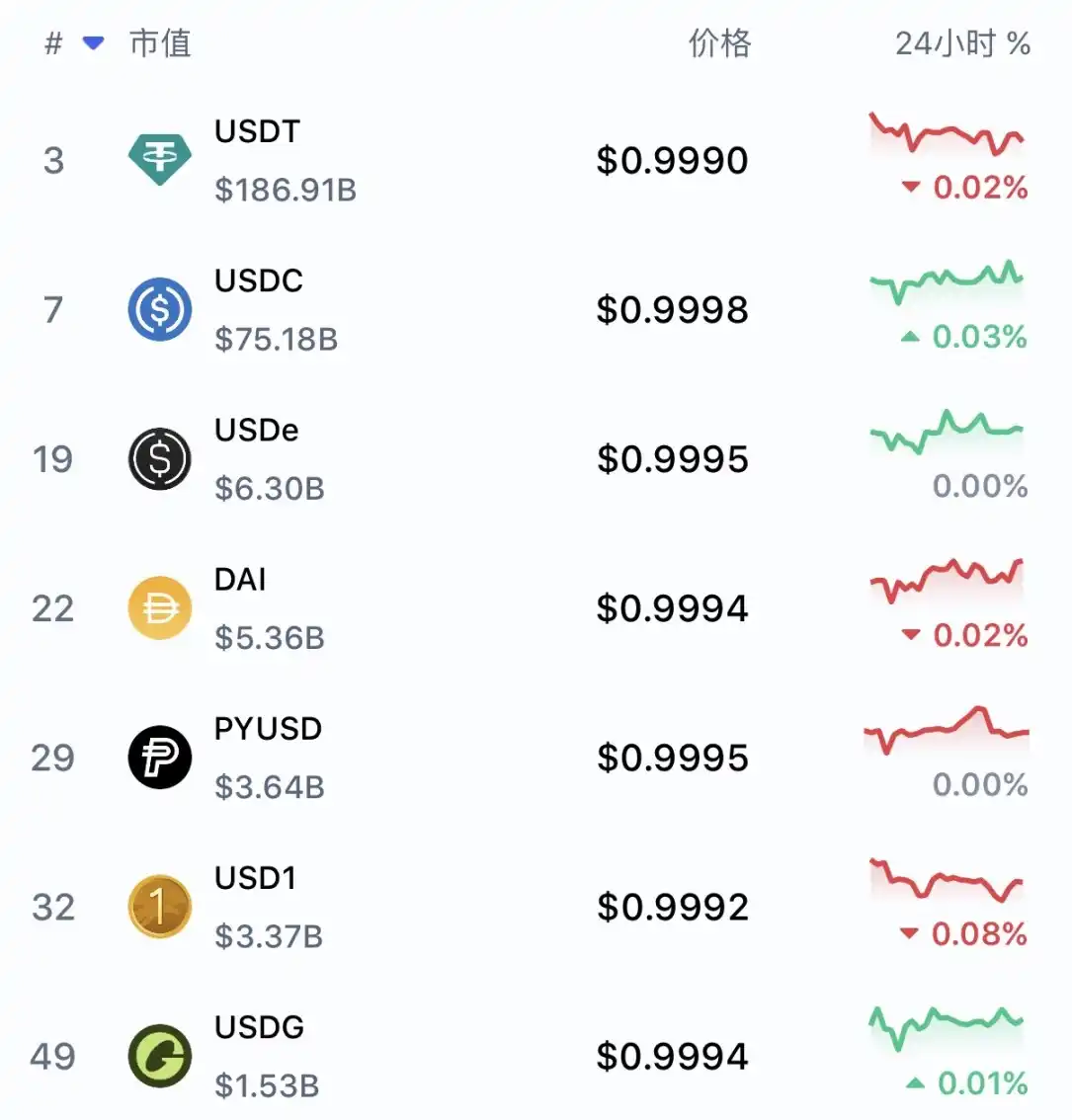
According to CoinMarketCap data, the current market capitalization of USD1 is $3.37 billion, ranking sixth in stablecoin market cap, accounting for about 1.8% of USDT's total market cap and 4.48% of USDC's total market cap.
At the centralized exchange level, USD1 has received relatively comprehensive trading support and has been listed on exchanges such as Binance, Coinbase, and Upbit. Taking Binance as an example, USD1 currently has 14 trading pairs, covering assets such as BTC, ETH, SOL, BNB, XRP, ASTER, among others.
Looking at the trading volume data from the past three days, the trading volume of the BTC/USD1 pair is around $5.13 billion, while the ETH/USD1 volume is around $38.9 million. For comparison, during the same period, the trading volume of BTC/USDT was about $5 billion, and ETH/USDT reached $3.59 billion; the trading volume of BTC/USDC was about $1.44 billion, and ETH/USDC was around $1.06 billion.
This comparison reflects a relatively clear reality: although USD1 has usability at the exchange level, its liquidity in spot trading of mainstream assets still significantly lags behind USDT, and there is an order of magnitude difference compared to USDC. At least at the current stage, USD1 appears more like a stablecoin introduced to the market rather than a base settlement asset with an established natural trading preference.
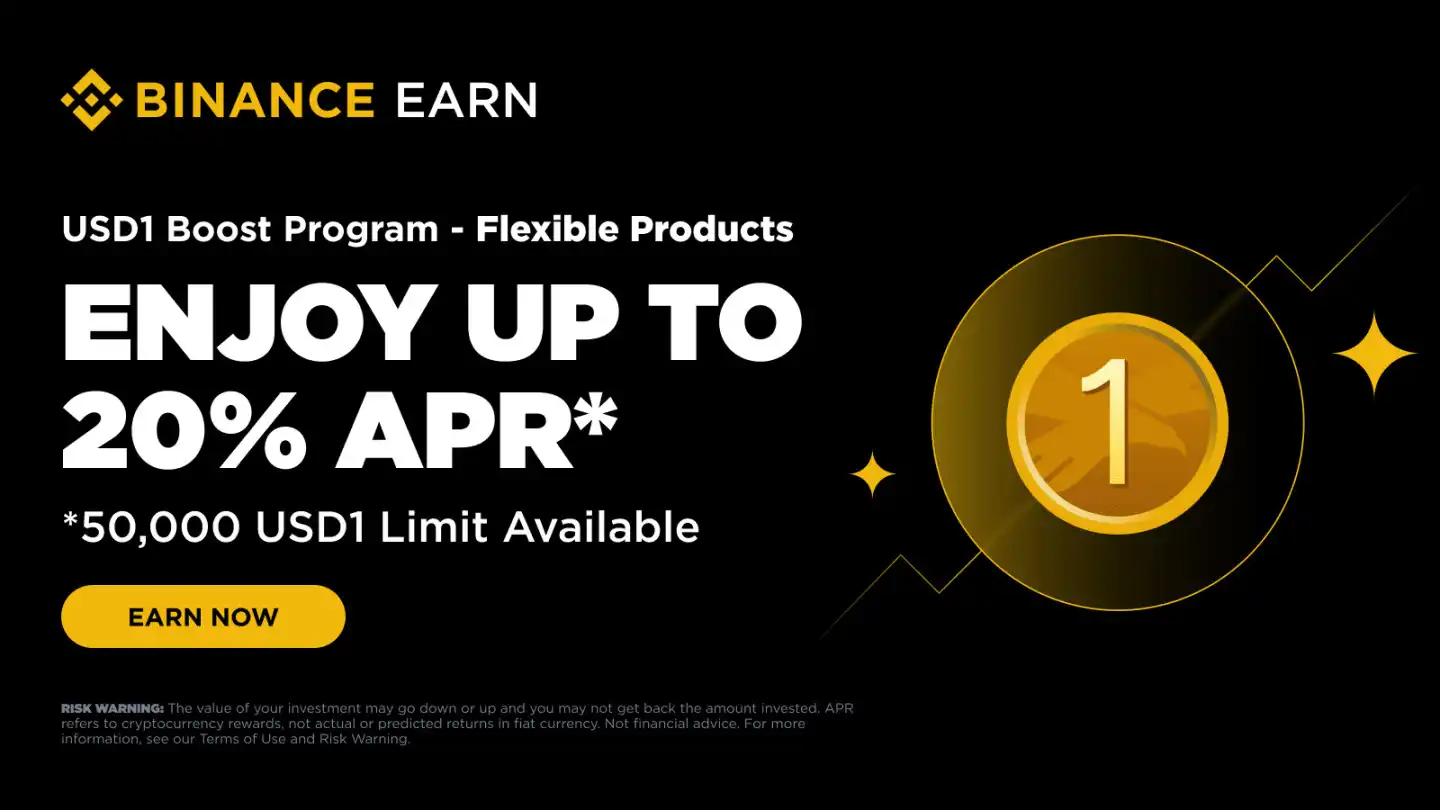
The recent rapid increase in the supply of USD1 is closely tied to incentive measures. On December 24, 2025, Binance launched a fixed-rate savings promotion for USD1, offering a maximum annual percentage yield of 20%. Prior to the start of the promotion, the supply of USD1 was around 2.7 billion tokens, which then quickly surged to over 3 billion tokens.
On January 5, 2026, WLFI officially announced that a governance proposal regarding "Using part of the unlocked treasury funds to incentivize USD1 adoption" had been approved with a 77.75% approval rate. This proposal signifies WLFI's commitment to further expanding the use cases of USD1 through more direct resource allocation.
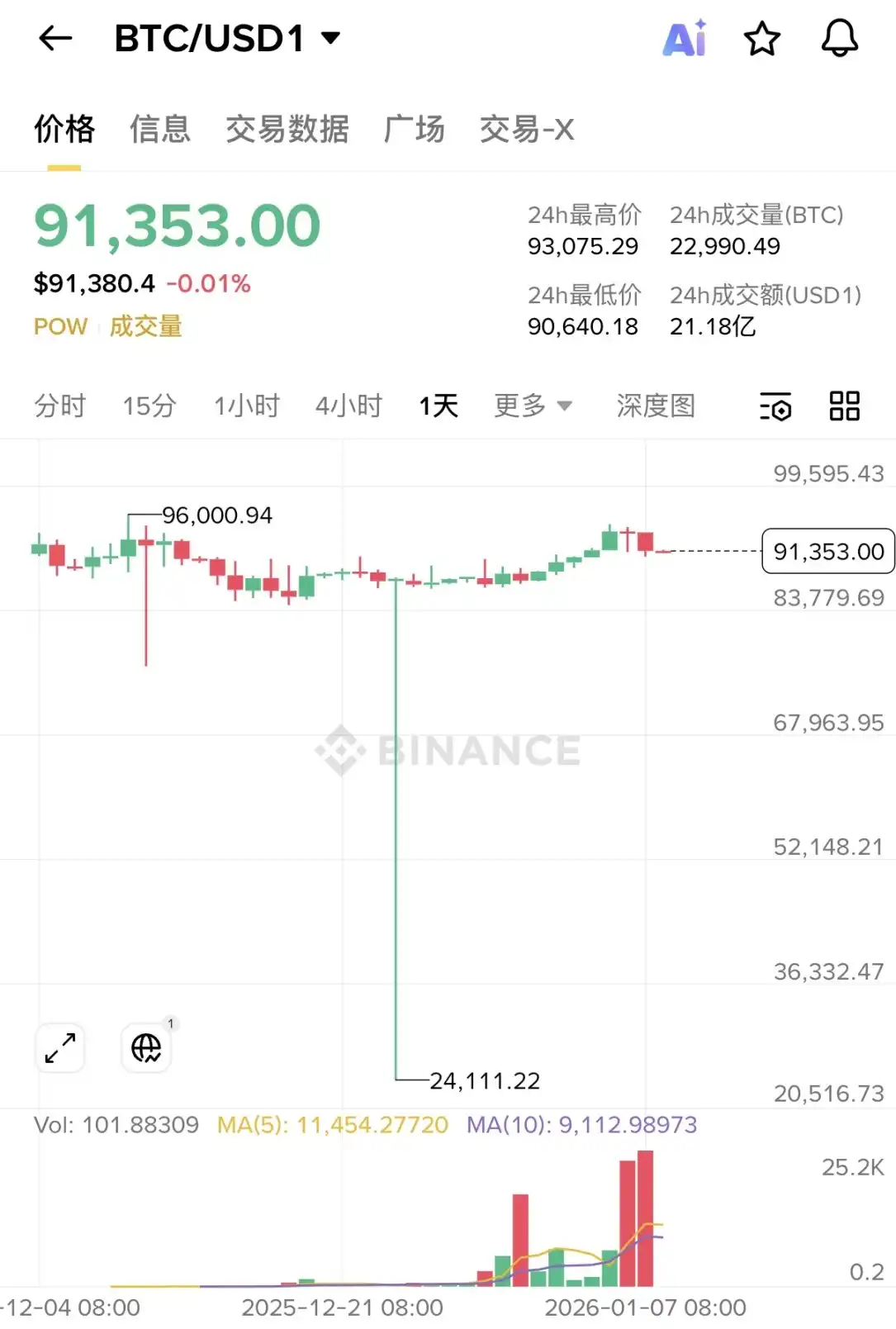
During this period, the market also experienced temporary volatility related to liquidity dynamics. On December 24, 2025, a large market order briefly drove down the BTC/USD1 price, causing it to quickly plummet to $24,111.22 near the $87,000 mark, resulting in a daily range of 73%.
On December 26, it was revealed by insiders that due to Binance's yield farming activities attracting many users to swap USDT for USD1, USD1 experienced a premium of approximately 0.39% at one point. Some funds were then used to obtain USD1 through the lending market and gradually sold on the spot market to meet the demand. Due to the initially low liquidity of the BTC/USD1 trading pair, rapid price fluctuations occurred. CZ explained that this trading pair was not included in any index, so no liquidation was triggered, and the fluctuations mainly reflected the insufficient establishment of liquidity for the new trading pair.
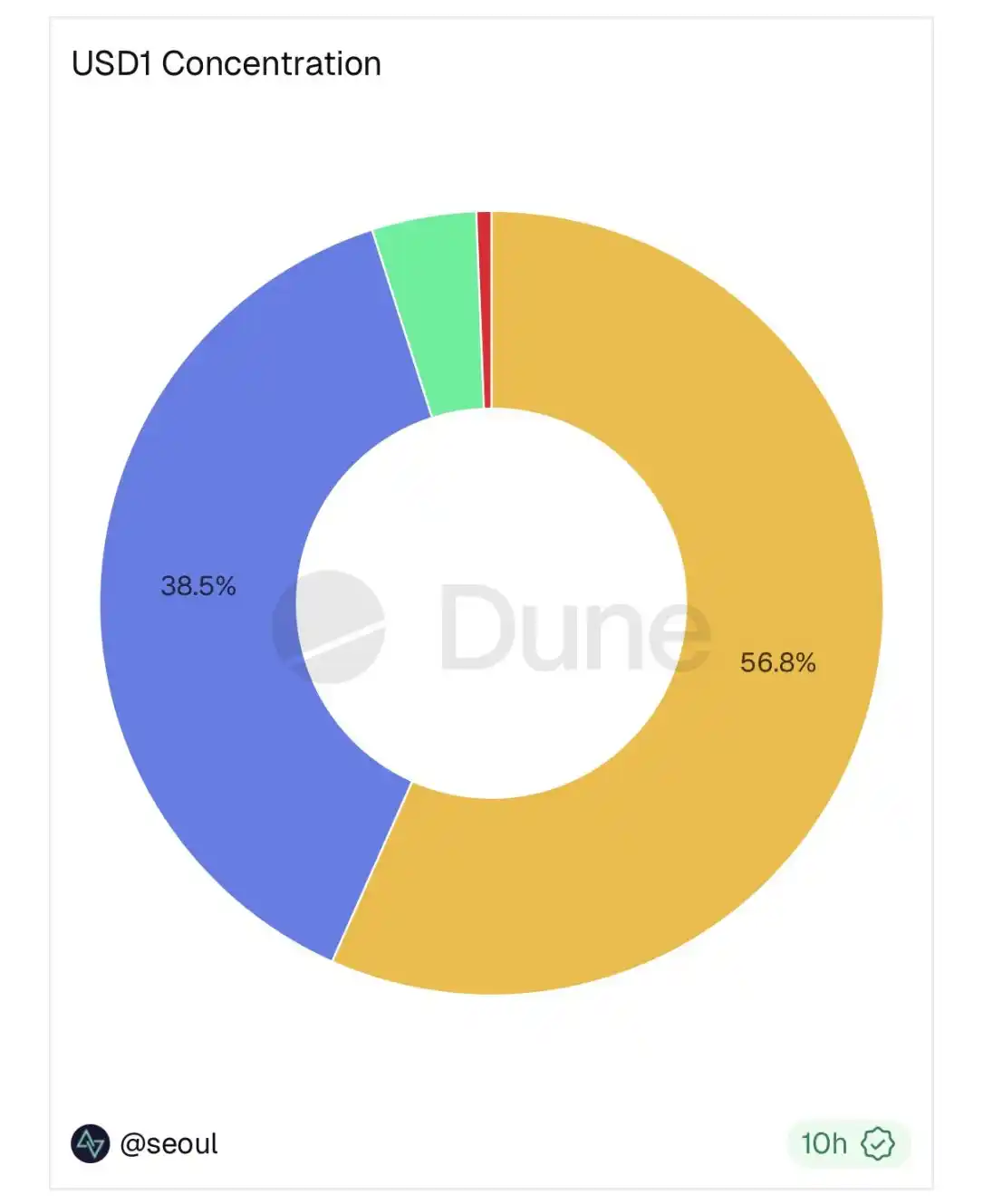
As of January 8, 2026, the market cap of USD1 was approximately $3.37 billion. From an on-chain distribution perspective, its issuance is mainly concentrated on the BSC and Ethereum mainnets, accounting for around $1.91 billion and $1.3 billion, respectively, together holding the vast majority of the share. In contrast, the size of USD1 on the Solana network is approximately $143 million, significantly lower in proportion. Despite WLFI's continued emphasis on supporting the Solana Meme ecosystem in terms of narrative and partnerships, USD1 currently still relies primarily on the liquidity structure of traditional EVM networks.
Compared to centralized exchanges, WLFI is also attempting to promote USD1 usage through on-chain scenarios. In September 2025, WLFI announced partnerships with the Meme launchpad BONK.fun and the decentralized exchange Raydium on Solana to introduce USD1 as a trading pair into the relevant ecosystem.
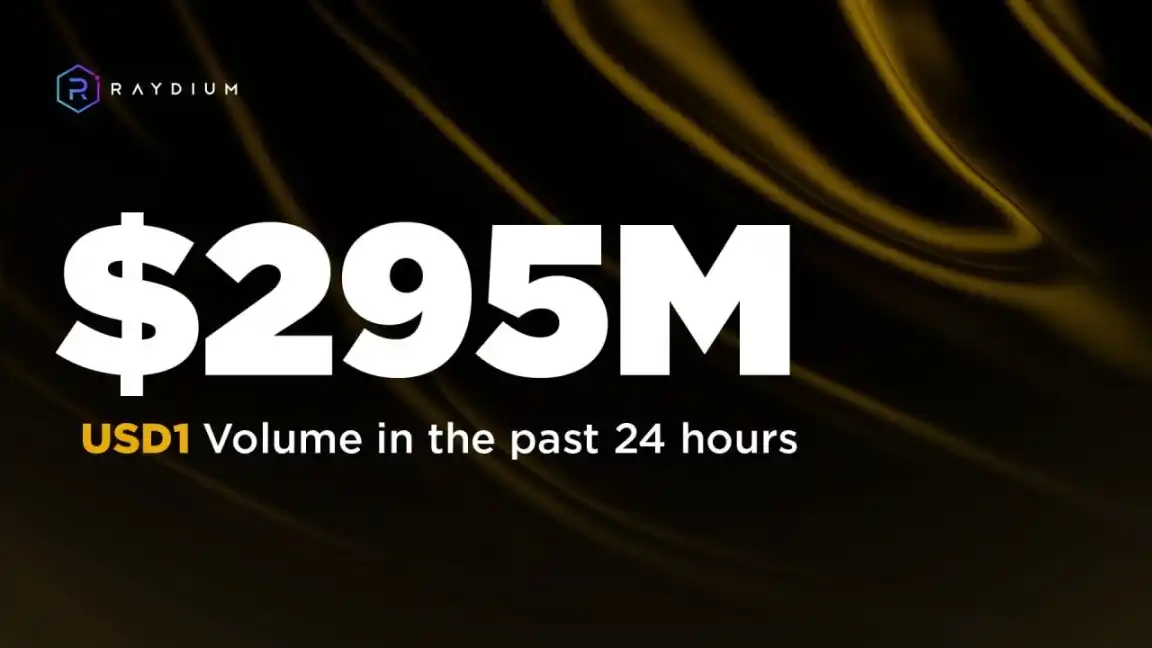
On January 6, Raydium released data showing that USD1's trading volume on the Solana network in the past 24 hours was approximately $295 million.
In addition, WLFI also disclosed that it had purchased Meme token B,1 and others to support community development. Such collaborations have provided a scenario closer to on-chain native usage for USD1, but the sustainability of related needs still heavily relies on community engagement and phased market sentiment, which is yet to be observed.
Furthermore, on January 8, WLFI disclosed that its affiliated entity WLTC Holdings LLC had applied to the Office of the Comptroller of the Currency (OCC) to establish the World Liberty Trust Company, National Association (WLTC). The institution is positioned as a national trust bank, specializing in the issuance, custody, and related financial activities of USD1 stablecoin.
According to WLFI's explanation, the core goal of establishing WLTC is to integrate the issuance, redemption, custody, and exchange functions between USD1 and the dollar within a single, highly regulated entity. WLFI stated that within a year of its launch, USD1's circulation has exceeded $3.3 billion and has been partially used by institutions for cross-border payments, settlements, and fund management.
If the related application is approved, WLTC plans to provide three core services to institutional clients under a federal regulatory framework, including the minting and redemption of USD1, fiat on/off ramps between the dollar and USD1, and custody and conversion services for USD1 and other stablecoins. The initial stage of these services is intended to be offered in a fee-free manner.
WLFI also emphasized that the proposed trust bank will adhere to compliance requirements including anti-money laundering, sanctions screening, and cybersecurity, and will implement institutional arrangements such as customer asset segregation, independent reserve management, and regular audits. The institution will operate under a regulatory structure compliant with the GENIUS Act.
In terms of existing partnerships, BitGo will continue to be one of the key partners of USD1 post the formal operation of WLTC, participating in supporting its future development.
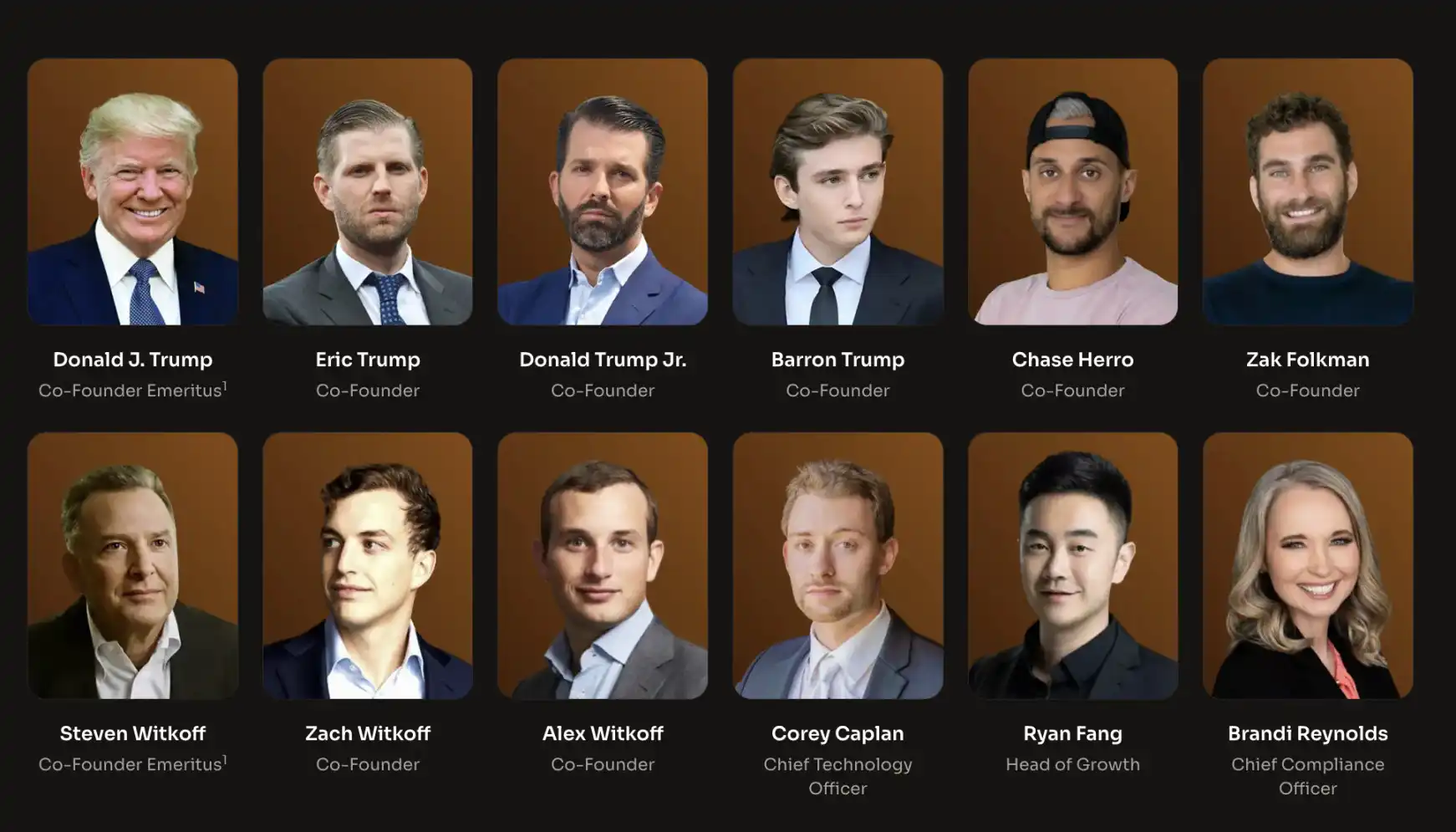
World Liberty Financial was established in 2024 as a project with a core focus on decentralized finance. Public information shows that the project has close ties to the Trump family in terms of structural design and market promotion, with relevant members playing roles in project promotion and ecosystem expansion. USD1, launched by WLFI in March 2025, is a US dollar-pegged stablecoin aimed at providing an on-chain settlement asset that can be exchanged 1:1 with the dollar, used for cross-border payments, DeFi activities, and liquidity needs in the digital asset market.
According to information disclosed on the WLFI website, each USD1 token is fully backed by a corresponding US dollar reserve, with the reserve assets mainly consisting of US dollars, short-term US Treasury bonds, and other cash equivalents. The related assets are held in custody by BitGo Trust Company and its affiliates, with BitGo also facilitating the issuance and redemption of USD1. Eligible BitGo clients can directly redeem USD1 for US dollars on a 1:1 basis, while other holders need to redeem through platforms that support USD1 or regulated custodians.
Similar to other centralized, compliance-oriented stablecoins, USD1 also explicitly outlines various risks in its official disclosure. The key constraints revolve around several aspects: USD1 is not legal tender and is not covered by deposit insurance; direct redemption is only available to eligible BitGo clients; although the reserve assets are primarily highly liquid, they may still face liquidity pressure in extreme circumstances; additionally, regulatory policy changes, address freezing mechanisms, and third-party platform risks may all impact the utility and circulation of USD1.
You may also like

Japan’s Three Megabanks Plan Joint Stablecoin Issuance in Fiscal 2026
MUFG, SMBC, and Mizuho reportedly plan to jointly issue fiat-pegged stablecoins in fiscal 2026, signaling Japan’s growing push into bank-led digital payment infrastructure.

Humanity Discloses H Token Dual-Chain Attack Details, With Losses on Ethereum and BSC Exceeding $36 Million
Humanity said the H token attack across Ethereum and BSC caused more than $36 million in losses after leaked ProxyAdmin keys enabled malicious contract upgrades and token minting.

White House Discusses CLARITY Act With Law Enforcement Ahead of Senate Vote
The White House discussed the CLARITY Act with law enforcement ahead of a Senate vote, focusing on illicit finance risks and developer protections.

$75 billion in foreign capital has fled, and South Korean retail investors have absorbed it all using leverage

Bitcoin Trading Guide 2026: Strategies for Experienced Traders

What Is XAUT and PAXG? Why Tokenized Gold Is Booming in 2026

Cryptocurrency CEXs are flocking to sell US stocks, and traditional brokerages are facing an "uninvited guest."

Will the SpaceX IPO Hurt Bitcoin? Here's What Traders Are Watching
Foreign selling in the South Korean stock market accelerates, with cumulative net sales reportedly reaching $75 billion this year
On June 9, The Kobeissi Letter, citing Goldman Sachs data, reported that global investors are selling South Korean stocks at an unusually rapid pace. In the latest trading session, foreign investors sold about $801 million worth of Kospi constituent stocks again; total foreign outflows last week reached about $10 billion, and the market has been in net foreign selling on nearly every trading day over the past month. According to the data cited in the report, foreign investors have sold about $75 billion worth of South Korean stocks so far this year. Meanwhile, South Korean retail and institutional investors together recorded roughly $69 billion in net buying over the same period, suggesting that the market’s main buying support has come from domestic capital rather than returning overseas funds. The information currently disclosed still mainly comes from The Kobeissi Letter’s retelling and Goldman Sachs data summaries, while public details on the statistical period and the specific definition of “selling” remain relatively limited.

Fortune Warns of Strategy’s Financing Structure Risks as Bitcoin Premium Narrows
Fortune warned that Strategy’s Bitcoin treasury model faces growing financing risks as MSTR’s net asset premium narrows and preferred stock dividend pressure increases.

Ferrari Challenge Le Mans: Carl Moon to Dominate in WEEX Livery

Sahara AI Responds to SAHARA’s Sharp Drop: No Contract or Product Security Issues Found, Internal Investigation Underway
Sahara AI responded to SAHARA’s 60% price drop, saying no token contract or product security issues have been found and an internal investigation is underway.

WEEX Deposit/Withdrawal Dynamic Island: Your Asset Status, Always in Sight
Scaling Crypto Derivatives: The Digital Asset Infrastructure Behind High-Volume Trading
In the fast-moving digital asset ecosystem, derivatives platforms face an extreme architectural test. High-leverage futures markets demand more than just standard security—they require absolute operational precision, zero-latency matching engines, and ironclad structural scalability, all while navigating intense market volatility.
As global platforms scale to meet these demands, the industry is shifting away from rigid, monolithic setups toward a more agile, "decoupled" infrastructure philosophy.
The Blueprint for High-Volume Copy TradingFor elite global exchanges like WEEX (founded in 2018), this architectural choice becomes critical when scaling high-volume retail features like social copy trading. When thousands of users automatically mirror the real-time strategies of elite traders simultaneously, it triggers sudden, monumental spikes in concurrent transactional volume.
To prevent execution latency or settlement bottlenecks during these peak volatility events, a platform's primary engine must remain entirely dedicated to risk management, copy-trade synchronization, and order matching.
The Architectural Rule: New-generation platforms must separate front-end user execution engines from heavy backend infrastructural overhead to eliminate operational friction.
By separating these layers, platforms can maintain complete sovereignty over their trading environments and user experiences while strategically aligning with institutional-grade infrastructure ecosystems. This strategic framework allows modern exchanges to leverage advanced Digital Asset Custody infrastructure such as Cobo’s behind the scenes, ensuring that backend wallet management scales elastically alongside trading spikes.
Capitalizing on Market Momentum and 400× LeverageIn a derivatives arena where platforms offer up to 400× leverage on perpetual contracts, capital efficiency and market agility are core business metrics. To capture market momentum, an exchange needs the ability to rapidly expand its asset offerings, supporting everything from legacy crypto assets to sudden, trending altcoins across a massive library of trading pairs.
Adopting a flexible, scalable Wallet-as-a-Service (WaaS) solution such as Cobo’s could completely rewrite the development timeline for high-growth exchanges. Instead of spending months of engineering capital building out custom backend wallet architectures for every new blockchain network, platforms can deploy localized infrastructure in days.
This agility allows platforms to instantly scale their listings to over a thousand trading pairs without compromising security or delaying time-to-market. It mirrors the exact operational advantages seen during high-velocity market events, similar to how advanced wallet infrastructure empowers platforms during sudden asset surges; allowing exchanges to pass that speed and liquidity directly to their global user base.
A Mature Foundation for GrowthThe synergy between trusted infrastructure ecosystems and global trading platforms represents the natural evolution of a maturing crypto market. As WEEX continues to scale its global spot and derivatives offerings for over 6 million users, adopting robust backend paradigms proves that platforms no longer have to compromise between cutting-edge trading velocity and uncompromised structural security.

Morning Report | BitMine increased its holdings by 126,971 ETH last week; trader Eugene announced his exit from the crypto market

Wang Chuan: How can one not feel anxious after the neighbor Old Wang made thirty times profit by investing in storage stocks? (Seven) - A quarter-century cycle

Get Paid to Onboard? Try WEEX’s New Homepage with Rewards for Registration, Deposit & Trade
WEEX Custom Layout: Build Your Perfect Trading Workspace in Seconds
Japan’s Three Megabanks Plan Joint Stablecoin Issuance in Fiscal 2026
MUFG, SMBC, and Mizuho reportedly plan to jointly issue fiat-pegged stablecoins in fiscal 2026, signaling Japan’s growing push into bank-led digital payment infrastructure.
Humanity Discloses H Token Dual-Chain Attack Details, With Losses on Ethereum and BSC Exceeding $36 Million
Humanity said the H token attack across Ethereum and BSC caused more than $36 million in losses after leaked ProxyAdmin keys enabled malicious contract upgrades and token minting.
White House Discusses CLARITY Act With Law Enforcement Ahead of Senate Vote
The White House discussed the CLARITY Act with law enforcement ahead of a Senate vote, focusing on illicit finance risks and developer protections.
$75 billion in foreign capital has fled, and South Korean retail investors have absorbed it all using leverage
Bitcoin Trading Guide 2026: Strategies for Experienced Traders
What Is XAUT and PAXG? Why Tokenized Gold Is Booming in 2026


