
When an AI Company Goes on a Wild Hiring Spree for Asian Female Coders, Attention Shifts to Winning the World


Original Title: ABG CMO is eating the world.
Original Author: @0xJuliechen, Content Creator
Original Translation: Lila, Richie, BlockBeats
「If your startup is not a YC-backed B2B SaaS + GPT shell company, and you haven't hired an ABG as your Chief Marketing Officer, then you're pretty much screwed.」
Dance Note:
· YC: Short for Y Combinator, widely considered the world's top startup accelerator
· B2B SaaS: Subscription-based cloud software sold to businesses
· ABG = Asian Baby Girl
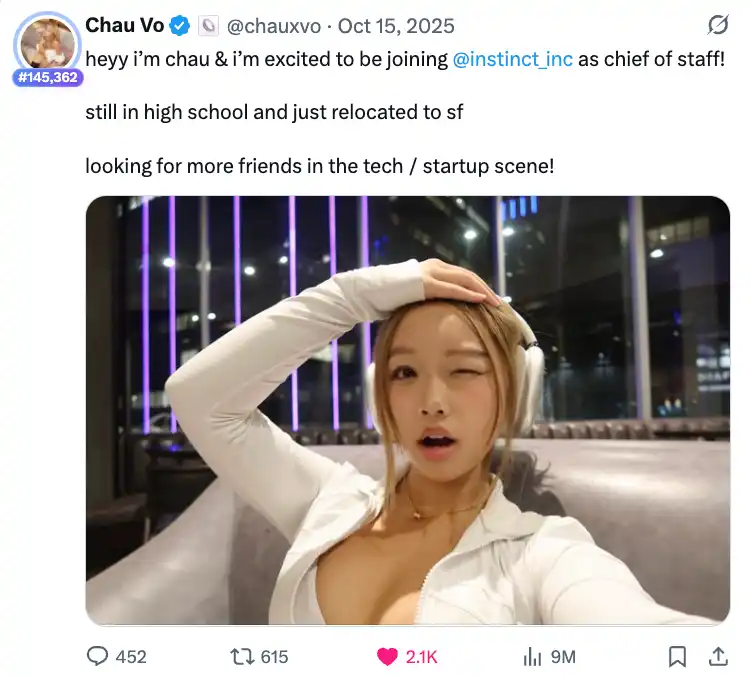
I've heard similar statements from countless AI company founders, each dreaming of finding the next Cluely: easily garnering millions of views, always in the spotlight. (Dance Note: Cluely is a highly controversial AI startup that pioneered a new paradigm of "viral marketing," as detailed later in the text.)
ABG = Asian Baby Girl. In Silicon Valley, it has become synonymous with young Asian women who excel in social media marketing. They are particularly skilled at creating eye-catching content, publishing viral articles, and marketing in a distinctively personal way. Suddenly, all AI startups are scrambling to hire them as Chief Marketing Officers.
Why? Because one viral post is much more effective than spending $50,000 on an advertising campaign.
A "thought leader" persona carefully cultivated on LinkedIn for months is no match for a "hot take" posted on X or a selfie for gaining more attention and engagement.
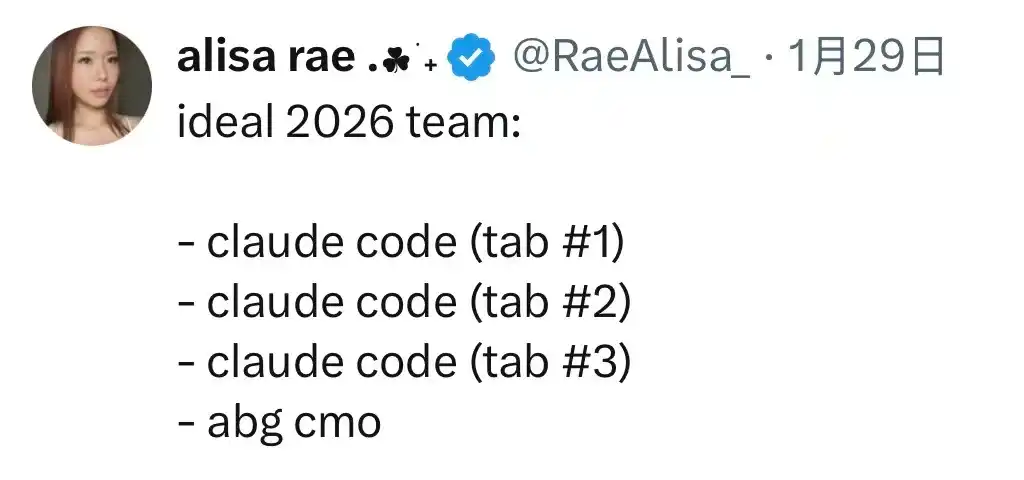
Are Asians naturally born marketers?
No, let me clarify: This is not about race (everyone of every race has an equal ability). This reveals some deeper issues in the evolution of the startup market.
The Feedback Loop of the Tech Market
From past viral breakout cases (such as @cluely), it can be seen that VCs chasing "traffic signals" have outweighed traditional financial metrics, leading to more funds flowing into more personality-driven, socially oriented projects.
Nowadays, more college students choose to be content creators rather than taking a $200k/year job at a big tech company, so more startups hire "ABGs" for marketing, raising the overall tech marketing standards, allowing creators to access higher-quality marketing resources.
Social media interaction data has become the sole standard for marketing effectiveness.
And this feedback loop is accelerating: More attention means more funds, creating higher barriers to entry, attracting more talent shifts, until it forms a stronger attention monopoly.
Likes, views, and shares are no longer just vanity metrics; they have become the new standard for due diligence.
The core is not in ABG, but in the attention economy.
How to Capture Hearts? Cluely Delivered the Perfect Answer Sheet
· Narrative: "Cheat on Everything" — perfectly aligned with founder @im_roy_lee's story (expelled from Columbia/Harvard). This is not just a slogan but a carefully crafted rags-to-riches story.
From "an utter failure" to "cheating with AI, ramping through big tech, YC, and A16Z." This kind of underdog narrative often simultaneously ignites people's aspirations and anger.
· Industrial Virality Machine: They recruited over 700 "editors" — mostly small creators on TikTok/Instagram. The model is: pay for performance. $1 per 1k views. Zero upfront cost.
· Content Formulization: Gibberish tweets + Edging on attractiveness + Lifestyle flaunting. Party videos (like the halted "1.5M Rager"), founder Roy Lee's persona as a "genius intern," flaunting wealth, disdain for traditional education. This marketing makes you think, "I really want to join this cool kids club"
· Total Platform Domination: X is responsible for creating a thought leader persona (150K+ followers), with TikTok/Instagram as the main battleground, and LinkedIn/Reddit used to spark native controversies.
What were the results? Daily average views of 10M+, 10B views in 3 months, at a cost much lower than traditional advertising. Traditional CPM (cost per mille) is $4, but they only need around $1.
But the fatal flaw is: The marketing investment far exceeds the product; they never actually developed a decent market-ready product. Viral spread is not a byproduct, but their only product.
When Cluely pivoted to an "AI Note Tool," the entire web ridiculed them. People wondered where all that money went.
Some even suggested: since they are so good, why not just be a marketing agency for other AI companies?
But most astonishingly: they did capture a certain truth. In an age of scarce attention, "controversy is still attention."
Truly ironic: everyone mocks Cluely, everyone wants to be Cluely.
(If you hate me but keep following my updates, you are my fan.)
What is the truth?
Attention is conquering the world.
Capital is flowing to companies that own consumer mindshare rather than just market share. Today, the best product doesn't necessarily win; the product with the best story does.
Every founder must also be a CMO, owning their IP. While the product is crucial, without marketing, your product will go unnoticed.
The next wave of successful startups will not be built by the most exceptional engineers. They will be created by those who are "code-literate and marketing-savvy."
Welcome to the new game.
You may also like

The large models in the United States are moving towards closure in the name of security

Morning Report | CoinEx becomes a key hub for Iran to evade sanctions, involving over $3.8 billion in funds; Kalshi seeks a new round of financing, with a valuation potentially rising to $40 billion

From the white-haired stock god to the billionaire fund mogul, the smart people shorting Nvidia are all getting rich using the same framework

Why do cryptocurrency projects always like to change their names?

Global Launch: As predictions become the most scarce asset in the AI era, Manadia is defining the next generation of the value internet

Who is footing the bill for the $64 billion accounting frenzy?
I never expected that the first application of AI x Crypto would be in security auditing

What is your view on Binance's competitive advantages?

ETH has entered a non-consensus phase, and the turning point is approaching!
The shift in the cloud of the air: from despising stablecoins a year ago to the high-profile entry of capital today
The survival dilemma of small and medium exchanges behind the withdrawal anomalies exposed by AscendEX
Why Is Bitcoin Falling Below $60K? 5 Key Market Drivers Explained
Bitcoin has dropped sharply amid ETF outflows, Strategy stock weakness, AI stock rallies, and changing Fed expectations. Explore the key forces driving BTC’s latest correction and what traders should watch next.

Bitcoin vs. Gold in 2026: Which Asset Performs Better in Different Markets?

Morning News | The draft amendment to the People's Bank of China Law aims to clarify the legal status of digital renminbi; South Korea will transfer about 40 unregistered virtual asset service providers to law enforcement agencies
The cryptocurrency industry has entered the "Show Me" era: merely relying on vision is no longer enough

Interpreting the Ethereum Foundation's new structure: Reaffirming self-sovereignty amid institutional trends
Former SpaceX engineer reconstructs the financial execution system using first principles
Standard Chartered Bank sings a 50x rhapsody again, aiming for AAVE to reach 3500 USD
The large models in the United States are moving towards closure in the name of security
Morning Report | CoinEx becomes a key hub for Iran to evade sanctions, involving over $3.8 billion in funds; Kalshi seeks a new round of financing, with a valuation potentially rising to $40 billion
From the white-haired stock god to the billionaire fund mogul, the smart people shorting Nvidia are all getting rich using the same framework
Why do cryptocurrency projects always like to change their names?
Global Launch: As predictions become the most scarce asset in the AI era, Manadia is defining the next generation of the value internet
Who is footing the bill for the $64 billion accounting frenzy?


