
Why was it said that Solana is no longer suitable for conferences?

Original Article Title: Solana Can't Host Conferences Anymore
Original Article Author: @abhitejxyz
Translation: Peggy, BlockBeats
Editor's Note: In December 2025, after Solana Breakpoint 2025 concluded in Abu Dhabi, Abhitej, an entrepreneur deeply involved in the Solana ecosystem as the co-founder of Filament Finance and now a core builder at Bento.fun, wrote this article. Drawing on his firsthand experience at Breakpoint multiple times, he reflects on whether builders are still truly at the center of the conference after it has transformed from an early developer-led gathering to a global event akin to the F1 Grand Prix and Bitcoin MENA, with institutions, capital, and grand narratives continuously flowing in.
Although the title may seem sharp, it is not a negation of the conference but rather a reminder from within the ecosystem: as Breakpoint evolved from a developer-centric meeting in the early days to a global event alongside the F1 Grand Prix and Bitcoin MENA, with institutions, capital, and grand narratives constantly pouring in, are the builders who truly "head down writing code" being diluted within it.
Unlike the macro judgments from an external perspective, Abhitej focuses on the qualitative factors that determine the direction of the ecosystem—whether the culture remains open, whether the stage still belongs to the builders, and whether participation is still low-barrier. The article does not attempt to provide a definitive answer, but it reminds us: Solana's vitality has never been above the stage and narrative, but rather on developers around the world who quietly, continuously, and authentically build products.
The following is the original text:
I attended the first Breakpoint held in Lisbon, and four years later, I came to Abu Dhabi for the latest edition. In between, industry giants fell, SOL's price completed more than one "roller-coaster" round-trip, and Memecoin mania repeatedly tested the resilience of the entire ecosystem.
But as the Solana ecosystem began to prepare for Breakpoint 2025, it had already established its position:
Leading in various core metrics such as transaction volume, app revenue, DEX trading volume, etc.
Having the most culturally aware and user-centric ecosystem atmosphere
Becoming the strongest, or at least one of the strongest, builder ecosystems
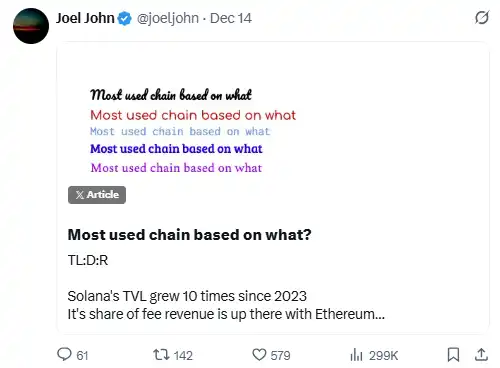
@joeljohn's article "Most used chain based on what?" also nicely pointed out Solana's recent dominance in multiple dimensions.
All of this unfolded against an extremely brutal backdrop for retail participants. Arbitrageurs squeezed out value to near limits, altcoins as a whole underperformed the market, and net developer inflow hit a low point. What this industry truly lacked was a spark of optimism, something to remind people: there is still beauty in the world of crypto.
I believe Breakpoint precisely lit that match.
As I walked into the Abu Dhabi Solana Breakpoint venue, the first thing I felt was not excitement but a sense of motion happening.
Not the loud, chaotic kind of excitement. More like an undercurrent. A force in flow.
This did not feel like walking into a conference. There was no tension, no deliberate social pressure, no anxiety of "I must be in the right room at the right time." It was more akin to a festival, a place where people had come not to "extract value from each other," but genuinely to celebrate "creation."
People were smiling, conversing, freely moving about. Developers, creators, founders, institutions, everyone found their place, and the whole did not feel imbalanced.
This sense of harmony was evident from the very beginning. No one group was disproportionately amplified: institutions did not dominate the narrative; creators were not treated as mascots; founders were not elevated to unattainable heights. Everyone seemed approachable.
And this, in itself, is quite rare.
The longer I stayed at Breakpoint, the more I sensed that all of this was not incidental but a deliberately crafted outcome.
The agenda was not a top-down information dump: five-minute lightning talks, debates, product demos, conversations. Brief, sharp, high information density. More people being seen, rather than a few repeatedly occupying the stage. You could distinctly feel that this was not a one-time stroke of inspiration, but the result of long-term iteration.
Breakpoint was not an overnight success but a gradual exploration over many years of "what truly works."
A brief interaction with Superteam India's @paarugsethi was enough to make me realize: how deeply Solana's ecosystem thinks about culture and founder community.
Disrupting Elitism
However, if we were to point out one way in which Solana has outperformed most ecosystems, it is this: it has successfully dismantled elitism.
There is no invisible hierarchy here where "only a few voices matter." As long as you have truly created something valuable, even if on a small scale, you can get a platform to showcase it.
This openness has changed everything: it reduces fear, invites more people to participate, and ultimately generates momentum. And momentum, will continue to compound.
After talking to more and more people, another characteristic has become clear: within the Solana ecosystem, there is a shared sense of direction. It is not a dogmatic consensus, but a state of "everyone moving forward together." There are leaders here, there are sources of signals, and there are individuals seen by others as directional coordinates. It is because of this that the ecosystem does not easily fracture.
In many ecosystems, people fight their own battles, their narratives conflict, the gaps widen, and everyone endlessly debates on "how things should be," yet they are reluctant to accept "what is working."
Solana's approach is different. If something is effective, it is accepted. If it aligns with the behavior of the new internet generation, it is studied, not ridiculed. There is no moral superiority here, no whitewashing. Even a memecoin, despite its chaotic and predatory phase, is seen as an acceleration experiment, a stress test for the internet capital market.
The system has crashed, some have taken advantage of the situation, and the lessons have been truly absorbed. Solana does not pretend that none of this ever happened but distills cognition in a way that encompasses the "entire ecosystem." This acceptance, in turn, has made room for innovation rather than accumulating resentment.
The most prominent feeling this year is Breakpoint's extreme Builder-first approach. The market has cooled down, the prices are no longer soaring, and the crowd that used to see "100x overnight" gains has significantly decreased. But it is precisely at this time that the true builders begin to shine.
DeFi appears more mature; infrastructure discussions return to reality: the predictability of block space, latency optimization, how to make application execution cheaper and more reliable.
You can see this change in specific products: Kalshi chooses Solana as its tokenization infrastructure; Phantom supports consumer-facing interface experiences; Phoenix with perpetual contracts, Prop AMM, new market designs; experiments in AI, robotics, privacy directions; hackathons, Superteam projects, those still rough but authentic early ideas that exist. People come to listen and share to learn, not to ask "how is this token pumping."
This kind of energy transformation is extremely important. It makes the entire conference feel solid, honest, and product-centric.
If we must point out one discomfort, it is this: there still exists some narrow-mindedness in the ecosystem — "if it's not Solana-only, it's not worth paying attention to."
This mindset is not unique to Solana, but it shrinks the pie. The real opportunity is not to win a single chain war but to reshape the entire tech stack. And that can only be achieved through collaboration, not posturing.
Ironically, Solana doesn't need to boast loudly. Anyone who walks into Breakpoint can feel it directly. This ecosystem doesn't need online mockery. The product, culture, builders, and momentum are already loud enough.
A "Festival"
This also brings me back to the initial conclusion: Solana is no longer suited for "holding conferences." Conferences are one-way, static, and bounded. What Solana is doing aligns more with the native form of the new internet, a festival, a celebration for builders. A space where culture, capital, experimental spirit, and belief collide.
And these "festivals" will only continue to grow: more vibrant, more immersive, more diverse. Every corner is adding a new flavor to this evolving internet.
Breakpoint 2025 is one of the best conferences I have attended so far and clearly shows where Solana is heading.
P.S.: In my view, choosing Abu Dhabi as the venue is one of the key reasons that make Breakpoint 2025 so special.
You may also like

New York Proposes Stricter Stablecoin Issuer Rules Aligned With Federal GENIUS Act
NYDFS proposed stricter stablecoin issuer rules aligned with the GENIUS Act, covering reserves, custody, redemption timelines, audits, and capital buffers.

Every exchange is a "Universal Exchange."

The counterattack of traditional finance: Alliance chains are quietly reviving

CryptoQuant Says Bitcoin Profitable Supply Is Near 45% Pressure Zone as On-Chain Data Points to Market Repricing
CryptoQuant said Bitcoin’s profitable supply is nearing the 45% pressure zone, signaling rising market stress, unrealized losses, and a possible on-chain repricing phase.

Bitcoin Falls Below 200-Week Moving Average as On-Chain Data Shows Over Half of Supply in Loss
Bitcoin dropped below its 200-week moving average as on-chain data showed over 50% of circulating supply is now in loss, signaling rising market stress.

CFTC Reportedly Plans New Prediction Market Rules Focused on Manipulation Risk and Public Interest Review
The CFTC is reportedly preparing new prediction market rules focused on manipulation risk, public interest review, and retail trader protections.

Meet the new WEEX trial fund—your gateway to greater profits

WEEX Labs Lands at Dutch Blockchain Week: A Disruptive Crypto × AI Conversation Sets Sail in Amsterdam

SK Hynix Reportedly Plans U.S. ADR Listing as Early as August, With SEC Approval Possible in Late June
SK Hynix may pursue a U.S. ADR listing as early as August, with SEC approval reportedly possible in late June amid strong AI chip supply chain demand.

SpaceX vs Tesla vs xAI: Which Elon Musk Trade Has the Biggest Upside in 2026?
OpenAI Reveals It Has Confidentially Submitted an S-1 to the SEC, Keeping the Door Open for a Future IPO
On June 9, according to an OpenAI announcement, the company recently confidentially submitted a draft S-1 registration statement to the U.S. Securities and Exchange Commission (SEC), beginning the preliminary compliance process for a potential initial public offering. OpenAI said it chose to disclose this proactively because it expected the news might leak; however, the company has not yet set a specific listing timeline, and related arrangements may still take some time.

Latest research from 13 top universities including Cornell University: The current state, challenges, and misconceptions of the fusion of Crypto and AI
Deconstructing Anthropic: The Best AI Company, Possibly Also a Type of Organizational Invention
Apollo and Blackstone Reportedly Back $35 Billion Anthropic Chip Financing as Deal Details Remain Unclear
On June 9, according to currently available news alerts, Apollo and Blackstone Group participated in a $35 billion financing for an Anthropic “chip project.” Based on the original wording of the report, the funding has already been raised, but public information remains limited. The financing structure, use of proceeds, project entity, and whether Apollo and Blackstone participated through equity, debt, or project financing have not yet been disclosed.

Humanity Protocol Security Incident Escalates: More Than $31 Million Stolen From Related Addresses as Attacker Continues Selling H for ETH
On June 9, according to monitoring by Onchain Lens, more than $31 million has been stolen from addresses linked to Humanity Protocol, and the attack is still ongoing, with the hacker continuously swapping H tokens for ETH. Project founder Terence Kwok later confirmed the security incident on X, saying the issue involved a private key leak.

Bloomberg: As Bitcoin Weakens, Stablecoins and RWA Continue to Drive Expansion in Crypto Businesses
In June, Bloomberg reported that despite Bitcoin falling below $60,000 last week, wiping out about $235 billion in market value within seven days, and dropping close to 50% from last year’s peak, some core businesses in the crypto industry are still expanding, mainly in stablecoins, real-world asset tokenization (RWA), payments, and infrastructure. The report also noted that overall altcoin activity has contracted significantly: altcoin market capitalization has fallen from a peak of about $431 billion in November 2021 to around $170 billion, and among the tens of millions of tokens issued in recent years, fewer than 1,700 still maintain meaningful trading activity.

Galaxy Deep Research Report: How Hyperliquid's HIP-4 Upgrade Changes the Landscape of Prediction Markets?
Binance Research: RWA Market Expected to Expand Nearly 6x from Early 2025, with Public Equities and Onchain Payments Heating Up Together
In June, Binance Research said in its monthly market report that the real-world asset (RWA) market is expected to grow by about 589% from the beginning of 2025. Bond- and money market fund-related RWA expanded by about $6.5 billion, up 83% year over year, while publicly traded equity RWAs grew by about 422%. The report also noted that monthly crypto debit card transaction volume exceeded $747 million in May, up 48.6% year to date.
New York Proposes Stricter Stablecoin Issuer Rules Aligned With Federal GENIUS Act
NYDFS proposed stricter stablecoin issuer rules aligned with the GENIUS Act, covering reserves, custody, redemption timelines, audits, and capital buffers.
Every exchange is a "Universal Exchange."
The counterattack of traditional finance: Alliance chains are quietly reviving
CryptoQuant Says Bitcoin Profitable Supply Is Near 45% Pressure Zone as On-Chain Data Points to Market Repricing
CryptoQuant said Bitcoin’s profitable supply is nearing the 45% pressure zone, signaling rising market stress, unrealized losses, and a possible on-chain repricing phase.
Bitcoin Falls Below 200-Week Moving Average as On-Chain Data Shows Over Half of Supply in Loss
Bitcoin dropped below its 200-week moving average as on-chain data showed over 50% of circulating supply is now in loss, signaling rising market stress.
CFTC Reportedly Plans New Prediction Market Rules Focused on Manipulation Risk and Public Interest Review
The CFTC is reportedly preparing new prediction market rules focused on manipulation risk, public interest review, and retail trader protections.


