
Wintermute: The four-year cycle is dead, Crypto Breakthrough 2026, where to next?

Original Title: The four-year cycle is dead. What will drive crypto in 2026?
Original Source: Wintermute
Original Translation: DeepTech TechFlow
Abstract:
What was once considered the "iron rule" of the crypto market, the four-year halving cycle, is facing an unprecedented challenge. Top market maker Wintermute pointed out in its latest 2025 annual report that the traditional cycle narrative has collapsed, and the market logic has shifted from "seasonal rotation" to "liquidity locking."
2025 did not see the expected widespread frenzy; instead, it showed extreme emotional polarization: on one hand, BTC and ETH entered the institutional hall under the blessing of ETFs, while on the other hand, altcoins experienced a sudden loss of momentum and shortened lifecycle.
Looking into 2026, can the crypto market break free from the current stockpile deadlock? Wintermute has outlined three core variables that could disrupt the status quo.
Body:
2025 did not bring the anticipated bull market, but this may be seen by future generations as the beginning of the cryptocurrency's transition from a speculative tool to a mature asset class.
The traditional four-year cycle is becoming obsolete. Market performance is no longer dominated by self-fulfilling timed narratives but rather depends on the flow of liquidity and the concentration of investor attention.
What changed in 2025?
Historically, native crypto wealth has acted as a fungible fund. Bitcoin's gains would spill over to Ethereum (ETH), then to blue-chip stocks, and finally reach altcoins.
Wintermute's over-the-counter (OTC) trading flow data indicates that this transmission mechanism significantly weakened in 2025.
Spot exchange traded funds (ETFs) and digital asset trust companies (DATs) have evolved into a "walled garden." They provide sustained demand for large-cap assets but do not naturally rotate funds into the broader market.
As retail interest shifted to the stock market, 2025 became a year of extreme polarization.
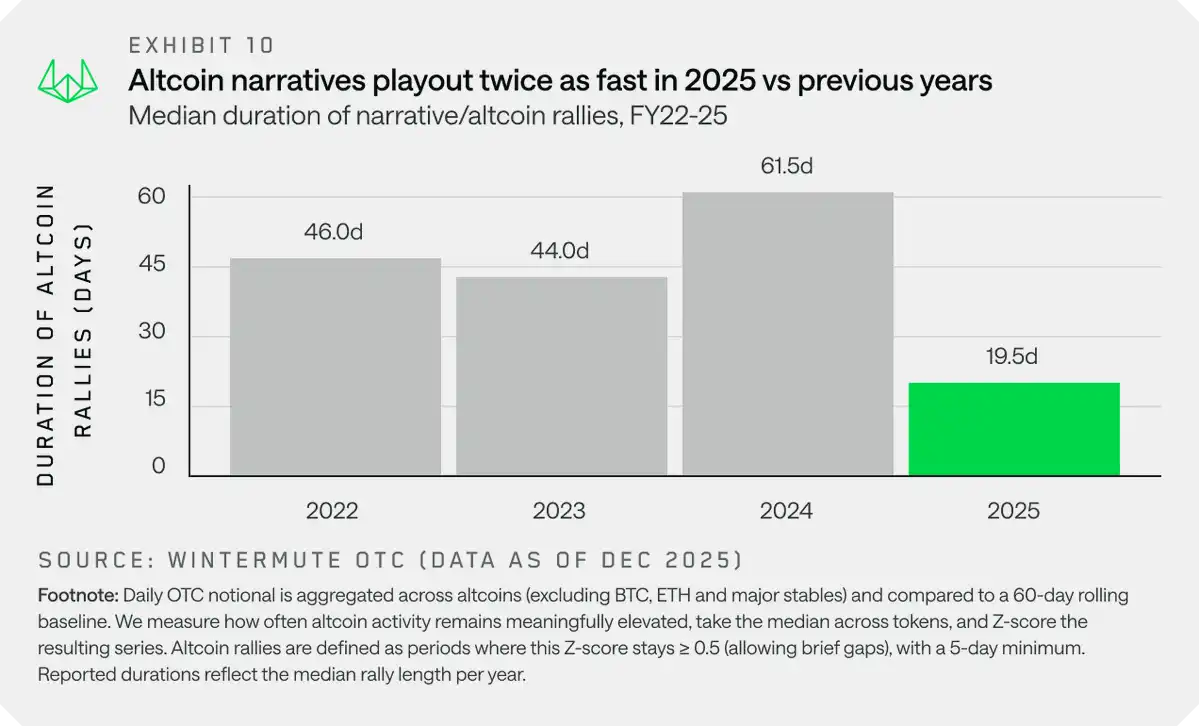
In 2025, the average rebound duration of altcoins was 20 days, much lower than 60 days in 2024.
A few mainstream assets absorbed the majority of the new inflows, while the broader market struggled.
Three Paths for 2026
If market participation beyond mainstream assets is to grow further, at least one of the following three things needs to happen:
1. Expanding Institutional Mandates
Currently, most of the new liquidity remains within institutional channels. A full market recovery requires institutional investors to expand the range of assets they can invest in.
Early signs are evident through Solana (SOL) and XRP's ETF applications.
2. The Wealth Effect from Mainstream Assets
A strong rebound in Bitcoin or Ethereum could trigger the wealth effect, spilling over to the broader market, similar to what happened in 2024.
The level of funds eventually flowing back into digital assets remains uncertain.
3. Rotation from Equities
Retail investors' focus may rotate back from the stock market (into areas like artificial intelligence AI, rare earths, quantum computing, etc.) to cryptocurrency, bringing in new inflows and stablecoin minting.
While this is the least probable scenario, it would significantly increase market participation.
The future outcome will depend on whether the above catalysts can effectively diffuse liquidity beyond a few large-cap assets, or if the trend of centralization will persist.
Understanding fund flows and the necessary structural changes will determine which strategies will succeed in 2026.
You may also like

The large models in the United States are moving towards closure in the name of security

Morning Report | CoinEx becomes a key hub for Iran to evade sanctions, involving over $3.8 billion in funds; Kalshi seeks a new round of financing, with a valuation potentially rising to $40 billion

From the white-haired stock god to the billionaire fund mogul, the smart people shorting Nvidia are all getting rich using the same framework

Why do cryptocurrency projects always like to change their names?

Global Launch: As predictions become the most scarce asset in the AI era, Manadia is defining the next generation of the value internet

Who is footing the bill for the $64 billion accounting frenzy?
I never expected that the first application of AI x Crypto would be in security auditing

What is your view on Binance's competitive advantages?

ETH has entered a non-consensus phase, and the turning point is approaching!
The shift in the cloud of the air: from despising stablecoins a year ago to the high-profile entry of capital today
The survival dilemma of small and medium exchanges behind the withdrawal anomalies exposed by AscendEX
Why Is Bitcoin Falling Below $60K? 5 Key Market Drivers Explained
Bitcoin has dropped sharply amid ETF outflows, Strategy stock weakness, AI stock rallies, and changing Fed expectations. Explore the key forces driving BTC’s latest correction and what traders should watch next.

Bitcoin vs. Gold in 2026: Which Asset Performs Better in Different Markets?

Morning News | The draft amendment to the People's Bank of China Law aims to clarify the legal status of digital renminbi; South Korea will transfer about 40 unregistered virtual asset service providers to law enforcement agencies
The cryptocurrency industry has entered the "Show Me" era: merely relying on vision is no longer enough

Interpreting the Ethereum Foundation's new structure: Reaffirming self-sovereignty amid institutional trends
Former SpaceX engineer reconstructs the financial execution system using first principles
Standard Chartered Bank sings a 50x rhapsody again, aiming for AAVE to reach 3500 USD
The large models in the United States are moving towards closure in the name of security
Morning Report | CoinEx becomes a key hub for Iran to evade sanctions, involving over $3.8 billion in funds; Kalshi seeks a new round of financing, with a valuation potentially rising to $40 billion
From the white-haired stock god to the billionaire fund mogul, the smart people shorting Nvidia are all getting rich using the same framework
Why do cryptocurrency projects always like to change their names?
Global Launch: As predictions become the most scarce asset in the AI era, Manadia is defining the next generation of the value internet
Who is footing the bill for the $64 billion accounting frenzy?


